With WNBA Officiating Becoming A Growing Concern, Cathy Engelbert Says The League Is 'On It'
The Commissioner says the WNBA is listening to complaints about officiating and has systems in place to improve consistency. But players and coaches say something has to change soon.
INDIANAPOLIS — As the WNBA heads into the second half of its season, questions around officiating have reached a boiling point. Coaches, players and broadcasters have all voiced frustration this year over inconsistent calls, excessive physicality, and what they describe as a lack of transparency or accountability from league officials.
During a press conference ahead of Saturday's All-Star Game, WNBA Commissioner Cathy Engelbert acknowledged that the league is well aware of the criticism. But she didn't offer much of a solution.
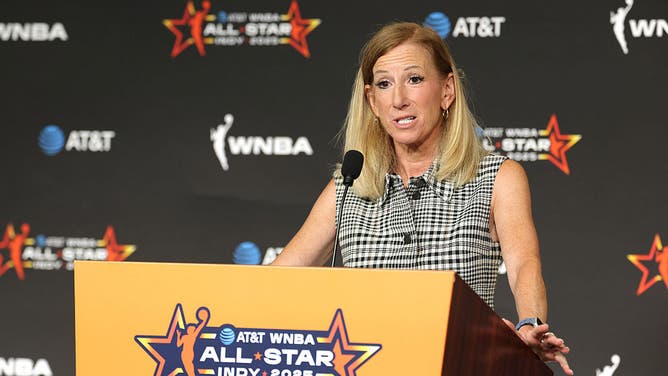
WNBA Commissioner Cathy Engelbert speaks to the media prior to the 2025 WNBA All-Star Game at Gainbridge Fieldhouse.
(Photo by Michael Hickey/Getty Images)
"As we go forward on the officiating, we hear the concerns. We take that employee input," Engelbert said. "Every play is reviewed. We spend hours and hours and hours. Obviously, we use that then to follow up with officials’ training.
"Consistency is important. I think some people observe our game versus other basketball formats [and think] there aren't a ton of fouls called, but I realize consistency is the name of the game."
WATCH: WNBA Superstar Caitlin Clark Takes Several Uncalled Fouls In Viral Video
Consistency, or a lack thereof, seems to be the source of the frustration. Statistically, the way games are being called this year doesn’t differ dramatically from past seasons.
"According to ESPN Research, foul calls are up slightly — with teams averaging 18.7 fouls per game, the highest since 2017 — while other metrics remain within historical norms," ESPN's Maria Lawson reported this past week. "Flagrant fouls are on pace to total 52 this season, the third most in league history when adjusted for the current 44-game schedule, but still well below last year's record of 77. Technical fouls are projected at 191, which would rank sixth most all time on an adjusted basis."
Engelbert said the league has independent evaluation processes in place for officials and that "there are ramifications" when those evaluations fall short.
"It’s something we need to continue to work on," she said. "As our game has evolved, so does our officiating. So we’re on it."
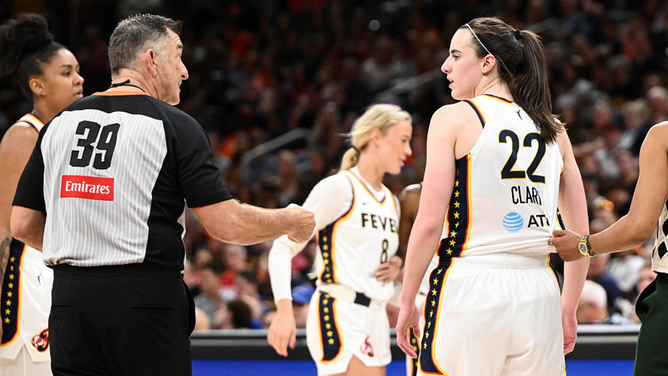
Caitlin Clark exchanges words with a referee during a game against the Connecticut Sun.
(Photo by Brian Fluharty/Getty Images)
Engelbert also emphasized that officiating complaints are not unique to the WNBA.
"As a fan of sports for 60 years now, I know that, you know, no one’s ever happy with officiating. All sports deal with it," she said. "But we're working hard to make sure we're putting the best product out on the court."
Those comments come after several high-profile complaints this season — particularly from stars like Caitlin Clark, Angel Reese, Kelsey Plum and Natasha Cloud. We've also heard complaints from coaches, including the Indiana Fever's Stephanie White and the Las Vegas Aces' Becky Hammon.
WATCH: Angel Reese Went Off On WNBA Referees: 'Tired Of This Sh*t'
According to Head of WNBA Officiating Monty McCutchen, though, there is no problem.
"We own the stuff that we need to own," he said. "We're really good about that and trying to get better. It's an important piece of our culture to drive toward better performance, but there's always going to be noise about officiating that is inaccurate. We have to stay the course to what good training and good performance look like."
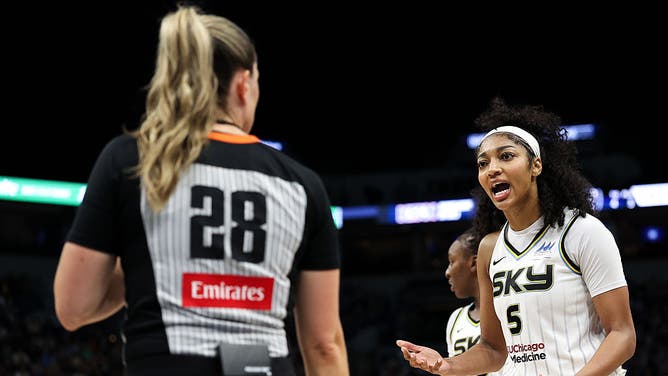
Angel Reese argues with referee Clare Aubry during the fourth quarter against the Minnesota Lynx.
(Photo by Matt Krohn/Getty Images)
On All-Star Weekend, Minnesota Lynx head coach Cheryl Reeve joked about McCutchen's denial, while also arguing that something has to change. She even went so far as to say that some of the league's officiating has been "alarming."
"Admitting you have a problem is the first step to making improvements," Reeve said on Friday. "And so I think until that happens, we're going to see challenges. You can't have a lack of self-awareness that maybe there are some things that need to be fixed.
"It's just like a basketball team. If we don't have enough talent, it's hard to win. I think the same is true for officiating."