Elizabeth Eddy Knew Speaking Out Could Cost Her Soccer Career, But She Did It Anyway
After an 11-year career, the former NWSL player reflects on the fallout from her women's sports stance, the support she received behind the scenes and what comes next.
Sometimes, doing what you believe is right comes with a cost. For former National Women's Soccer League (NWSL) midfielder Elizabeth Eddy, she knew that long before she ever hit "post."
Eddy officially announced her retirement Tuesday after an 11-year professional career.
"I'm deeply thankful to God, my family, friends, teammates, staff, coaches and fans for this wild, wonderful journey, both full of blessing and growth," Eddy said in a video posted to her social media.
And, in a conversation with OutKick on Monday, she said she's at peace with how everything unfolded — even if it didn't come without consequences.
"I would say overall, big picture, I’m feeling really settled and very excited for the future," Eddy said. "As I look back on my career, I’m recognizing, like, wow, you played 11 years, won seven titles, three NWSL championships, three shields. And I'm ready for the next chapter."
But that "next chapter" didn't just arrive on its own. It followed one of the most controversial moments of Eddy's career.
Elizabeth Eddy Made A Decision She Knew Wouldn't Be Received Well
Last fall, Eddy made headlines after publishing an essay calling on the NWSL to adopt sex-based eligibility standards to protect women's soccer.
It wasn't a spur-of-the-moment decision. In fact, she wrestled with it for a long time. Because she knew the backlash would be swift and intense.
"At the beginning of the year, I was kind of thinking about it," she said. "And then, full transparency, I would say I was too selfish. I wanted to play more than I wanted to do what I thought was right."
That internal conflict came to a head when her club, Angel City FC, scrimmaged against a U14 boys' team and lost. Eddy emphasized that it is beneficial for women's teams to play against these younger boys because "it forces you to play at a faster rate."
Ultimately, though, her team captain decided not to schedule any more of these scrimmages because it wasn't worth the injury risk. Plus, she was worried that one of the boys' parents would record it, post it on TikTok, and "it would look bad for the team."
"To me, that was a huge wake-up call," Eddy said. "If professional athletes of the highest level were so physically outmatched by teenage boys, yet there's this pressure to hide that reality rather than acknowledge it. That's why protected categories are so vital."

Elizabeth Eddy warms up with her Angel City FC teammates.
(Photo by Kevork Djansezian/Getty Images)
That realization, combined with a broader sense of responsibility, ultimately pushed her to speak publicly.
"The thing that was so scary for me is that I understood the cost," Eddy said. "I was willing to be like, hey, 11 years I've given to something, and that's OK. Whatever happens, I'm going to trust the process because I do believe this is right and that it's worth it for the future."
What happened was fierce backlash — and not just from fans and media. Some of it came from inside her own locker room, where she says differing opinions weren't always welcomed.
MORE: NWSL Teammates Slam Elizabeth Eddy As 'Transphobic' For Essay Defending Women's Sports
"It was pretty brutal," Eddy said. "Unfortunately, the league's become a place where having a diverse question or opinion or thought is not very well received."
Professional women's soccer has become a space where the inclusion of trans-identifying and DSD males has not only been welcomed but also encouraged and celebrated. Some of the biggest stars in the game — like Megan Rapinoe and Alex Morgan — have made it their favorite hill to die on.
The NWSL itself has backed this stance. We saw it earlier this month when the league posted its kickoff hype graphic, complete with a trans flag.
"I think people have let their social agendas and political agendas become a Trojan horse, running it through women's soccer," Eddy said.
One of the biggest hurdles Eddy faced was the imagery used when the media got a hold of her essay. The New York Post, for example, published Eddy's essay alongside an image of Orlando Pride player Barbra Banda, a Zambian athlete who previously failed a sex eligibility test.
It's important to note, though, that Eddy never once mentioned a player by name nor did she want to single anyone out. And she had nothing to do with choosing that photo.
"That was a pretty unfortunate circumstance for me as a player trying to build a relationship with other people in my team and in my industry who don't agree with the way the pictures were chosen for the article," she said.
Opposing Voices Are Being Silenced
While some players publicly pushed back on Eddy's stance, she says the private conversations told a different story.
"I've had quite a few teammates, peers from other teams in the league, or peers I've played with on past teams, who have been like, 'Hey, I totally agree with you. I totally agree with you. I totally support what you're doing.'"
Those players, though, admitted to her that they are afraid to voice that support publicly. They're afraid of being ostracized or losing their livelihoods on the soccer field.
"It's really hard, but I think the right thing to do is to share a juxtaposing opinion and then hope that there's a space where we can talk about it," Eddy said. "But it's a very one-sided conversation, and I'm hoping it will become two-sided."
What Comes Next For Elizabeth Eddy
Now stepping away from professional soccer, Eddy is shifting focus. But she isn't slowing down.
The 34-year-old newlywed has already begun competing in professional surfing events and is diving deeper into advocacy work surrounding women's sports.
"I've really come to realize that using the position that I'm in to speak and continue to advocate for women's exclusivity in women's sports is really important to me," she said.
That includes everything from speaking on national stages to engaging at the local level. She's had conversations with local mayors and candidates for the California Attorney General's office. She's also becoming active in city council and school board meetings.
"Read the minutes, read the schedule and what topics I'm personally passionate about," Eddy said. "Go to this meeting, speak up, try to help move the project forward."
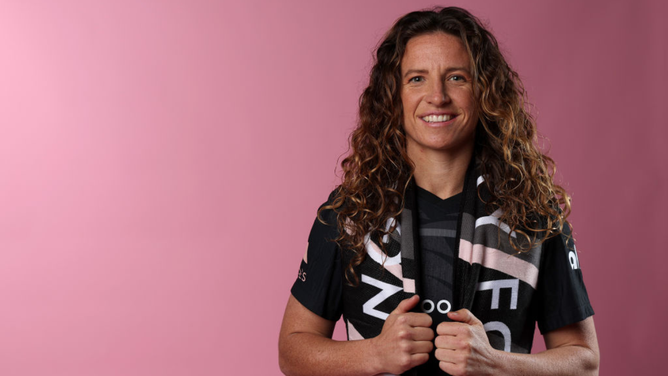
Elizabeth Eddy has retired after 11 years with the NWSL.
(Photo by Sean M. Haffey/Getty Images)
For Eddy, the issue isn't just about her own career. It's about what comes next for the generation behind her.
"I would say any young female athlete — soccer or any sport — to speak up for what you believe is right and actually get in this game," Eddy said.
Even after all the negative she's experienced since she published her essay in October, Eddy believes there's a path forward.
"People have to choose to come together on both sides, and both have to be willing to give to get," Eddy said. "It's really important that we try and have a seat at the same table."
And if the NWSL isn't willing to protect women, she said, "then they need to change the name to the National Open Soccer League." At least then they'd be honest about it.