Future Of USC-Notre Dame Rivalry In Doubt After New Statement
Trojans AD cites competitive disadvantage as only Big Ten team playing major road games after Week 4
One of the most compelling off-field storylines in the 2025 college football season has been the future of the historic rivalry between the USC Trojans and Notre Dame Fighting Irish.
The rivalry started in 1926, with 96 games contested between the two sides. Long considered the "Greatest Intersectional Rivalry" in college football, it's been an integral part of the chase for a National Championship numerous times over the decades. Including arguably the most famous recent iteration; the infamous "Bush Push" game in 2005 in South Bend.
All that history has come to a head in 2025, as the new reality of an expanded college football playoff and conference realignment have taken over. While the SC-Notre Dame game has been a foregone conclusion in the past, as of mid-November, there's no future game on the schedule between the two sides.
RELATED: Potential Last Ever USC-Notre Dame Filled With Fireworks Early
And with a new statement on Friday afternoon from USC Athletic Director Jenn Cohen, that doesn't look to be changing anytime soon. That's bad news for fans, players, coaches, and likely for Notre Dame as well.
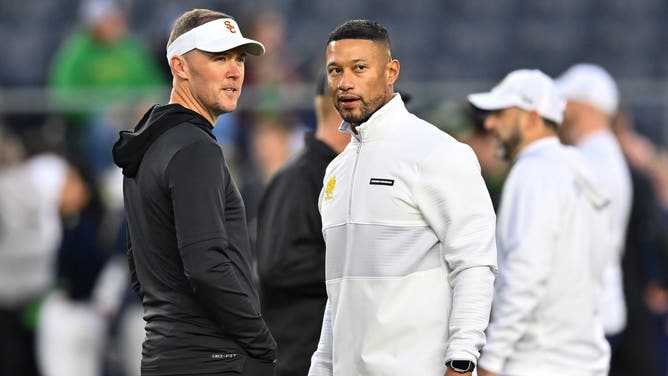
SOUTH BEND, Ind. - USC Trojans head coach Lincoln Riley and Notre Dame Fighting Irish head coach Marcus Freeman chat before the game at Notre Dame Stadium on Oct. 14, 2023. Photo: Matt Cashore-USA TODAY Sports
USC-Notre Dame Rivalry A Casualty Of New Priorities?
As part of a "State of Troy" update posted Friday morning, Cohen addressed USC's non-conference scheduling priorities moving forward. And without addressing Notre Dame specifically, she explained why the Trojans do not want to continue the rivalry game without a change in when it's played.
There's plenty to parse through in her statement, but there are a few key details and takeaways.
"First, the when and where: for the well-being of our student-athletes, and to schedule equitably with our Big Ten rivals, we want to play our non-conference opponents in the Coliseum as early as possible every year," Cohen writes.
"USC is the only team in the Big Ten to play a non-conference road game after Week 4 in either of the past two seasons. USC is also the only team to play a non-conference game after Week 4 in both seasons. Moreover, the only other Big Ten teams to play non-conference games after Week 4 in either the 2024 or 2025 seasons played at home against Group of 5 foes (UCLA vs. Fresno State, 11/30/24; Northwestern vs. UL-Monroe, 10/4/25).
Meanwhile, last year's College Football Playoff champions finished fourth in the Big Ten and played all their non-conference games at home in Weeks 1-3. An additional road trip in the middle of conference play – without key players – may have stressed their roster beyond its limits or cost them a third defeat and eliminated them from playoff contention. Instead, they qualified despite two Big Ten losses."
Cohen's case is that the timing of non-conference games has become vitally important with an expanded playoff. Particularly one decided by poll voters with short memories and a massive case of recency bias. Ohio State is a good example. The Buckeyes lost to the Michigan Wolverines late in the season, which was significant enough to warrant calls for Ryan Day's job. But because they had built up a quality resume prior, and it was their second loss of the season and not their third, they made the playoff anyway. And they won it.
Ohio State was a deserving champion, its road was difficult, and it was arguably the best team in the country even entering the playoff. But with any tournament, anything can happen, and getting in can lead to surprising outcomes.
Cohen wasn't done, saying that SC doesn't want to disadvantage themselves against other similar programs. And throwing a bit of shade towards Notre Dame in the process.
"Intentionally making our road to the CFP significantly more difficult than our Big Ten peers does not align with our goal to win championships," Cohen explained. "That said, we want to play meaningful games, and we recognize USC's unique position in college football history. USC is the only FBS program that has never played an FCS opponent. We embrace challenging matchups – they prepare us for conference play, excite our fan base, and grow our brand and revenues.
"That is why, of our three non-conference games each year, we will schedule at least one Power 4 opponent. If that opponent is a rival with whom we share a long and storied tradition, all the better."
Wonder whom that rivalry with a "long and storied tradition" might be!
Cohen and USC have a point. There's no advantage to USC playing the game in October in South Bend, or more specifically, November in LA. The Trojans now have to travel to the Midwest, or East Coast, several times per season. Adding another major road trip, one that's outside the conference schedule, against a perennially top-10 opponent, is something no other team within a difficult conference would do. Alabama isn't going to play Oregon in Eugene in October. Ever.
Equally, the late-season game in LA doesn't help SC much either. Normally, a quality win would impact playoff discussions. And in some years, a big win over the Irish could push SC into the top-12. But with SC hoping to compete for Big Ten championships, it's yet another unnecessary risk. Think of it this way; if SC enters the Notre Dame game on Thanksgiving weekend at 10-1, loses, but still goes to the Big Ten conference championship game with an 8-1 conference record, then loses, they're likely out of the playoffs, because they lost two games in a row.
Play that game earlier in the season, then go on an 8-1 run in the Big Ten Conference before losing to say, an 11-1 or 12-0 Ohio State team, things might change. The record is the same, the timing isn't.
For the Irish, why not agree to play the game in September? What difference does it make to them? It's unclear, though Marcus Freeman has said he wants to play the game anytime, anywhere. If that's true, the Irish should agree to SC's terms and get the game back on the schedule. The fact that it's already mid-November and the Irish haven't agreed, suggests this game could be in trouble for next year and beyond. That's a loss for all involved.