Former Idaho State Athlete Happy Supreme Court Is Empowering Women Against Trans Athletes
Madison Kenyon told OutKick why it's important for her to continue to fight for female athletes
Madison Kenyon, known by most as "Madi," had an incredible opportunity to continue both her athletic and academic career at Idaho State in 2019. She joined the Bengals' track & field team while she studied to become a registered nurse.
But something strange happened in 2019. Madi realized that one of her opponents was a male. That was strange, since Madi obviously competed on the women's team at Idaho State. Remember that prior to 2022, no one knew who "Lia" Thomas was. In fact, at that point, "Lia" Thomas was going by Will Thomas and competing in men's swimming at the University of Pennsylvania.
"It was a much more brushed-under-the-rug situation," Kenyon told OutKick. "And I saw lots of women trying to speak out, and it seemed like we were being silenced, that our voices weren't being heard, even though we were trying."
Much has changed since Kenyon first encountered a male athlete beating women in sports back in 2019. Most recently, the University of Pennsylvania entered into a resolution agreement with the Department of Education to apologize for allowing Thomas to compete on the women's swimming team and remove Thomas' accolades from its record books, something Kenyon wholeheartedly supports.
"Any actions that go to right women [of previous wrongs] and their success in their sports are the correct actions to take," Kenyon said. "It's really good to see them empowering women and recognizing that there is a difference between the sexes."
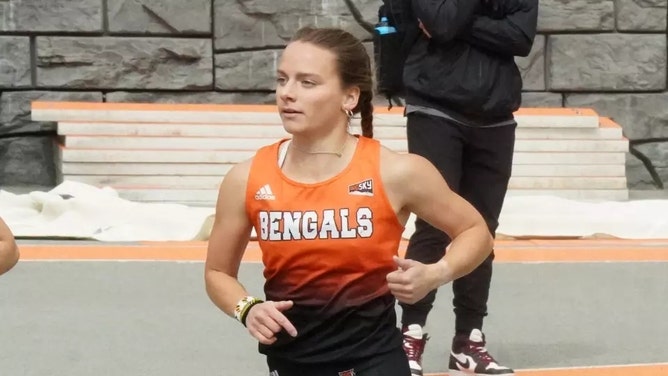
Madison Kenyon competed against a biological male athlete when she was on the women's track & field team at Idaho State University.
(Idaho State University Athletics)
But Kenyon isn't just speaking out on this hot-button topic. She's taking action. Last week, the Supreme Court agreed to hear two cases that center around transgender athletes (biological males) competing in women's sports. While many common-sense states have rightfully moved to ban the ridiculous practice, several left-wing-run states (like California, Maine and Minnesota) have continued to push for males in women's sports.
Kenyon is a plaintiff in one of the two lawsuits, related to her time competing against a male while in college at Idaho State.
"I'm really grateful that the Supreme Court has agreed to hear this case. It's sending a message to women that we have a chance to be listened to, and we have a chance to be told that we do matter," Kenyon said. "We hope that they'll be able to restore the integrity to women's sports and preserve opportunity, safety, and the ability of women to be safe in their sports."
Hal Frampton, Senior Counsel for the Alliance Defending Freedom (ADF), added that his firm, which is representing the plaintiffs in both cases, was thrilled to find out that SCOTUS agreed to take on these important cases.
"We're very encouraged and overjoyed that the Supreme Court is going to speak on this issue and hopefully stand up for fairness and safety in women's sports," Frampton said. "It's been a long, hard-fought battle for folks like Madi and some of our other clients. And it's just wonderful to know that they're going to get their day in court in front of the Supreme Court."
SCOTUS recently ruled on a case involving "transgender minors," finding that state bans on "gender-affirming care" for children are Constitutional legal. Frampton noted that the precedent set in that case should boost ADF's case.
"It's certainly helpful now that the Supreme Court has stepped in and said that states are free to regulate dangerous medical procedures and that that doesn't constitute discrimination on the basis of gender identity. We're hopeful that that same kind of logic will prevail and protect fairness and safety in women's sports."
Culture shifts on the issue of males competing in women's sports
In 2019, when Kenyon first experienced a male dominating in women's sports, it was almost a taboo issue. Far-left radicals used their tried-and-true tactics of scaring women into compliance. These women were told they were "bigots" or "transphobes" for daring to speak out to protect fairness in their sports.
That has changed drastically over the past five years. As more Americans have become aware of the issue, the majority stance is established: men don't belong in women's sports. Pro-women advocates like OutKick's Riley Gaines have changed the narrative. Kenyon says she's grateful that Gaines chose to speak out.
"Riley is an amazing example of women speaking up and really saying that we're not going to be silenced. She has been able to build a great platform to really address this issue. And I think women like Riley have been able to motivate a lot of other women who are scared to speak up. And I'm so grateful for her bravery and her courage in addressing that issue."
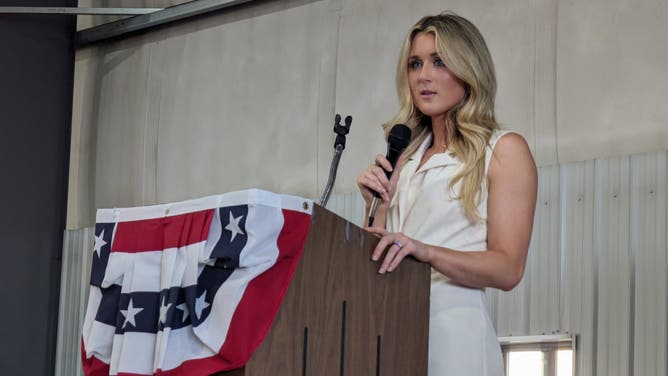
Former college athlete Madison Kenyon thanked Riley Gaines for advocating strongly for fairness in women's sports.
(Roger LaPointe/The News-Messenger / USA TODAY NETWORK)
Despite that, there are still many fighting for men to compete in women's sports. That includes left-wing politicians who are beholden to their radical base. But perhaps much more disappointing are the former female athletes – who are no longer affected by the issue, like the retired Megan Rapinoe – using their platforms to hold other women back.
"It's really sad to see women whose careers were so successful and were built on a fair playing field supporting an unfair playing field," Kenyon said. "Had their experience been different, maybe their careers would have been a lot different as well."
There is no definitive date set for the Supreme Court to hear the cases, but they are likely to happen sometime in early 2026. The decision by SCOTUS in both cases is going to set a very important precedent that will have effects that reach beyond the realm of sports. The simple debate here is whether discrimination laws apply to gender identity.
President Trump, and the American majority who voted for him, have made their position clear. People cannot change their biological sex and stake claims to women’s sports and private spaces. Hopefully, the Supreme Court falls in line with that position, as well.