New NBA Television Schedule Is Overkill For An Already Struggling League
NBA nearly tripled its broadcast revenue with record $76 billion deal. But oversaturation, rising costs, and waning interest could undermine it.
The NBA released its upcoming national television schedule for the 2025/26 season, the first under its 11-year, $76 billion media rights deal with ESPN/ABC, NBC, and Amazon.
Starting after the end of the football season, there will be nationally-televised NBA games every night of the week:
- Mondays: Peacock
- Tuesdays: NBC + Peacock (doubleheader)
- Wednesdays: ESPN / ESPN App
- Thursdays: Prime Video
- Fridays: Prime Video and ESPN / ESPN App
- Saturdays: Prime Video (afternoon) & ABC / ESPN App (evening)
- Sundays: ABC / ESPN App (afternoon) & NBC / Peacock (evening)
That's a lot of games for a league struggling to maintain interest.
While the NBA nearly tripled its annual broadcast, concerns about further diluting the product remain.
How the NBA’s $76 Billion TV Contract Impacts Fans
Viewers were not clamoring for more nationally televised NBA games. There were already not enough compelling matchups to fill four nights of games between ESPN/ABC and TNT. Now, the league will need to spread games across seven nights between three partners.
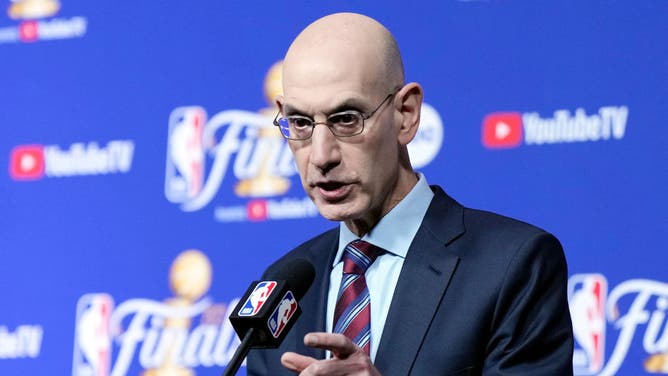
SAN FRANCISCO, CALIFORNIA - JUNE 02: NBA commissioner Adam Silver speaks to the media prior to Game One of the 2022 NBA Finals between the Golden State Warriors and the Boston Celtics at Chase Center on June 02, 2022 in San Francisco, California. NOTE TO USER: User expressly acknowledges and agrees that, by downloading and/or using this photograph, User is consenting to the terms and conditions of the Getty Images License Agreement. (Photo by Thearon W. Henderson/Getty Images)
Moreover, fans will have to start paying more to watch the games. In addition to cable or satellite, viewers will need to subscribe to Peacock for $10.99/mo and Amazon Prime for $14.99/mo. Cord-cutters will also need ESPN's upcoming direct-to-consumer app for $29.99/mo.
From October to May (the June Finals will only air on ABC), that will cost streamers $55.97/mo or $447.76 a year. The NFL can (probably) get away with that. The NBA can't.
And therein lies the problem.
Will Oversaturation Hurt NBA Popularity?
The NBA is among the only sports leagues in America whose viewership is declining, despite recent adjustments to out-of-home viewing. This past NBA Finals was the second-lowest on record, and viewership is down around 50% over the past decade.
The ratings for the past two seasons have shown that younger stars like Shai Gilgeous-Alexander and Anthony Edwards don't drive viewership – at least not yet. LeBron James remains the NBA's biggest draw, but turns 41 in December and doesn't play for a championship-caliber team.
And after the Lakers, Warriors, and Knicks, the drop-off in nationally relevant teams is steep. That's not ideal for a league planning to air 10 to 14 nationally televised games each week.
The NBA media elites are going to have to convince fans that teams in Oklahoma City, Memphis, and Sacramento matter too. Good luck. Stephen A. Smith and Charles Barkley are still complaining that they had to spend June in Indiana.
Finally, seven days a week is overkill even for the diehards. The NBA got greedy. It got greedy at the expense of its already dwindling fan base.