EXCLUSIVE: Sen. Bill Cassidy Questions NCAA President Charlie Baker Over Age Gaps, Fairness In College Sports
With college rosters featuring players in their mid-20s—and even former pros—Senator Bill Cassidy wants answers from the NCAA about how that impacts fairness and safety.
A new battle may be brewing over NCAA rules, this time centered on the lack of age limits for student-athletes entering college sports. The issue has prompted questions from a Senate committee directed at NCAA President Charlie Baker.
If you’ve ever noticed that some college athletes in football, baseball, basketball or Olympic sports appear older than the typical college student, there’s a simple reason: there’s no age restriction for NCAA competition. Athletes get five years to play four competitive seasons.
While that may not seem like a major concern, imagine being an 18-year-old freshman lining up against a 26-year-old senior who has taken a redshirt year, received a medical waiver or simply delayed college enrollment.
Sources: Turmoil At Florida State, Auburn Forcing Tough Decisions On Mike Norvell, Hugh Freeze
Many athletes are still competing thanks to the NCAA’s "Covid year" eligibility extension, though those numbers are gradually declining as we move further away from that period.
Another key factor contributing to the age gap involves international athletes who are eligible to play NCAA sports even after having competed professionally overseas — a situation seen most often in basketball and, increasingly, football.
The NCAA Has Plenty Of Ongoing Problems
In this case, we obviously see this more in college basketball and even football. Additionally, the ways in which international students can make money off their NIL has been hampered by NCAA rules put into place, with some athletes waiting for their team to take overseas trips to cash in on the rules that hamper them while in the states.
Take Luka Bogavac, for example. The North Carolina signee previously played professionally in the Adriatic Basketball Association and will turn 22 before playing his first college game.
Or consider Sananda Fru, a 21-year-old freshman at Louisville who has already competed for Basketball Löwen Braunschweig in Germany.

FAYETTEVILLE, AR - AUGUST 30: Arkansas Razorbacks wide receiver Monte Harrison (11) tries to leap through a tackle attempt by Alabama A&M Bulldogs linebacker John Robinson (53) during the college football game between the Alabama A&M Bulldogs and Arkansas Razorbacks on August 30, 2025, at Donald W. Reynolds Razorback Stadium in Fayetteville, Arkansas. (Photo by Andy Altenburger/Icon Sportswire via Getty Images)
It really doesn't matter which sport you play, there are examples scattered throughout college campuses, which include Arkansas wide receiver Monte Harrison, who started playing college football at 29-years-old. This came after he spent 10 years in the MLB.
While none of this is the fault of these athletes, it does raise questions about competitive balance when older players — often with professional experience — compete against traditional college freshmen.
Now, U.S. Senator Bill Cassidy, M.D. (R-LA) who is chair of the Senate Health, Education, Labor, and Pensions (HELP) Committee, is asking NCAA President Charlie Baker questions regarding the fairness and protection of athletes.
What Senator Bill Cassidy Is Asking Of NCAA's Charlie Baker
In a letter (below) obtained by OutKick, Senator Cassidy calls for greater transparency to "ensure that traditional-age student-athletes — both domestic and international — compete on an even playing field with older newcomers who may arrive with substantial pre-college experience."
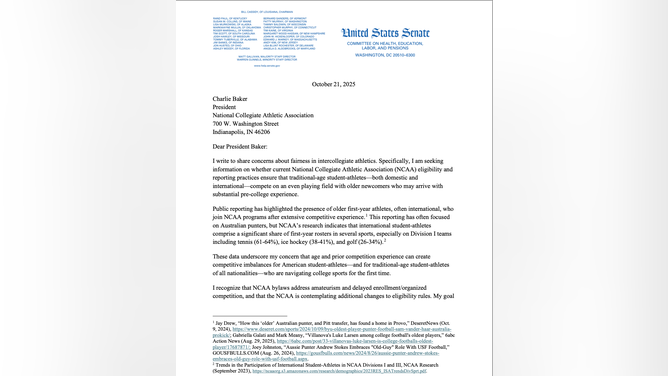
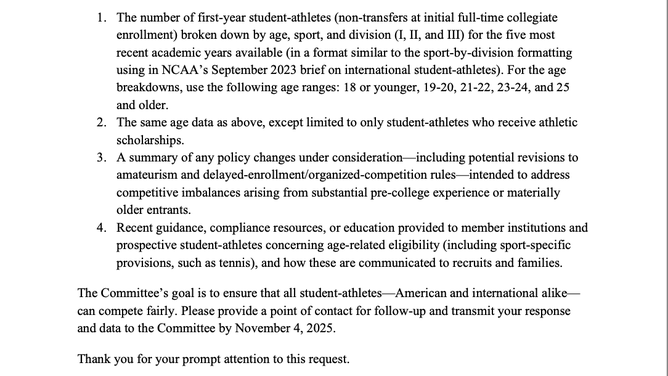
According to information obtained, the Senator from Louisiana is asking NCAA President Charlie Baker the following questions, hoping for data from the organization.
- The number of first-year student-athletes (non-transfers at initial full-time collegiate enrollment) broken down by age, sport, and division (I, II, and III) for the five most recent academic years available (in a format similar to the sport-by-division formatting using in NCAA’s September 2023 brief on international student-athletes). For the age breakdowns, use the following age ranges: 18 or younger, 19-20, 21-22, 23-24, and 25 and older.
- The same age data as above, except limited to only student-athletes who receive athletic scholarships.
- A summary of any policy changes under consideration—including potential revisions to amateurism and delayed-enrollment/organized-competition rules—intended to address competitive imbalances arising from substantial pre-college experience or materially older entrants.
- Recent guidance, compliance resources, or education provided to member institutions and prospective student-athletes concerning age-related eligibility (including sport-specific provisions, such as tennis), and how these are communicated to recruits and families.
"The Committee’s goal is to ensure that all student-athletes — American and international alike — can compete fairly," U.S. Senator Bill Cassidy wrote to NCAA President Charlie Baker.
The NCAA Has Sent The Following Statement To OutKick:
"The NCAA has consistently advocated for the ability to set and enforce commonsense eligibility and transfer rules to address issues such as those described in this letter. That ability is currently under attack in courts across the country. This is why we’re focused on partnering with Congress to resolve today’s patchwork of state laws and inconsistent, conflicting court decisions that risk robbing high school athletes of the ability to compete and obtain an education through college sports." – Tim Buckley, NCAA senior vice president of external affairs
For the foreseeable future, the NCAA has plenty of problems to deal with regarding college athletics, as college commissioners are looking for congressional help regarding NIL, antitrust protection and a bevy of other issues.
These latest questions will certainly catch the eyes of NCAA leaders, as they try to navigate this new era of college sports.