MLB Is Already Preparing To Lock Players Out As Soon As Possible
MLB's making excuses to implement a salary cap
Major League Baseball is already laying the groundwork for squandering all the growth and increased interest they've worked so hard to develop. And it's all to protect cheap owners who refuse to spend money.
This issue became more obvious thanks to recent reports of a disastrous meeting MLB commissioner Rob Manfred had in the Philadelphia Phillies clubhouse.
Phillies star Bryce Harper was one of several players who was reportedly upset with the tone and content of Manfred's discussion with the team. The disagreement seemingly stemmed from Manfred talking around an issue that players are rightfully upset about: the potential for a salary cap in upcoming labor negotiations.
"If you’re talking about a salary cap you can get the f— out," Harper said.
Harper's agent, Scott Boras, told The Athletic this week that players, especially Harper, are not going to accept a salary cap because they've seen, first-hand, the consequences of it.
"Young players need to talk with veterans like Harper," Boras explained. "Harper has been fighting the consequences of caps his whole life. Harper received the potential for a total of $10.9 million, $9.9 million plus $1 million in roster bonuses, for his draft signing in 2010.
"Two years later, in 2012, a draft cap was implemented and the top-paid player in the draft, Byron Buxton, got $6 million. Fifteen drafts later, the top player is receiving $9.25 million, well below Harper. Harper knows what caps can do to players’ rights, especially young players."
Manfred, who works for the owners, hasn't exactly hidden his desire to implement a salary cap to protect his bosses. Couching it in terms of appealing to small market fans, who mistakenly believe that only big market teams can spend money. Starting this discussion now demonstrates just one thing: the league is absolutely going to impose yet another work stoppage next year.
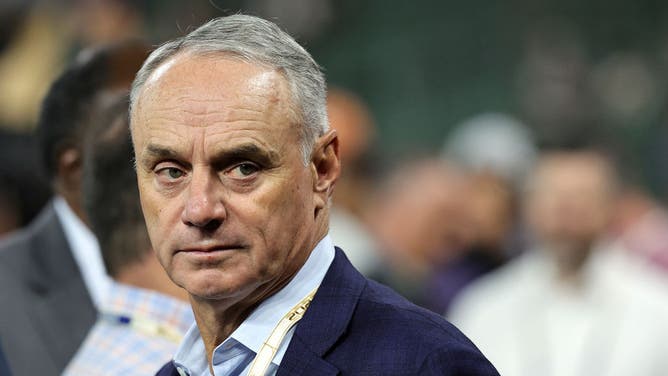
Major League Baseball commissioner Rob Manfred is trying to impose a salary cap on players in the league. (Photo by Bob Levey/Getty Images)
MLB Is Cutting Off Its Nose To Spite Its Face
In the aftermath of the clubhouse incident, Harper told the media that he wouldn't give more details on what happened.
"Everybody saw the words and everything that happened, but I don’t wanna say anything more than that. I want to focus on my teammates and our union as a whole and just worry about winning baseball," he said.
But it wasn't just him; other players were reportedly "disappointed" in the tone of the conversation. As well as frustrations that he was being cagey instead of just saying the words "salary cap" out loud. One of the union's top execs, Bruce Meyer, has previously stated that this is Manfred's current strategy with players.
"It’s kind of continuation of a pattern which has gone on for decades, which is, the other side … tries to go directly to players, tries to create divisions between players," Meyer explained on a recent episode of "Foul Territory." "The league and some of the individual owners have made no secret that they would like to see a system that they tried to get for 50 years, which is a salary-cap system."
The agreement between the league and the MLBPA expires in December 2026, and there's only one reason for Manfred to start his propaganda campaign now: to prepare fans and players for another work stoppage. And if they take a hard line on a salary cap, it could cost the league games, and an immense amount of good will.
Salary caps do one thing, and one thing only: help owners. They do not help players, they do not increase competitive balance, they do not make small market teams more likely to be on a level playing field with the big market teams. As just one example, the Patriots, Chiefs and Eagles have won 8 of the last 11 Super Bowls. In fact, there's been just 11 different teams to play in the Super Bowl in the last 11 seasons.
The NFL salary cap hasn't created more variety among championship teams, it's created dynasties. Meanwhile, in MLB, with no salary cap, nine different teams have won the last 11 World Series, and 15 different teams have played in it. The league with the competitive imbalance is the NFL, not professional baseball.
But Manfred's bosses, particularly those in, say, Pittsburgh, Miami, Tampa and elsewhere, realize that they can gain enormous amounts of sympathy by telling their fans that they simply can't compete with high-spenders in LA, New York and Boston. The reality, of course, is that they could easily spend more than they do. But they won't. And a salary cap would ensure they never have to. That's why Manfred's pushing it so hard.
What it's actually going to do is ensure that players become even more united against a cap, leading to an inevitable work stoppage in 2026. And if it drags into the 2027 regular season, all the increased ratings and attendance built up in the last few seasons would be lost. While a disaster for the sport, it sure would help the owners who use their team as a piggy bank find more excuses. And maybe that's the real value play for MLB and Rob Manfred.