Jim Jordan Targets Sports Broadcasting Act, Urges NFL, MLB, NBA & NHL Commissioners to Brief Congress
The SBA was first enacted in 1961 and the sports-viewing landscape has changed drastically since then
Rep. Jim Jordan (R-OH) is challenging the foundation of televised sports in America, calling on league commissioners to brief Congress about a law that shapes how fans watch—and pay for—their favorite games.
Jordan sent letters to NFL Commissioner Roger Goodell, MLB Commissioner Rob Manfred, NBA Commissioner Adam Silver and NHL Commissioner Gary Bettman, OutKick has learned. In the letters, Jordan asks the four commissioners to come to Washington, D.C. to discuss potential changes to the Sports Broadcasting Act, which was originally enacted in 1961 to allow the major sports leagues to pool their broadcasting rights and sell them without violating antitrust laws.
The SBA allows leagues to collectively sell TV rights without running afoul of antitrust laws—something that would normally be illegal in most industries.
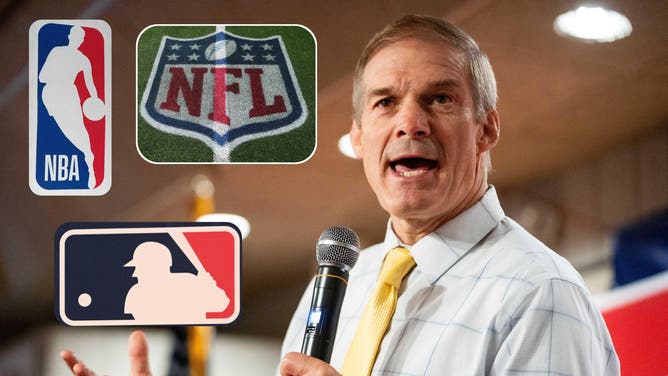
Rep. Jim Jordan (R-OH) sent letters to the commissioners of the NFL, MLB, NBA and NHL asking them to come to Capitol Hill to discuss potential changes to the Sports Broadcasting Act of 1961.
(Imagn Images)
According to Jordan, the Act is outdated given the proliferation of streaming and other avenues to which leagues can sell their broadcasting rights. This shift has made it increasingly expensive and complicated for fans to access live sports, who now have to shell out hundreds, if not thousands of dollars, to watch the various sports leagues.
Jordan's letter to Goodell, which mirrors the other three letters, states, "The sports broadcasting market has changed significantly since the SBA was enacted, and recent antitrust cases have raised important questions about whether the SBA should be modified or repealed as a result. We write to request a briefing on the National Football League’s (NFL) participation in the sports broadcasting market, and how the antitrust exemptions established by the SBA affect that participation."
The letter continues: "Part of the problem results from the fact that the SBA’s antitrust exemptions were adopted at a time when sports leagues broadcast their games primarily on network television. The SBA only applies to ‘sponsored telecasting,’ which ‘refers to broadcasts which are financed by business enterprises… in return for advertising time and are therefore provided free to the general public.’ Courts have consistently held that the SBA does not exempt sports leagues from antitrust liability when it comes to distribution channels where subscribers pay a fee, such as cable television, satellite, pay-per-view, or digital streaming services."
This issue – where fans are forced to purchase multiple streaming services – is something OutKick has covered extensively. OutKick founder Clay Travis wrote a lengthy column about the financial hardships facing sports consumers.
"Watching your favorite team play is becoming more expensive, less convenient, and more frustrating than it was just a few years ago, that's an awful trilogy of failure," Travis wrote. "At a time when technology has never been more omnipresent and ease of transmission has never been cheaper and more reliable, why are we going backwards when it comes to watching our favorite teams play? And why are leagues allowing it to happen? In an era when getting kids to care about sports is often impossible -- youth game watching rates are at abysmal levels -- why are sports leagues giving up the future to make a few extra dollars in the short term?"
According to an OutKick review, an NFL fan who wished to stream every nationally-broadcast game would have to shell out $111.94 per month, or $671.64 from the start of the season in September through the Super Bowl in February. And that's not including NFL Sunday Ticket. Add in that option, and a consumer is looking at another $80 per month, or $480 for the entire season. That's over $1,000 to watch the NFL, and that's a major problem.
Jordan also joined Travis' radio show, Clay & Buck, to discuss the issue.
Jordan’s efforts could prompt long-overdue changes to a system that many argue is failing modern sports fans.