World Athletics Report: 50-60 Male DSD Athletes Competed In Women’s Elite Track & Field Finals
Decades of Olympic and World Championship results were skewed as male-bodied athletes with DSD conditions took women’s podium spots.
A new report from World Athletics reveals what many women’s sports advocates have been warning about for years: Dozens of male athletes with differences in sex development (DSD) have been dominating women’s track and field for more than two decades.
In a presentation Friday at the World Championships in Tokyo, Dr. Stéphane Bermon — head of health and science at World Athletics — revealed that between 50 and 60 DSD athletes who went through male puberty have competed in the finals of elite women’s track and field events since 2000.
In total, Bermon said 135 DSD finalists were identified between 2000 and 2023 (because many competed in multiple events).
Athletes with male biology are "significantly over-represented" in women’s finals, Bermon explained, which "compromises the integrity of the female competitions."
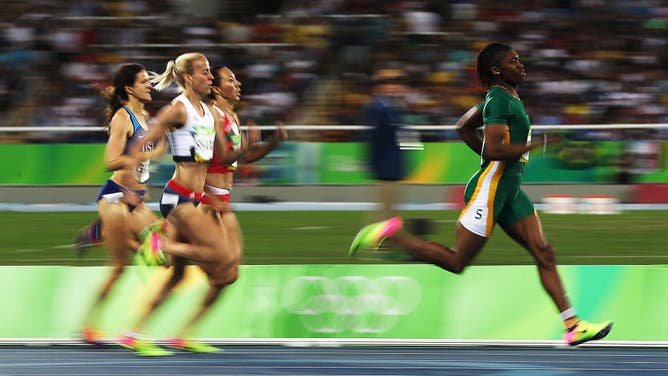
DSD athlete Caster Semenya blows past female competitors at the 2016 Rio Olympics.
(Photo by Ian MacNicol/Getty Images)
Data Shows DSD Athletes Overrepresented In Women’s Finals
The data, which was pulled from years of anti-doping testing, showed consistently elevated testosterone levels. Officials say the actual number of DSD athletes is likely even higher.
This new report lands just as World Athletics begins enforcing its updated eligibility rules for the first time at a global meet. Starting with the 2025 Worlds in Tokyo, any athlete who wants to compete in the women’s category must take a one-time genetic test.
That test looks for the SRY gene, which lives on the Y chromosome and triggers male development. If the gene is there, you're male, and you’re not eligible to compete in the female category.
"We are saying, at elite level, for you to compete in the female category, you have to be biologically female," World Athletics President Sebastian Coe said. "It was always very clear to me and the World Athletics Council that gender cannot trump biology."

Sebastian Coe, President of World Athletics, speaks during the opening ceremony on day one of the World Athletics Championships Tokyo 2025.
(Photo by Michael Steele/Getty Images)
And the numbers shared in Tokyo show exactly why World Athletics had to draw the line.
A slide from Bermon’s presentation revealed that DSD athletes are 151.9 times more likely to reach the finals of elite women’s events than they should be based on how rare these conditions are in the general population.
For example, in 2016, the entire women's 800m podium at the Rio Olympics was made up of DSD male athletes — including gold medalist Caster Semenya, who also won gold in 2012. In 2021, another DSD athlete, Christine Mboma of Namibia, took silver in the women’s 200m at the Tokyo Games.
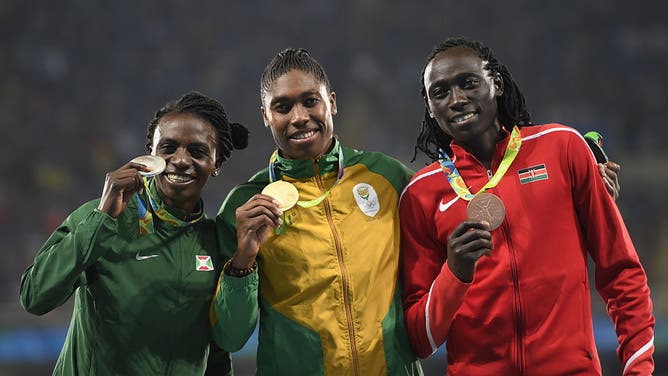
Silver medalist Burundi's Francine Niyonsaba, gold medalist South Africa's Caster Semenya, and bronze medalist Kenya's Margaret Nyairera Wambui pose on the podium for the Women's 800m Final.
(ERIC FEFERBERG/AFP via Getty Images)
British Olympian Lynsey Sharp, who finished sixth in Rio, later told Sky News: "Sometimes I look back and think I could have had an Olympic medal." She called it "a really difficult time" that "tainted" her Olympic experience.
Neither Semenya nor Mboma has competed at the elite level since World Athletics implemented stricter rules in 2023, including mandatory testosterone suppression and a full ban on trans-identified males who’ve gone through male puberty.
And now, with SRY testing, the line is even clearer: Only biological females can compete in the women’s category.
Other sports are beginning to follow suit.
As OutKick reported in August, World Boxing recently implemented the same SRY gene test for its international female competitors after two reportedly DSD male athletes — Imane Khelif and Lin Yu-Ting — won gold medals at the 2024 Paris Olympics. And earlier this month, USA Cycling updated its policy to define "female" based on sex at birth, not gender identity.
RELATED: Imane Khelif Appeals World Boxing Ban Over Mandatory Sex Testing Rule
The International Olympic Committee has also formed a new working group, called "Protection of the Female Category," to study how to ensure fairness in women’s events across all sports.
"We understand there’ll be differences depending on the sport," new IOC President Kirsty Coventry said. "But it was very clear from the members that we have to protect the female category."
And with this new report from World Athletics, the data speaks for itself.