Why Don’t More Athletes Run for Office? | Erin Maguire
Stephen A. Smith recently revealed that Democratic operatives are encouraging him to run for public office — and it sparked headlines across the political and sports worlds.

NEW ORLEANS, LOUISIANA - FEBRUARY 07: ESPN featured commentator and executive producer on set on February 07, 2025 in New Orleans, Louisiana. The Philadelphia Eagles and the Kansas City Chiefs will face each other on Sunday. (Photo by Aaron M. Sprecher/Getty Images)
Not because it was some shocking pivot, but because it felt like a natural evolution.
Smith, one of the most recognizable voices in sports media, has never shied away from controversy. He leans left, speaks boldly, and has built a following by being unapologetically himself. That authenticity is what people respond to — and it’s exactly why the left is ready to back him.
But what happens when an athlete or sports figure brings that same authenticity and conviction to conservative beliefs?
That’s when the story changes.
In an era where athletes are expected — and often celebrated — for speaking out on progressive causes, those who lean right are often pressured into silence. It’s not because conservative athletes don’t exist. It’s because they’ve been made to feel they shouldn’t speak, let alone serve.
RELATED: The Era of Woke Sports Is Dead | Clay Travis
But they should.
There’s a legacy here.
Jack Kemp, former Buffalo Bills quarterback and current Buffalo Bills Wall of Fame member, didn’t just retire and fade into the background — when his gridiron career ended, he started another in the public arena. He served nine terms in Congress and became a national leader on economic growth and tax policy.

HUD Secy. Jack Kemp smilingly listening to Pres. Bush's address to Natl. Bd. of Realtors. (Photo by Diana Walker/Getty Images)
Today, Rep. Burgess Owens, a former Super Bowl champion, serves in Congress with the same intensity and conviction that defined his playing career.
These men didn’t simply transfer their fame into politics — they transferred their work ethic, their focus, and their ability to lead under pressure. And they’re proof that athletes have what it takes to succeed in public life.

Representative Burgess Owens, a Republican from Utah, speaks during a Senate Judiciary Committee hearing in Washington, D.C., U.S., on Tuesday, April 20, 2021.
That doesn’t mean every athlete should run for office — just like not every politician should. But it does mean we should see more of them step forward. Reaching the highest levels of professional sports demands the same qualities we say we want in our leaders: discipline, teamwork, accountability, and grit.
Many of these athletes have deep ties to their hometowns or to the cities where they played. They’ve already spent their careers representing something larger than themselves. Imagine what they could do if they did it in Congress or on a school board.
But instead of encouraging that, it's been punished.
Athletes who challenge progressive orthodoxy are rebuked.
Just look at Kansas City Chiefs kicker Harrison Butker — a Super Bowl champion and devout Catholic who has never hidden his conservative views. He’s campaigned alongside Sen. Josh Hawley, spoken openly about his support for President Trump, and delivered speeches defending traditional values.
The backlash has been fierce. Critics label him extreme, divisive, or out of touch simply for expressing beliefs held by millions of Americans — the same beliefs he credits for his discipline and success on the field.
My only criticism of Butker? He plays for the Kansas City Chiefs — and as a proud member of Bills Mafia, I eagerly look forward to when 2024 NFL MVP Joshua Patrick Allen beats the Chiefs in the playoffs and wins us our long-deserved Super Bowl. But that’s beside the larger point here.

GLENDALE, AZ - FEBRUARY 12: Harrison Butker #7 of the Kansas City Chiefs warms up before the game against the Philadelphia Eagles prior to Super Bowl LVII at State Farm Stadium on February 12, 2023 in Glendale, Arizona. (Photo by Cooper Neill/Getty Images)
Meanwhile, athletes who push leftward causes are championed as brave and righteous. The contrast couldn’t be clearer.
The NFL’s decision to quietly remove "End Racism" from its end zones was telling. Not because racism ended — of course it didn’t. But because the league had veered too far into political pandering, misreading both its audience and many of its players. The entertainment industry — sports included — demands loyalty to a left-leaning ethos. And that doesn’t reflect the country, the fans, the voters, or much of the locker room.
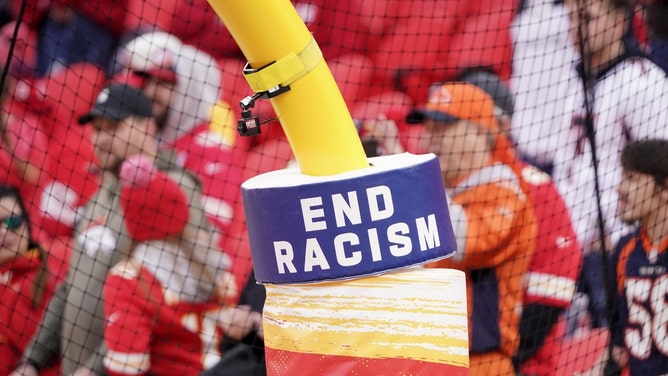
The NFL stops using 'End Racism' messaging ahead of Super Bowl in New Orleans. (Denny Medley-Getty Images)
Athletes shouldn’t be expected to politicize the field of play. But off the field? Their lived experiences, discipline, and connection to their communities make them uniquely qualified to lead. The traits that took them to the top of their sport are the same ones that can take them to the halls of Congress.
That’s why more athletes should step forward — not as performers of a narrative, but as participants in a democracy. Their careers have been defined by grit, discipline, and delivering under pressure. They know how to take a hit and get back up. That doesn’t just make for good athletes. It makes for exceptional public servants.
No, not every athlete should run. But more could — and more should. They’ve already spent their lives representing something bigger than themselves. Why stop now?
Being conservative in sports isn’t a contradiction. It’s not risky, rebellious, or wrong. It’s real. And it’s time we made room for it — not just in the locker room, but in the public square.
(Erin Maguire is a guest contributor at OutKick. Follow on social media.)