West Virginia AG: Supreme Court Ready To 'Put This Issue To Bed' In Women's Sports Debate
West Virginia Attorney General JB McCuskey says the fight over women's sports has drifted away from basic biology and common sense.
West Virginia Attorney General JB McCuskey has a pretty simple way of describing what he sees as the absurdity of the debate over biological males competing in women's sports.
"It’s like trying to convince somebody that two plus two is three," McCuskey told OutKick ahead of next week’s Supreme Court hearings. "If they believe it’s three, you’re never going to be able to convince them that it’s four."
The problem, of course, is that common sense has taken a backseat to ideology.
"If they have committed themselves to an idea, and they have essentially made it their entire personality — the idea that two plus two equals three — there is no level of logic that’s going to change their mind," McCuskey explained, "even at the expense of the very people that they claim to want to support."
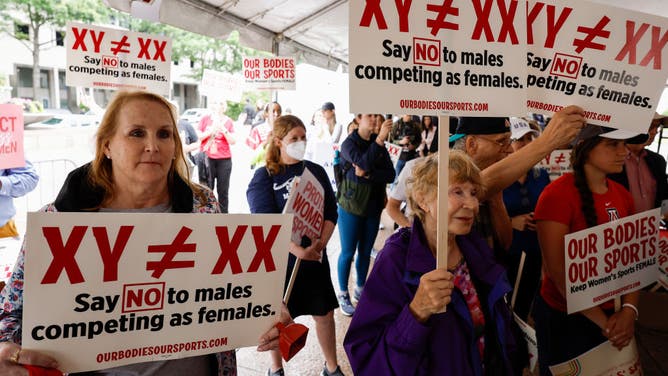
Demonstrators listen to the speaking program during an "Our Bodies, Our Sports" rally for the 50th anniversary of Title IX at Freedom Plaza.
(Photo by Anna Moneymaker/Getty Images)
McCuskey is heading into oral arguments next week as West Virginia defends its Save Women's Sports Act in West Virginia v. B.P.J., one of two cases the Supreme Court is hearing on whether states can keep girls' and women's sports teams female-only.
DETAILS: Next Week's Supreme Court Hearings Could Redefine Women's Sports — Here's What You Need To Know
It's a major moment for female athletes across the United States. But McCuskey doesn't seem to think it'll be a nail-biter.
"We’re very confident," he said. "Not just because of the strength of our arguments, but also the strength of the legal team we have here in West Virginia is as good as you’ll find anywhere in the country."
SCOTUS Cases On Transgender Athletes Will Have A Massive Impact On Women's Sports Nationwide
Strip away the legal jargon, and what's at stake is pretty clear.
"We are asking the court to decide whether or not states have the ability to create a system where biological males are not allowed to compete against biological females in sports," McCuskey said.
"And this is important because we know that biological males are bigger, faster and stronger than biological females, and we have Title IX in this country, which was created to ensure that women had access to playing fields and academic opportunities that were for a very long time not available to them."
That brings us to what’s really hanging over next week's arguments: what happens if the Supreme Court rules against West Virginia? McCuskey didn't dance around it.
"If the Supreme Court finds that our law violates Title IX," he said, "every girls' sports team in America would be illegal."
But if the court rules in favor of West Virginia, it's a win for female athletes and all the states that want to protect them.
"In the absence of congressional action, which we know isn’t going to happen for a myriad of reasons," McCuskey said, "states that want to enact common sense laws that protect women’s sports, that protect girls from being on playing fields with biological males who are bigger, stronger and faster than them, taking their opportunities away — not just for competition in middle school and in high school, but for NIL deals and professional contracts and all of the amazing benefits that happen when young women participate in competitive athletics — then those states would be free to pass those laws and understand that those laws are not just common sense, but are also constitutional and legal."
Part of why he's so invested, McCuskey told OutKick, is that this debate is personal for him. Not only are all of West Virginia's female athletes his constituents, but "one of them happens to be my daughter."
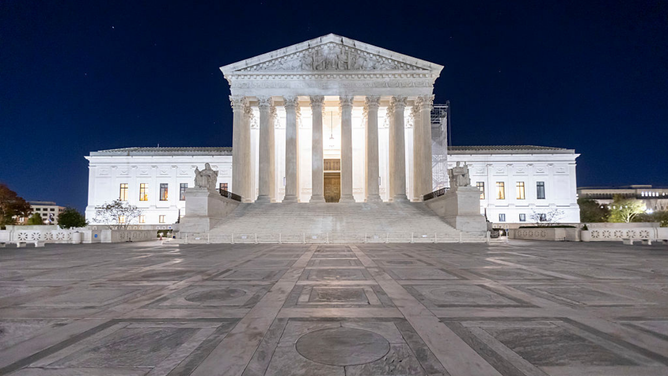
Supreme Court hearings for both West Virginia v B.P.J. and Little v Hecox are scheduled for January 13, 2026.
(Photo by Nicolas Economou/NurPhoto via Getty Images)
As oral arguments get underway on Tuesday, McCuskey said athletes and parents should be paying attention and expecting clarity.
"I think they should be looking for a big win," he said, adding that female athletes deserve "real guidelines around the competitive nature of their sports" and "some certainty moving forward" — certainty that they're competing on a safe and fair playing field and that "you don't have to be worried about a biological male coming in and taking your spot away from you."
McCuskey believes the Supreme Court is "ready to put this issue to bed." And he's confident it will.
Because West Virginia is simply asking the Court to acknowledge what's always been true. To say, once and for all, that two plus two is four — and that no amount of outcry or insistence can change the math.