Next Week's Supreme Court Hearings Could Redefine Women's Sports — Here's What You Need To Know
On Jan. 13, SCOTUS will hear back-to-back cases from Idaho and West Virginia that challenge state laws limiting girls' and women's sports to biological females.
Next week, the U.S. Supreme Court will take up two cases that could fundamentally reshape the future of girls' and women's sports.
The justices will hear arguments in Little v. Hecox and West Virginia v. B.P.J., both of which put state laws protecting female-only sports teams directly on trial. At the heart of both cases is a simple but hugely consequential question: Can states protect women's sports or not?
The rulings could affect everything from youth leagues and high school teams to college programs and scholarship opportunities nationwide.
So before oral arguments begin on January 13, here's what you need to know.
Little v. Hecox (Idaho)
This case centers on Idaho's Fairness in Women's Sports Act, a law passed in 2020 to keep girls' and women's sports teams female-only. Idaho lawmakers argued the law was necessary to protect competitive fairness and athletic opportunities for women in athletic competitions where biological differences matter.
The law was challenged by Lindsay Hecox, a transgender-identifying male who wanted to compete on Boise State University's women's track team. A federal judge quickly blocked Idaho from enforcing the law, and the case eventually landed before the Ninth Circuit Court of Appeals.
The Ninth Circuit sided with Hecox, ruling that Idaho's law likely violates the Constitution's Equal Protection Clause. Put more plainly, the court wasn't convinced Idaho had a strong enough justification for excluding transgender-identifying males from women's sports, at least under the way the law was written.
The appeals court also criticized a provision allowing schools to verify an athlete's sex if a dispute arises, calling it potentially invasive.
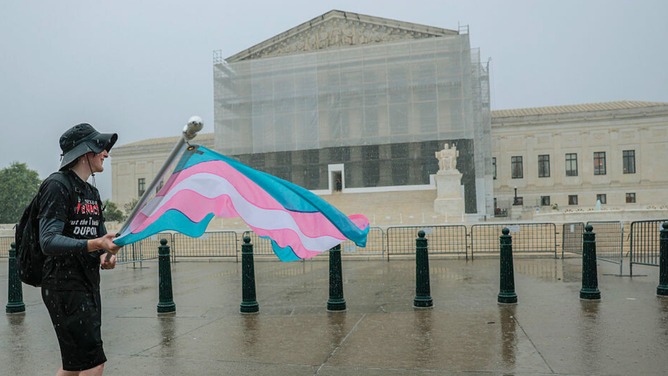
(Photo by Anna Moneymaker/Getty Images)
Idaho appealed to the Supreme Court, arguing that the lower courts missed the point. The state says this case isn't about discrimination, but about acknowledging biological reality in a context where physical differences can determine outcomes, podium spots, scholarships and roster opportunities.
In Idaho's view, if states aren't allowed to draw sex-based lines in sports, women's athletics lose their meaning altogether.
West Virginia v. B.P.J.
The second case comes out of West Virginia and challenges that state's Save Women's Sports Act, which similarly limits girls' and women's teams to biological females.
The lawsuit was brought by Becky Pepper-Jackson, a male middle school student who identifies as transgender. Pepper-Jackson sued after being barred from joining the school's girls' track and cross-country teams. Lower courts ruled against the state, agreeing with B.P.J. that the law likely violated federal civil rights protections.
RELATED: West Virginia Transgender Middle School Athlete Allegedly Told Female Teammates 'Suck My D**k'
In this case, the Fourth Circuit Court of Appeals focused heavily on Title IX. The court held that excluding transgender-identifying males from girls' teams likely amounts to sex discrimination under Title IX. Notably, the court stopped short of fully resolving the broader constitutional question, but it made clear it believed West Virginia's policy conflicted with federal law as currently interpreted.
West Virginia appealed, asking the Supreme Court to answer two critical questions:
- Does Title IX require schools to allow transgender-identifying males to compete in girls' sports?
- Does the Constitution prevent states from defining girls' teams based on biological sex?

People hold Save Girls Sports signs in protest of transgender athlete during the CIF State Track and Field Championships.
(Photo by Kirby Lee/Getty Images)
This case is especially significant because Title IX was originally designed to create and protect women's sports, not to erase sex-based categories. West Virginia argues that forcing schools to include biological males in female competitions undermines the very purpose of the law.
Why These Cases Matter
Together, these two cases put the future of women's sports squarely before the Supreme Court.
The justices will decide whether states are allowed to recognize biological sex in athletics — where physical differences are obvious and consequential — or whether doing so violates federal civil rights law. The answer will shape policies affecting everything from middle school track meets to Division I scholarship programs.
No matter where you fall politically, these cases will define the rules of the game going forward. And by hearing them back-to-back, the Court is signaling that it understands just how high the stakes are.
OutKick will be on the ground in Washington, D.C., when oral arguments begin next week. A decision could come later this year. The outcome may determine whether "female" remains a protected category — or becomes a free-for-all for anyone who claims womanhood.
So, yeah, this is a very big deal.