Three Female Supreme Court Justices Pushed Back Against Laws Protecting Women's Sports, And That's A Shame
During Tuesday's hearings, the divide on the bench was impossible to miss. Three female justices landed squarely on the wrong side of fairness, biology and common sense.
On Tuesday, the Supreme Court heard two cases regarding the legality of state laws that ban trans-identifying males from girls' and women's sports teams. It's a common sense issue — one that, in a sane world, should result in a 9-0 ruling in favor of the states. That is to say, in favor of protecting safety and fairness through sex-based categories in sports. After listening to nearly four hours of arguments, however, I'm more inclined to predict the Court will split, 6-3.
What's really disappointing is that those three votes will come from women.

On Jan. 13, 2026, the Supreme Court heard two cases involving state laws banning biological male athletes from girls' sports.
(Oliver Contreras / AFP via Getty Images)
The cases out of Idaho and West Virginia should not have been complicated. Both states passed laws drawing a clear line that girls' and women's sports are for females only. Because in athletics, biology is important.
And yet, as the arguments unfolded, it became clear that three justices — Sonia Sotomayor, Elena Kagan, and Ketanji Brown Jackson — were hell-bent on avoiding that conclusion.
Liberal Justices Pushed Back On State Laws Protecting Women's Sports
Of course, it's the justices' job to ask tough questions. No one expects them to lob softballs and flower petals at state solicitors. But what stood out Tuesday was a clear imbalance in the questioning. Sotomayor, Kagan and Jackson repeatedly pressed Idaho Solicitor General Alan Hurst, West Virginia Solicitor General Michael Williams, and Justice Department lawyer Hashim Mooppan with hostile hypotheticals, procedural escape hatches and various narrowing maneuvers.
MORE: Key Takeaways From Supreme Court Hearings On Transgender Athletes In Women's Sports
They pushed mootness and "as-applied" exceptions — anything, it seemed, to sidestep the bigger question and avoid a broad ruling that would allow states to protect girls and women with clear, enforceable laws.
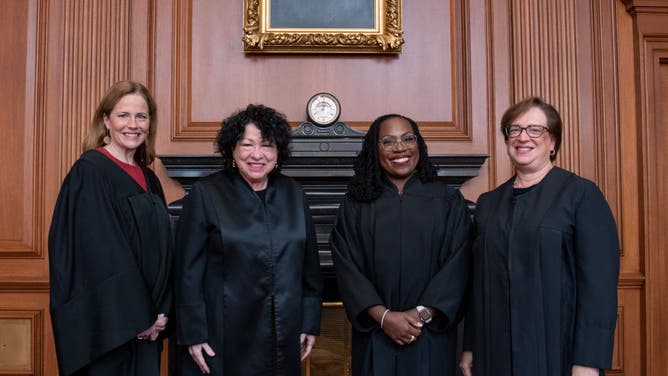
Justices Amy Coney Barrett, Sonia Sotomayor, Ketanji Brown Jackson and Elena Kagan pose at a courtesy visit in the Justices Conference Room.
(Photo by Collection of the Supreme Court of the United States via Getty Images)
They didn't bring that same energy to the plaintiffs' attorneys.
Kathleen Hartnett and ACLU attorney Joshua Block were not subjected to the same level of scrutiny from these three justices. In fact, at times, the questioning from the liberal justices sounded less like inquiry and more like advocacy — helping the plaintiffs refine arguments for why their clients should be treated as exceptions, even while conceding that sex-based categories themselves are legitimate.
That approach stood in stark contrast to Justices Samuel Alito, Neil Gorsuch and Brett Kavanaugh, who consistently pressed for clarity. They returned again and again to basic principles: if schools are allowed to have boys' and girls' teams, what do those words actually mean? Are the plaintiffs really challenging sex-based categories, or are they simply asking to be exempt from them? And what happens to schools, athletes and women's sports if the Court refuses to provide a clear answer?
There was an obvious disconnect, and I'm certainly not the only woman who noticed it.
Questioning From Female Justices Was ‘Painful’ & ‘Disappointing’
Payton McNabb is a former high school volleyball player who suffered long-term injuries when a male player spiked a volleyball into her head during a 2022 match. Now an ambassador for Independent Women, she said the hearings were tough to watch.
"It’s painful to see Justices Sotomayor, Jackson and Kagan — female leaders sitting on the highest Court in the land — suggest that women's privacy, safety and equal opportunity is negotiable," McNabb told OutKick.
"Allowing men into women's sports and spaces abandons equality and fairness. I had hoped these female justices would admit biological realities and how important it is to protect women-only spaces. After years of fighting, I am ready for the Supreme Court to now stand with women and defend her legacy. If the Supreme Court can’t define ‘woman,’ then women have no rights left to defend."
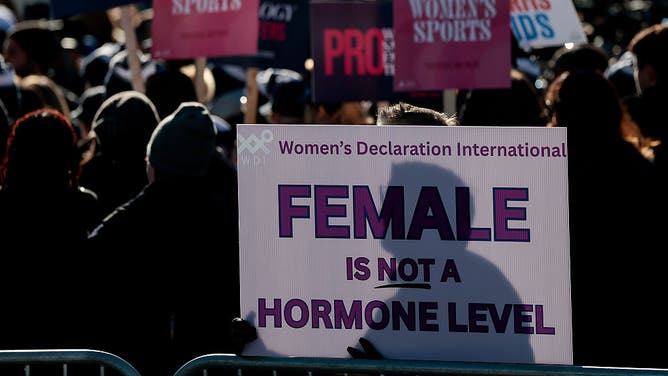
Protesters against transgender athletes competing in women's sports gather outside the Supreme Court.
(Photo by Heather Diehl/Getty Images)
Legal analyst Kerri Urbahn echoed that frustration on Fox News’ The Faulkner Focus on Wednesday.
"I'm generally optimistic that [the ruling] will go the way most of the country sees it. You know, people call this an 80/20 issue. I'm beginning to think it's a 90/10 issue," Urbahn said. "So I do think the court is going to follow where the public is on this.
"However, do I think it's 9-0? I'm not sure about that. The female justices were pretty hostile to the position of the female athletes, which I just found, as a woman, disappointing and surprising."
Disappointing? Yes. Surprising? Probably not.
Justice Jackson solidified her position years ago during her confirmation hearing, when she famously declined to define the word woman, saying, "I’m not a biologist."
And that's exactly what these cases come down to. If we're going to have sex-based categories — and everyone involved now seems to agree that we must — then we have to be willing to define sex.
Sotomayor, Kagan and Jackson are not unintelligent women. They did not reach the highest court in the land by accident. They know what a woman is. But like so many on the Left, they have allowed this all-consuming ideology to override common sense — saying exactly what they’re supposed to say, when they're supposed to say it — even at the expense of girls and women.
They're not alone, of course. Over the past few years, we've watched a number of elite female athletes — Megan Rapinoe, Billie Jean King, Candace Parker, Simone Biles — advocate for men in women's sports. Women who benefited directly from sex-based protections now turning around and pulling up the ladder behind them.
And for what? To protect the feelings of boys, even if it costs millions of girls their opportunities, their safety and their privacy? Because that's what their side demands for them to do?
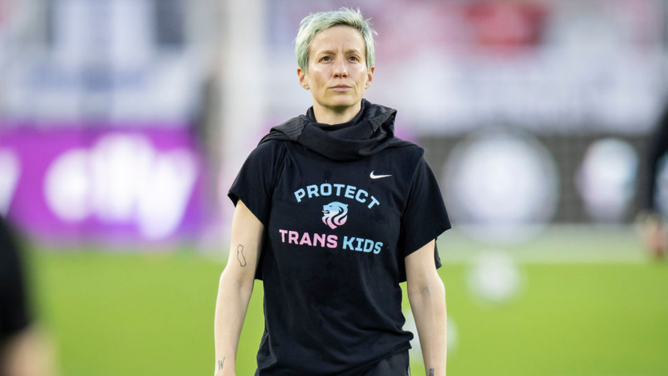
Megan Rapinoe wears a shirt that says "Protect Trans Kids" while she walks back to the locker room before the 2022 NWSL Challenge Cup Semifinal.
(Photo by Ira L. Black - Corbis/Getty Images)
And, to be clear, I'm not here to pretend that tribalism doesn't exist on both sides of the political aisle. But when it comes to something as simple as scientific classifications of "men" and "women," there shouldn't even be a debate.
The vast majority of Americans, across party lines, agree on this. According to an April 2025 poll by NBC News, 75 percent of American adults believe trans-identifying males should not be permitted to participate in female sports. And if everyone were being honest with themselves, I'm guessing that number would be even higher.
But alas, gender ideology has melted enough brains that we're now asking the highest court in the land to decide what is a "boy" and what is a "girl" — and whether women deserve equal opportunity and fairness in sports at all.
It will be a shame if three women on the Court choose to be on the wrong side of this moment.