Key Takeaways From Supreme Court Hearings On Transgender Athletes In Women's Sports
The Supreme Court spent more than three hours Tuesday hearing arguments in the Idaho and West Virginia women's sports cases. Here’s what stood out.
The U.S. Supreme Court heard oral arguments Tuesday morning in two cases that could shape the future of girls’ and women's sports: Little v. Hecox and West Virginia v. B.P.J.
Both cases challenge state laws that limit girls' and women’s teams to biological females. But after hours of arguments, it was clear the fight wasn't playing out the way many people talk about it online.
Instead, attorneys for the plaintiffs repeatedly acknowledged the need for sex-based categories — then argued their own clients should be treated as exceptions.

A man holds up a sign reading "Protect women's sports" as he demonstrates outside the US Supreme Court as justices hear arguments in challenges to state bans on transgender athletes in women's sports.
(Oliver Contreras / AFP via Getty Images)
Here’s a quick refresher on the two cases before we get into what actually happened in the courtroom.
Little v. Hecox: Idaho is defending its Fairness in Women’s Sports Act, which limits girls' and women's teams to biological females. The law was challenged by Lindsay Hecox, a transgender-identifying male who wanted to compete on Boise State University's women's track team.
- Arguing for Idaho: Alan Hurst, Idaho Solicitor General
- Arguing for the Trump administration: Hashim Mooppan, Justice Department
- Arguing for the plaintiff: Kathleen Hartnett
West Virginia v. B.P.J.: West Virginia is defending its Save Women's Sports Act, challenged under Title IX. The lawsuit was brought by Becky Pepper-Jackson, a male middle school student who identifies as transgender. Pepper-Jackson sued after being barred from joining the school's girls' track and cross-country teams.
- Arguing for West Virginia: Michael Williams, West Virginia Solicitor General
- Arguing for the Trump administration: Hashim Mooppan, Justice Department
- Arguing for the plaintiffs: Joshua Block, ACLU
We listened to all three and a half hours of hearings so you don't have to. Here are the key takeaways.
#1: Both plaintiff attorneys conceded sex-based sports categories are legitimate.
In Little v. Hecox, Justice Samuel Alito quickly boxed Hartnett into admitting two things:
- boys' and girls' sports must be separated
- self-identification alone isn't sufficient
Hartnett argued that eligibility should depend on whether a transgender-identifying male has mitigated athletic advantage through testosterone suppression. Simply saying "I'm a woman," she agreed, was not enough.
That's when Alito cut straight to the point: "So what you seem to be saying is, yes, it is permissible for the school to discriminate on the basis of transgender status?"
Hartnett attempted to argue that such discrimination would be OK only for athletes who still have a competitive advantage. Some exclusions are valid, she explained — just not for her client.
RELATED: Protesters Duel Outside Supreme Court As Clash Over Trans Athletes, Women’s Sports Reaches D.C.
That exchange undercut the idea that these laws are inherently discriminatory. The disagreement was no longer whether sex-based exclusions can exist, but how broadly they can be applied.
#2: The real fight was over who gets to be an exception to the rule.
Once self-identification was off the table, both plaintiff teams shifted to the same basic argument:
- In Idaho, Hartnett argued that trans-identifying males who suppress testosterone should be eligible to compete in women's events.
- In West Virginia, ACLU attorney Joshua Block argued that his client should be eligible because the athlete has not yet gone through puberty and therefore lacks the advantages the law is designed to address.
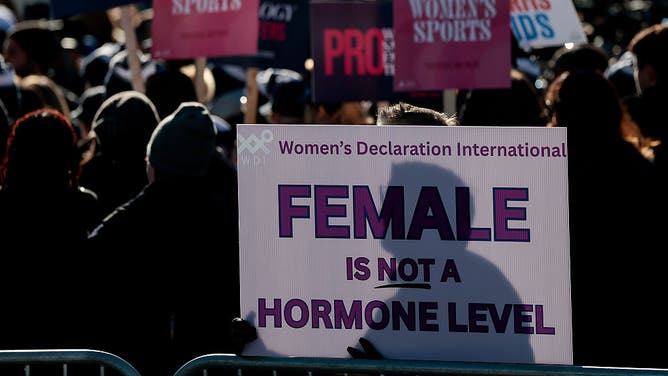
Protesters against transgender athletes competing in women's sports gather outside the Supreme Court.
(Photo by Heather Diehl/Getty Images)
At one point, Justice Neil Gorsuch asked Hartnett whether she wanted to challenge "the distinction between boys and girls on the basis of sex, or whether or not you are perfectly comfortable with the distinction between boys and girls — you just want an exception to the biological definition of girls."
Hartnett responded, "We’re not asking for a particular definition or even really an exception. What we’re saying is that the way it applies in practice is to exclude birth-sex males categorically from women’s teams, and that there’s a subset of those birth-sex males where it doesn’t make sense to do so."
In other words, the rule is fine, but it doesn't apply to my client.
#3: Sotomayor, Kagan and Jackson aggressively pushed back on Idaho and West Virginia.
The three liberal justices spent much of the morning pressing to avoid a broad ruling — either by arguing the case was moot or by narrowing it to athlete-specific, "as-applied challenges."
Justice Sonia Sotomayor repeatedly suggested the case should be moot based on the fact that Hecox is graduating soon and the law no longer applies to this particular situation. Kagan and Jackson both tried to narrow the question, pushing the idea that courts should make individualized exceptions where a law's justification doesn't apply to a particular athlete.
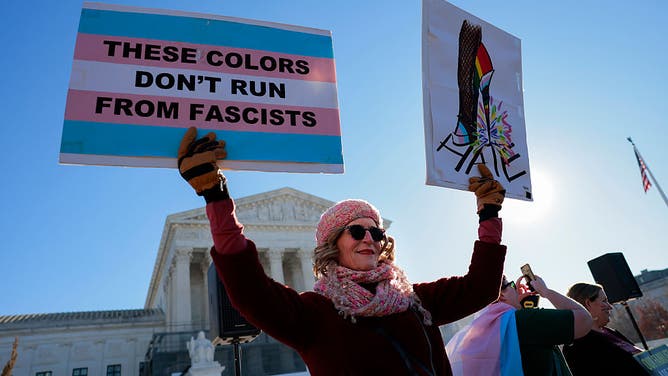
A protester supporting transgender athletes competing in women's sports gathers outside the Supreme Court.
(Photo by Heather Diehl/Getty Images)
#4: The Court seemed skeptical of athlete-by-athlete line-drawing.
The justices repeatedly questioned whether courts or schools are equipped to decide which athletes meet testosterone requirements on a case-by-case basis.
"Making sure that a transgender athlete does lack an -- or does not have an unfair advantage would require ongoing testosterone monitoring because testosterone can fluctuate," Hurst said. "That is invasive, that is intrusive, and that's expensive."
In other words, that’s not even feasible in the real world.
Justice Ketanji Brown Jackson didn't seem to think this would be an issue, though.
"Well, that's the burden of the person," Jackson said. "The person who wants to play has to demonstrate to you, to whatever degree of scientific certainty, that they don't have a competitive advantage."
Mooppan, though, argued this practice would open a whole new can of worms.
"I worry that if you allow as-applied claims to a small enough group, you're essentially collapsing the difference because you're essentially requiring a perfect fit, because whenever you have a reasonable but not perfect fit, the subset who falls within that will come in and bring an as-applied claim."
#5: We have to determine the definition of "sex."
And this is what it all ultimately comes down to. In the oral arguments for Little v Hecox, Justice Alito delivered the hammer.
It went like this:
Alito: "Do you agree that a school may have separate teams for a category of students classified as boys and a category of students classified as girls?"
Hartnett: "Yes, Your Honor."
Alito: "If it does that, then is it not necessary for there to be, for equal protection purposes… an understanding of what it means to be a boy or a girl or a man or a woman?"
Hartnett: "Yes, Your Honor."
Alito: "And what is that definition? For equal protection purposes, what does it mean to be a boy or a girl or a man or a woman?"
Hartnett: "Sorry, I misunterstood your question."

Activists rally outside the U.S. Supreme Court as the court hears arguments on trans athlete bans in women's sports.
(Bill Clark/CQ-Roll Call, Inc via Getty Images)
Hartnett struggled to provide a definition for the word "woman." That's a problem that has surfaced repeatedly in this debate. Doing so would undermine her entire case and — if we're being honest — the entire transgender movement.
"Title IX prohibits discrimination on basis of sex," Alito said. "It's a statutory term. It must mean something. You're arguing that here there's discrimination on the basis of sex. And how can we decide that question without knowing what sex means?"
The Bottom Line
Across both hearings, the plaintiffs' attorneys made quiet, yet consequential concessions:
- Sex-based sports categories are legitimate.
- Self-identification alone is not enough.
- The dispute is about whether their client should be exempt.
That framing leaves the Court with a choice: either endorse athlete-by-athlete exceptions that courts and schools must referee indefinitely — or affirm that states may draw clear lines based on sex.
And based on Tuesday's hearings, I'm leaning toward the latter.