EXCLUSIVE: NIH Director Jay Bhattacharya Tells OutKick About 'Shocking' COVID Vaccine Info, Failure Of Masks
NIH director criticizes mask mandates, lockdowns and gain-of-function research in exclusive interview
Dr. Jay Bhattacharya is the director of the National Institutes of Health, the organization formerly run by Dr. Francis Collins and Dr. Anthony Fauci, and he spoke to OutKick exclusively on Tuesday about his new role, pandemic failures and how things went wrong under the previous administration.
His importance extends significantly beyond "just" NIH. And his appointment there under the second Donald Trump administration marked a dramatic about-face for an organization that was instrumental in creating many of the issues and problems we faced as a society during the pandemic.
Dr. Bhattacharya was one of the authors of the Great Barrington Declaration in 2020. That paper contained a blueprint for focused protection during the COVID-19 pandemic. Instead of locking down all society, Bhattacharya and his co-authors wrote, we should look to protect the most vulnerable. That's been proven prophetic, as the harms from lockdowns far exceeded any benefits.
He also conducted a study in Silicon Valley early on in the lockdowns that identified COVID was far more prevalent in the community than people realized. That meant the virus was also far less deadly than organizations like the World Health Organization had suggested. He was skeptical about the efficacy of cloth masks, advocated for opening schools, and participated in a roundtable hosted by Florida Gov. Ron DeSantis in 2021 that illustrated how ineffectual the Anthony Fauci doctrine had been. Around that same time, Bhattacharya also spoke out against vaccine mandates and other abuses, which decrea d sed public confidence and trust in vaccines.
RELATED: FDA Admits COVID Vaccines Likely Led To Deaths Of Children
In short, he was a voice of sanity in a sea of absurdity, proven right about nearly every pandemic-related policy. For his efforts, he was demonized, labeled, censored, and targeted by Collins and Fauci in emails. OutKick had the exclusive opportunity to ask him about many of these issues, and what he's bringing to NIH that his predecessors didn't.
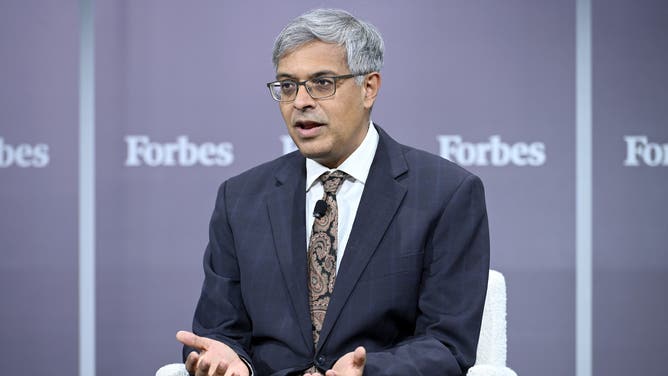
Jay Bhattacharya, M.D., Ph.D., Professor of Health Policy, Stanford University, speaks at the Forbes Healthcare Summit Day 2 at Jazz Lincoln Center, New York, NY, December 5, 2023. (Photo by Anthony Behar/Sipa USA)
Dr. Jay Bhattacharya On What Went Wrong, COVID Vaccines, Masks And The Lab Leak
One of the most important accomplishments Dr. Bhattacharya achieved during the pandemic was to show the public a different way to handle COVID. To demonstrate that Fauci and his allies did not have all the answers, or automatically know the best path forward because of their position. When asked why there was so little willingness from the outside to engage with his ideas and views, Bhattacharya admitted it was "really frustrating."
"I mean it’s really frustrating because I’ve always thought of science as this open place where people can disagree with each other, he said.
He hoped that his landmark study in Santa Clara from early in the pandemic, showing that many more people had COVID than we'd already found, would "change how people thought about the lockdowns and all the measures." Those results showed that the virus was much more widespread than previously realized, and that "the lockdowns…hadn't stopped the disease from spreading."
Yet, despite the damage being caused to children from school closures, lockdowns and other mandates, "the scientific community was very resistant to the lessons of a scientific study, even though the study was repeated over and over again by a number of other groups and found very similar things."
Any effort to approach Fauci or other important authority figures with data demonstrating the failure of lockdowns was almost immediately shot down. When asked why Fauci, Collins and other top "experts" were so resistant to taking in new information, Bhattacharya believes that Fauci or others like him couldn't bring themselves to "say 'I don't know' when there's so much at stake."
That's the issue though; by giving inaccurate advice on masks and other policies instead of admitting uncertainty, Fauci caused more harm than good. And Bhattacharya believes that there were more "nefarious" and "worse" motivations too. Particularly around the COVID vaccines and the "financial incentives" involved.
"There’s monetary interests going on, right? Especially with the pressure to take the COVID vaccine, deny basic reality about its effectiveness in stopping infections or preventing infections and transmission. And then there’s probably the worst of this, even worse than the financial incentives, it’s just pure old groupthink on topics.
"A few scientific leaders got to say what was true and false, even when the evidence didn’t agree."
NIH Employees Upset About Ending DEI Programs
Now that Dr. Bhattacharya is running NIH, he's been able to make some changes to organizational functions and oversight the agency does, particularly around research it funds. For example, despite the Wuhan Institute of Virology being heavily implicated in the release of COVID, NIH, he discovered, literally cannot audit if US government money went to funding gain-of-function research.
"It turns out I can’t audit the Wuhan lab or the money we sent to it. The system was set up so that I could not look into foreign support that’s put out of the sub award," Bhattacharya explained.
To fix this, he implemented substantive changes to ensure that this could never be repeated. That, as with domestic research labs, NIH could directly trace and audit where taxpayer money goes when it comes to international lab research. For making that common sense change, he was attacked by the left, including science-based media. He was accused of being not "interested in foreign collaboration" and "cutting off foreign funding," when all he asked for were obvious guardrails against a potential lab leak of a dangerous pathogen funded by the US government.
It's a perfect example of how easy it is for disgruntled employees, due to political opposition, passing information to allied media sources to promote a specific agenda. Speaking of agendas, OutKick asked Bhattacharya about if he'd learned anything further about the motivations behind Fauci and Collins changing course on masks and other policies after just a few weeks and without any new evidence. With investigations ongoing, however, there's little he can say other than the groupthink and uncertainty.
In direct contrast to that previous administration, Bhattacharya said he's working to roll back the divisive, pointless DEI programs that helped nobody. But current employees at NIH were furious at those changes, going as far as staging a walk out during a town hall Bhattacharya hosted. Several hundred even signed a document called the "Bethesda Declaration," an obvious response to his Great Barrington Declaration.
Bhattacharya said much of the anger from those employees stemmed from the fact that "we're not funding DEI anymore." And that new leadership was willing to acknowledge that the virus may have spread due to a lab leak partially supported by NIH itself. He believes the only way to reestablish trust with the public is to admit those realities and learn from them. While many inside NIH were furious, instead of firing them for rebellion, Bhattacharya invited them into his office to talk, a direct contradiction to how Fauci and Collins handled disagreement.

Director of the National Institutes of Health Jayanta Bhattacharya testifies before the Senate Appropriations Subcommittee on Departments of Labor, Health and Human Services, and Education, and Related Agencies in the Dirksen Senate Office Building on June 10, 2025 in Washington, DC. (Photo by Win McNamee/Getty Images)
New NIH Director Charts New Path Forward
Dr. Bhattacharya also recently published an article explaining the failures of our previous pandemic planning documents. Those documents were developed by government organizations prior to the pandemic in order to guide our work to combat viruses. However, the recommendations therein were catastrophically idiotic and comically dangerous. Suggesting that we search in bat caves thousands of miles from human settlements, then bring whatever was found back to labs. Those labs would then potentially enhance the viruses, if they weren't capable of infecting humans, in order to develop vaccines or treatments to combat them.
Insanity doesn't even begin to cover it. And Bhattacharya said it's "worse than most people think."
"It is an absolutely nutty kind of idea," he said. Made even worse by the fact that the labs conducting that work are "not always the best at biosafety and biosecurity." That could lead to lab leaks, such as the potential Wuhan lab leak. "It's nuts" that we used to do things this way, Bhattacharya explained.
His intention is to create a better path forward, one that discourages such risky research. As well as demands "reproducibility" in science, particularly around masks.
"If you actually require reproducible results, actual rigorous results from any randomized trial, then you wouldn’t have all the masking of toddlers and other nonsense that went on," he said. "Because there wasn’t a single randomized trial that showed that the masks work in any appreciable way."
Bhattacharya ‘Shocked’ About FDA Conduct On COVID Vaccines
When news broke that an internal FDA memo sent by Dr. Vinay Prasad had revealed a potential direct link between COVID vaccines and the deaths of at least 10 children, it was a stunning rebuke of our vaccination policy. OutKick asked Dr. Bhattacharya what his reaction was after seeing that memo, and he said he was "shocked" that the former authorities at the FDA had "worked to hide it" from parents.
"I was saddened for the parents who vaccinated their children in good faith," he said. "Shocked that the prior FDA had essentially worked to hide it or at least had not worked to try to find it. And the damage done is tremendous, not just to those 10 families, but to the confidence that Americans have in our vaccine surveillance systems."
He believes that "many childhood vaccines are tremendously important for the health of children." And that our insistence on vaccinating toddlers has done immeasurable damage to trust in vaccines and recommendations. "The old versions" of the FDA and CDC, he said, "ignored the evidence, ignored basic standards of benefit/harm calculations and recommended that children as young as six months get the vaccine"
As a result, many have now questioned other vaccines. An understandable and regrettable outcome from rushed, biased recommendations. "I can understand," he said, "why parents would now look at all of the vaccine recommendations and say, well, why should we trust anything else when you’ve made this obviously bad recommendation?"
It's one thing to call out the failures, but it's equally important that those left behind learn lessons from COVID and our failures. Dr. Bhattacharya believes those who refuse to learn those lessons have quit. "The ones that are left... with the NIH, there’s so many people who kept their head down during the pandemic in order not to get canceled, who have good ideas," he explained.
Imagine, fear of cancellation kept people from telling the truth or sharing their ideas. Ideas that might have changed bad policy, bad recommendations, and prevented unnecessary harm. Still, he doesn't expect apologies because "the ego is too high for so many of those folks."
Refreshingly, Bhattacharya is taking the exact opposite approach as head of NIH. "I will never do a devastating takedown of a scientist that disagrees with me," he said. "That is not conducive to good science happening. I fully expect there to be scientists who disagree with me. And if they show me data where I’m wrong, I will change my mind."
If Fauci and the former CDC and FDA authorities had thought similarly, the world would quite literally be a different and better place today. Instead, they focused on "DEI nonsense that doesn't help anybody."
One of his main objectives in his role is to restore public confidence in science, to "reform the systems so that the groupthink doesn't ever happen again." To focus on "the basis of scientific truth," and "task scientists with reversing the chronic disease crisis."
If scientists "can contribute to making America healthy again, that will help restore trust in science," he said. And, as with so many other things, he's right about that too.
Watch the full interview here: