The NBA's Return To China Undermines Its Entire Social Justice Movement | Bobby Burack
While the league’s players and executives deserve scrutiny, Brooklyn Nets owner Joe Tsai’s role is particularly relevant.
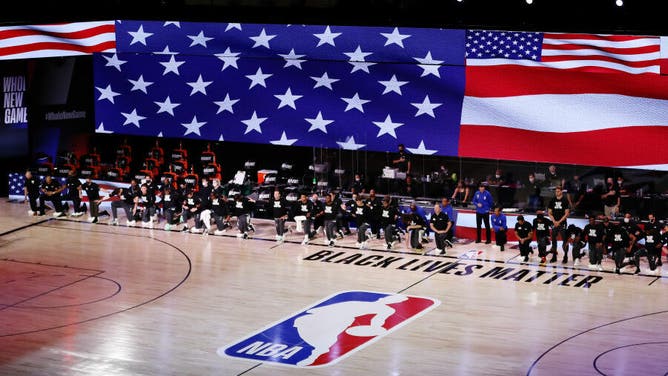
The NBA is the most politically active professional sports league in the United States. From painting "Black Lives Matter" on courts to organizing player walkouts after police shootings, the league has presented itself as a moral authority on issues of justice and discrimination. Yet this week, the same league will return to China to play two preseason games in Macau — its first in the country since 2019.
The NBA’s absence from China began after then–Houston Rockets general manager Daryl Morey posted on social media support for pro-democracy protests in Hong Kong. The Chinese government retaliated by suspending NBA broadcasts, canceling events, and cutting sponsorships.
Morey’s comment — a brief show of support for free expression — triggered not only Beijing’s outrage but also criticism from within the league. LeBron James notably called Morey's comments "selfish" and "misinformed."
Now, as the NBA seeks to rebuild its relationship with the Chinese market, the same human rights concerns that caused the initial rift remain unresolved. In 2021, then–U.S. Secretary of State Mike Pompeo declared that China was committing an ongoing genocide against Uyghur Muslims in Xinjiang province.
Further, Human Rights Watch, Amnesty International, and the United Nations Office of the High Commissioner for Human Rights (OHCHR) have documented widespread abuses in Xinjiang, including mass detentions, forced labor, sexual abuse, and the forced sterilization of Uyghur women. China has repeatedly denied the allegations, calling the facilities "reeducation centers."
Morgan Ortagus, Pompeo’s former spokesperson, detailed the extent of these atrocities in an interview with OutKick.
"We are seeing the most egregious human rights abuses in a generation," Ortagus said. "We have evidence — sworn testimony and credible reporting — of forced abortions, forced sterilizations, and mass internment. Even if you’re pro-choice, you should be against the government forcing women to undergo abortions or sterilizations. It’s horrific," Ortagus explained.
She also criticized Western corporations that continue to do business with China:
"It’s incomprehensible that China is still embraced by the international community — even allowed to host the Olympics — while it works to erase an entire ethnic group in Xinjiang."

LOS ANGELES, CALIFORNIA - OCTOBER 22: A pro-Hong Kong activist holds a photo depicting LeBron James as Chinese communist revolutionary Chairman Mao Zedong before the Los Angeles Lakers season opening game against the LA Clippers, outside Staples Center, on October 22, 2019 in Los Angeles, California. Activists also printed 16,000 pro-Hong Kong t-shirts to hand out to those attending the game and encouraged them to wear the free shirts as a form of peaceful protest against China amidst Chinese censorship of NBA games. (Photo by Mario Tama/Getty Images)
NBA Players’ Financial Ties to Forced Labor
In 2022, ESPN reported that at least 17 active NBA players had endorsement deals with Chinese shoe companies Li-Ning and Anta. Specifically, both brands rely on supply chains that source cotton from Xinjiang, where the forced labor of Uyghur Muslims remains widespread.
Among the highest-profile athletes profiting from these partnerships are Golden State Warriors stars Klay Thompson and James Wiseman, both signed to lucrative Anta deals reportedly worth more than $80 million combined. Miami Heat guard Jimmy Butler also signed with Li-Ning in 2020, joining other NBA players tied to Chinese brands.
OutKick founder Clay Travis wrote at the time, "NBA players who condemn American institutions for supposed systemic injustice are cashing checks from companies connected to modern-day slave labor."
Still, neither the NBA nor the players’ union has conducted or released an independent review of the league’s ties to Xinjiang-linked manufacturers. Warriors head coach Steve Kerr, who frequently comments on U.S. political and social issues, has declined to criticize China publicly. His silence has come to symbolize the NBA’s broader unwillingness to confront its contradictions.
Via Getty.
Brooklyn Nets Owner’s Deep Ties to China
While the league’s players and executives deserve scrutiny, Brooklyn Nets owner Joe Tsai’s role is particularly relevant. Tsai is the co-founder and executive vice chairman of Alibaba Group, a Chinese technology conglomerate with close ties to the Chinese Communist Party.
This week, Alibaba announced a multi-year partnership with the NBA to provide artificial intelligence and cloud computing services for the league in China — an agreement that deepens both parties’ financial relationship.
Tsai has long pushed for the NBA’s return to China. "I think the NBA is in a very good place with respect to its relationship with China," Tsai said last year. "China is actually the NBA’s biggest fan base. What happened before — it’s water under the bridge."
Of course, Tsai’s sentiment ignores the reality for Uyghur detainees, political prisoners, and persecuted minorities who remain targets of Beijing’s oppression.
The Broader Silence
Despite extensive reporting documenting forced labor and surveillance in Xinjiang, the U.S. sports media has largely avoided criticism of the NBA’s financial entanglements with China. Economic interests appear to outweigh ethical considerations, of course.
China represents a multibillion-dollar market for the league, accounting for hundreds of millions of viewers and massive apparel sales. A 2023 report by Statista estimated that nearly 500 million Chinese fans watch NBA content annually — a figure that underscores the stakes for the league’s business partners.
Publicly confronting China’s abuses could jeopardize that market. That same caution does not exist when addressing political issues in America, where players and coaches have faced little to no financial consequence for speaking out.
Ultimately, the NBA's silence on human rights violations in China stands in sharp contrast to its vocal activism at home, exposing a moral double standard that undermines the credibility of every social cause the league claims to champion.