CDC Data Reveals Extremely Low Efficacy For This Year’s Flu Vaccine As Experts Fail Again
New reports show the shot was nearly useless against the dominant strain.
Thanks to a series of improvements within federal agencies, things are rapidly improving within the U.S. government's leading public health agencies. Dr. Jay Bhattacharya now runs both the National Institutes of Allergy and Infectious Diseases and the CDC, as interim director. Marty Makary is a huge improvement at the FDA, someone who will put actual evidence-based medicine first.
But the public health industrial complex remains the public health industrial complex, and if there's one thing for certain about that industry, there will always be recommendations for products that don't live up to expectations.
For years, we heard from leading "experts" like Dr. Ashish Jha, who was the White House COVID-19 Response Coordinator, that it was vitally important to get both the flu vaccine and the COVID shot. Preferably at once, as he so eloquently put it.
"The good news is you can get both your flu shot and your COVID shot at the same time. It’s actually a good idea," he said. "I really believe this is why God gave us two arms—one for the flu shot and the other one for the COVID shot."
Anthony Fauci has made similar remarks. For example, when he said in a YouTube interview, "I think that that’s an important point to make too—that if I get the flu shot, I’m not just protecting myself, but I’m also contributing to helping protect my family... and the general community."
RELATED: Why Was Anyone Ever Pushing COVID Vaccines For Kids?
Well, the latest CDC estimate of the effectiveness of the flu shot has just been released, and boy oh boy, it's ugly yet again.
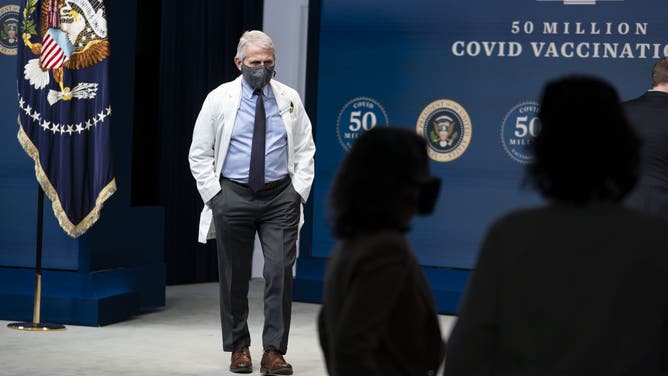
Dr. Anthony Fauci participates in an event commemorating 50 million COVID-19 vaccine shots during a ceremony at the White House. (Photo by Doug Mills/Pool/Sipa USA)
Flu Vaccine Had Minimal Efficacy In 2025-26 Winter Season, CDC Finds
One study from the Cleveland Clinic covering uptake of the flu vaccine among their employees for the 2024-2025 respiratory virus season found that it actually had negative efficacy. Essentially, those of their employees who got the flu shot were actually significantly more likely to test positive for the flu, and have symptoms, than those who didn't.
RELATED: New Study Shows Those Who Received Flu Shot Were More Likely To Get Flu
The CDC's examination for 2025-2026 wasn't that bad, which is to be expected, but particularly for adults, it's pretty darn bad.
According to the "Interim Estimates of 2025–26 Seasonal Influenza Vaccine Effectiveness — United States, September 2025–February 2026," published as a CDC Morbidity and Mortality Weekly Report, the flu shot this winter season had just 22-34% effectiveness against outpatient visits for influenza among adults over 18-years-old. For actual hospitalization, it was just 30% effective.
This year's vaccine had more efficacy against Influenza B, but the CDC found that 88% of flu infections this past year were Influenza A. And the funniest part is, they discovered that after they'd already selected the vaccine for winter.
"During the current 2025–26 influenza season, 88% of subtyped influenza A–positive specimens were influenza A(H3N2); among those, 93% of genetically characterized samples were clade 2a.3a.1 subclade K (J.2.4.1), an antigenically drifted influenza virus that was first identified by CDC in June 2025 after selection of the 2026-26 vaccine viruses and that differs from the 2025–26 A(H3N2) influenza vaccine virus," the report explains.
So, essentially, they figured out that the most prominent strain of influenza this winter would be Influenza A, and one specific subclade, but they chose the wrong vaccine for that strain, and it was too late to change it.
Breaking down the data a bit more, it shows just how ineffective the flu vaccine was against the most severe impacts for older age groups. To study this, they used a "case" group and "control" group. Effectively, those who tested positive for the flu were in the case group, and those with flu-like symptoms who did not test positive were the "control" group.
Among adults, 37% of those in the "case" cohort were vaccinated, compared to 40% in the "control" cohort. A difference so small that it's almost meaningless. The senior citizen demographic was even worse. 44% of those hospitalized above the age of 65 were vaccinated, compared to 46% of controls.
This design is meant to ensure that vaccine efficacy is tested between groups that felt sick enough to seek medical care, eliminating the potential for bias by avoiding testing who's simply more likely to go to the doctor. The assumption being that those who were vaccinated and tested negative did not get the flu because of their vaccine. If the flu shot were highly effective, using this criteria, there would be a large gap. As a hypothetical, the case group would have, say, 10-20% vaccination rates compared to the 46% control rate.
That's not what happened, because the flu shot simply wasn't very effective. And this is, again, against hospitalization, one of the most important metrics to measure vaccine efficacy against.
To be fair to the flu vaccine in 2025-2026, the efficacy rate was not zero. There was some level of effectiveness. The CDC found it was more protective for younger age groups, though in a very limited sample. And it generally has a favorable risk-benefit profile. But again, we're seeing that the messaging from the Usual Expert Suspects was inaccurate, overhyped, and disappointing. Just like the COVID vaccine. The Fauci's and Jha's of the world never deserved our trust, and even when they're out of office, we continue to see why.