Finally, We're Moving Towards A Sane Approach To COVID Vaccines
Top federal health officials are finally enacting sane policy
The era of absurd COVID vaccine policies and recommendations in the United States is over. Finally. Though it's years too late for many who were coerced, forced, or pressured into getting vaccines based on inaccurate information, purposefully misleading claims from pharmaceutical companies, and inexcusable decision-making from federal agencies.
And it's all thanks to a new presidential administration appointing new leadership at the top of the National Institutes of Health, National Institute of Allergy and Infectious Disease, and the Food and Drug Administration.
A new research letter from top federal health administrators explains that blindly accepting the word of Pfizer and Moderna is no longer acceptable. And that the one-size fits all mindset of disgraced "experts" like Anthony Fauci and Francis Collins is not going to continue indefinitely.
About time. Especially considering the elevated risk of significant side effects.
READ: COVID Vaccines For Children Carry Significant Risks, Few Benefits
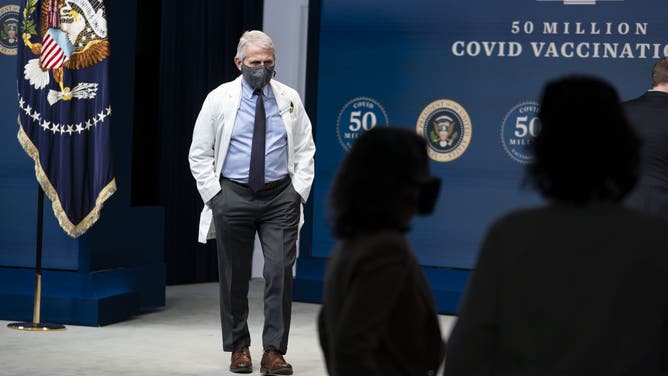
Dr. Anthony Fauci. (Photo by Doug Mills/Pool/Sipa USA)
Sane COVID Vaccination Policy Is Finally Here
A new letter from Vinay Prasad, Chief Medical and Scientific Officer at the Center for Biologics Evaluation and Research at the FDA, and Marty Makary, the new commissioner of the FDA, has detailed how COVID vaccines and booster doses won't just receive a pre-determined stamp of approval moving forward.
"Over the past 5 years, the United States has moved toward an annual Covid-19 booster program," they write. "Each fall, Covid-19 booster shots are developed, alongside seasonal influenza vaccines, and are recommended for every American. As compared with vaccination policies in all European nations, the U.S. policy has been the most aggressive."
They then compare these recommendations and policies to other high-income countries, confirming that the US is a global outlier thanks to previous leadership claiming that the American public can't be trusted to discern the difference between recommendations and policies separated by age group.
"While all other high-income nations confine vaccine recommendations to older adults (typically those older than 65 years of age), or those at high risk for severe Covid-19, the United States has adopted a one-size-fits-all regulatory framework and has granted broad marketing authorization to all Americans over the age of 6 months," the new letter continues. "The U.S. policy has sometimes been justified by arguing that the American people are not sophisticated enough to understand age- and risk-based recommendations. We reject this view."
The fact that previous administrators legitimately believed that the public were too stupid and simplistic to understand that young children were at significantly lower risk than the elderly is just one of many discrediting examples of their hubris, ego, and desire to control behavior. Not to mention that demands and policies were based on unsupported assertions that an endless series of yearly booster doses would undoubtedly benefit everyone. Regardless of age, regardless of previous infection, or underlying health. Starting from as young as six months old.
As Prasad and Makary write, "..The benefit of repeat dosing — particularly among low-risk persons who may have previously received multiple doses of Covid-19 vaccines, had multiple Covid-19 infections, or both — is uncertain. The American people, along with many healthcare providers, remain unconvinced."
Overwhelmingly, the public, including those who work in healthcare, have rejected annual boosters.
"Over the past two seasons, uptake of the annual Covid-19 booster has been poor, according to the Centers for Disease Control and Prevention (CDC). Less than 25% of Americans received boosters each year, ranging from less than 10% of children younger than 12 years of age in the 2024–2025 season to 50% of adults over 75 years old.
"Even health care workers remain hesitant, with less than one third participating in the 2023–2024 fall booster program. Here may even be a ripple effect: public trust in vaccination in general has declined, resulting in a reluctance to vaccinate that is affecting even vital immunization programs…"
Less than a third of healthcare workers are getting COVID booster doses. Less than a third. And these are often professionals who work directly with those who might have an active COVID infection. That's how ineffective previous doses have been at preventing transmission, or demonstrating clear benefits to those who work in medicine.
What does this mean moving forward? That the FDA and other top health leaders are going to demand pharmaceutical companies actually provide meaningful evidence instead of having their claims immediately rubber-stamped.
"For all healthy persons — those with no risk factors for severe Covid-19 — between the ages of 6 months and 64 years, the FDA anticipates the need for randomized, controlled trial data evaluating clinical outcomes before Biologics License Applications can be granted. Insofar as possible, when approving a Covid-19 vaccine for high-risk groups, the FDA will encourage manufacturers to conduct randomized, controlled trials in the population of healthy adults as part of their postmarketing commitment."
The fact that this wasn't already federal policy is a historic embarrassment for previous leadership. Out of fear, panic, control, you name it, Fauci, the CDC and FDA disgraced themselves by abandoning evidence-based policies for COVID vaccination and booster doses. Instead of demanding Pfizer and Moderna demonstrate through gold-standard research that their boosters had sustained benefits, even for those with prior immunity, they signed off on annual shots. Telling the public that it was the single most important thing they could do to protect themselves and those around them.
Even though those doses were targeted at strains that were no longer circulating.
That too, is coming to an end.
"Sample-size calculations should aim to demonstrate that vaccines reduce the incidence of the primary end point with a lower confidence interval bound that is ideally above 30%. People who have had Covid-19 in the past year should not be excluded — since evidence is needed for the average American. Follow-up should extend for a minimum of 6 months to ensure that early booster gains persist."
As they explain, based on Pfizer and Moderna getting away with low-quality research, we have no idea what benefits there might be to annual boosters.
"We simply don’t know whether a healthy 52-year-old woman with a normal BMI who has had Covid-19 three times and has received six previous doses of a Covid-19 vaccine will benefit from the seventh dose," they say.
Finally, the days of demanding toddlers get COVID vaccines based on nothing are over. The new leadership will "demand robust, gold-standard data on persons at low risk."
This raises the all-important question: why wasn't this the policy from the start? Why didn't Fauci and the CDC, or the FDA, demand robust data from pharmaceutical companies on COVID boosters in 2021 and 2022? Unfortunately, there's an obvious answer. And it shows, as Makary and Prasad explain, why trust in public health is the lowest it's ever been.