What Is The Target Market For ESPN's New $29.99 Per Month Streaming Service? | Clay Travis
ESPN's launch of a streaming service, to me, feels like a panicked move.
On Thursday, ESPN officially launched ESPN+, a sports streaming service that costs $29.99 a month. The company said the new offering was targeting two distinct consumer groups: a. cord nevers, aka those people who have never had a cable or satellite subscription, and b. cord cutters, aka those who have cut the cord and no longer have cable or satellite subscriptions. The move is necessary because, according to the New York Times from Thursday: "ESPN is in around 61 million homes today between cable, satellite and services like YouTube TV. ESPN receives around $15 per subscriber monthly from distributors for all of its networks."
Just more than a decade ago, ESPN was in 100 million homes, so it has lost 40 percent of its subscribers in a relatively short period of time.
That's because the business of cable sports on TV, to a large degree, has completely and totally collapsed.
This is something I've been writing and talking about on OutKick for over a decade. In fact, when I started writing about cord-cutting back in 2013, people thought I was crazy. But it turns out, I pretty much nailed it. Cable has collapsed and sports have become way more expensive and way less convenient in a streaming era.
(Getty Images)
And the big question that still remains for everyone involved in media is this: how low is the floor of the cable and satellite bundle? Right now we are at 60 million subscribers. Is the floor 50 million? Forty million? Lower? I'm a cable and satellite subscriber and probably will be until I die -- hell, I still get print newspapers delivered to my house. But if you told me today, would you rather have a sports TV show or 5 million YouTube subscribers, I'd rather have 5 million YouTube subscribers. And I don't even think that's a tough call.
Which is why ESPN's launch of a streaming service, to me, feels like a panicked move.
Especially at a price of $29.99 a month, or $360 a year.
If ESPN really wanted to burn the boats on the cable TV business, they needed to offer the channel for like $9.95 a month. Yes, they'd gut their existing business, but they would be building a long-range future. Here it feels like they're trying to have their cake and eat it too. They want the cable and satellite revenue, but also want the long-term direct streaming relationship with the consumer. But how does that work when you're competing with companies like Netflix, Apple and Amazon that are all in on streaming and don't have to worry about disrupting their existing business?
This might have worked in 2014, but it's a decade too late now.
It's like rearranging the deck chairs on the Titanic.
The long-range business flywheel points to everything, eventually, ending up on streaming.
ESPN president Jimmy Pitaro said one reason ESPN felt it had to move now on launching its service was, "We thought it (launching the streaming service) was the right thing to do for the sports fan because the trends (loss of subscribers) were not slowing down. If anything, they were accelerating."
Uh oh.
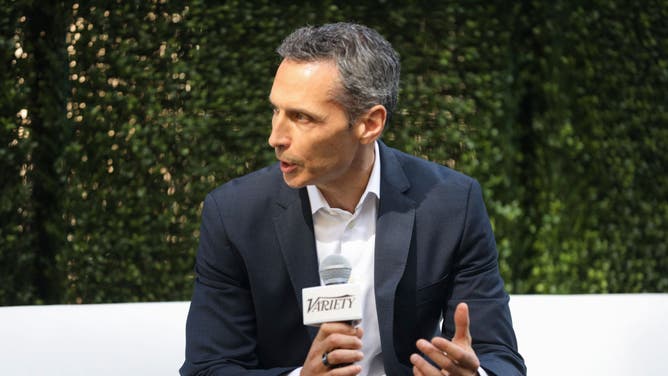
ESPN's Jimmy Pitaro speaks onstage at Variety's Sports & Entertainment Breakfast presented by City National Bank at the Maybourne Beverly Hills on July 21, 2022 in Beverly Hills, California. (Photo by Katie Jones/Variety via Getty Images)
If the math above from the New York Times is correct, this means ESPN is producing about $11 billion a year in revenue for Disney, plus another $2 billion or so in advertising. So call it roughly $13 billion a year in revenue. Which is still a lot of money, but is down by nearly half from what it would have been projected to be a decade ago. If the cable and satellite bundle hadn't collapsed, ESPN would be producing roughly $23 billion a year instead of $13 billion a year. So that's $10 billion in lost revenue, which adds up, even at a place like Disney. Given that ESPN's business model remains renting sports games from leagues – ESPN is just a middleman here between the leagues and the consumers, with a bit of a chance with the NFL of late which I'll discuss below -- the revenue collapse has necessitated cutting the UFC -- albeit replaced with the less expensive WWE -- losing most of Major League Baseball -- albeit with a potential regional replacement offering online -- losing the Big Ten completely in all sports -- and paying much more for one-third of the NBA than it paid for half of the NBA in the past.
The result is, ESPN's entire sports business now boils down to essentially renting three sports from the leagues: Monday Night Football from the NFL, one-third of the NBA, and the entire sports programming of the Southeastern Conference. Plus, the college football playoff. Yes, there are other offerings, but purely from a business perspective, the NFL, the NBA and the SEC are, for better or worse, ESPN's entire business.
ESPN pays a reported $2.7 billion a year for Monday Night Football, somewhere in the neighborhood of $2 billion a year for the NBA, and around $1.6 billion a year for the SEC ($300 million) and the college football playoff rights ($1.3 billion). (Some of the playoff games are sublicensed back to TNT so they get a bit of this back.). The NFL rights fee, in particular, is likely to surge even higher come 2030 when this deal expires. But even without that happening, just these three assets command more than $6 billion a year.
And with the NFL deal expiring soon and the college football playoff expanding next year, it's not crazy to forecast these costs going to an average of $9 billion or $10 billion a year. (Given that ESPN's profit is reported at roughly $2 billion, this will go up in smoke in a hurry.)

SEC football. (Photo by James Gilbert/Getty Images)
By the way, rough eyeballing of these rights fees would suggest that the SEC by itself, which at $300 million a year for every football, basketball and baseball game, plus the conference network, looks like the best deal in all of sports. Interestingly, the SEC Network, unlike the Big Ten Network, doesn't come with a long-term commitment from the SEC. If the SEC walked from ESPN when its deal expires in 2034, the SEC Network would just vanish. Or go wherever the new deal is. That is, unlike the jointly owned Big Ten and Fox networks. The SEC Network as an entity provides no long-range value for ESPN unless it keeps the SEC. (A side note of credit for ESPN here: CBS made the most boneheaded move in sports rights history letting the SEC leave its game of the week. And to its credit, ESPN grabbed the SEC at a fantastic rate. It's likely that the single most profitable asset in ESPN's entire portfolio right now is the SEC.)
The result of all these expenses and the collapsing cable and satellite subscribers?
Disney can no longer rely on ESPN to fuel its profits. In fact, Disney mostly makes money -- a whopping 43 percent of its operating income per the Wall Street Journal -- now from the amusement parks. And according to the Wall Street Journal, Disney as a company made $15.6 billion in 2024 profit. That sounds like a lot, but it's actually LESS than the company made in profit in 2016, $15.7 billion, before the collapse of ESPN and cable began, leading to the stock price stagnating. The stock price of Disney today is $118, nearly identical to the $114 stock price of 2015. If you bought Disney stock a decade ago when ESPN was at its peak, it hasn't increased in value in a decade. Meanwhile, the S&P 500 has more than tripled in the same time period. It gets worse, factoring in inflation -- thanks Joe Biden! -- and Disney would have needed to increase earnings by 35 percent since 2026 just to maintain the same value on the income it does make. So in actual value of earnings, Disney has lost 35 percent of its profit in the past decade.
Put simply, Disney and ESPN have been an awful place to put your money for the past decade.

Walt Disney World. (Getty Images)
You might as well have buried your cash in the backyard.
And the only reason things haven't been much worse is because Disney has been able to increase costs at its theme parks -- lots of moms and dads out there have felt these price increases, by the way, it costs a small fortune to vacation at Disney now -- to subsidize the collapse of the rest of the company.
Looked at in this way, ESPN's purchase of the NFL assets for a reported 10 percent of its own business, looks like a desperate Hail Mary. (ESPN paid less to buy the NFL Network completely -- a reported $2.5 billion -- than it does to rent Monday Night Football games from the NFL every year. Think about that for a minute: ESPN is going to pay more to rent NFL games over the next decade than its business will actually be worth. How is that remotely sustainable? The NFL desperately wanted out of the cable media business. What surprises me is that it took equity in the NFL. Why? Because if the NFL ever walks away from ESPN, its equity is mostly worthless. The NFL Network deal, from this perspective, looks smart for ESPN and dumb for the NFL because it handcuffed the league and guaranteed it will always have games to air. Of course, it's also possible that the NFL is making so much money that it just wanted the headache of running a media business to go away. But If I ran the NFL, I would have wanted cash, not equity, for my cable assets.)

(Getty Images)
Let me pause here for a moment and respond to the inevitable commenters screaming that ESPN will be fine and even if it's not, all of cable will collapse anyway and WHY DON'T I MENTION THAT BECAUSE I'M SO BIASED. Well, most of cable programming is cheap. It doesn't cost very much to put on, say, news programming. Trust me, I've done a ton of it. Studios don't cost a ton and neither do opinion shows. You don't have to rent presidential press conferences, pay much for debates, the conventions are great drama, but even better business. Fox News, for instance, is WILDLY profitable for this reason. But FS1 isn't. Because live sports programming is insanely expensive and live news coverage is pretty cheap. So the fixed costs of cable programming outside of sports are tiny. Only sports requires a huge capital outlay to rent programming. (I'm not optimistic that there is any large market for any sports streaming offering of TV/cable products, period. I just don't see the market for any of it, as I'll discuss below.)
In fact, here's something interesting: ESPN is basically the last cable sports property standing and it's now competing with Netflix, Apple, Amazon on streaming and Fox, NBC, and CBS on broadcast television. That is, ESPN's business model really doesn't exist anywhere else, everyone else has largely thrown in the towel on cable sports and put its top games either on streaming or "free" broadcast networks. Which brings us back to the big streaming launch by ESPN..
ESPN's idea, as I stated above, is that they can trade $15 a month in cable and satellite fees for $30 a month in streaming fees.
But, and this is key, I don't believe there's any market for ESPN's streaming service.
ESPN president Jimmy Pitaro said it wants to target the cord nevers, mostly young people, who have never had a cable and satellite subscription, and cord cutters, mostly older, cost-conscious consumers. But here's the problem -- young people are going to mostly illegally stream and most of the cord-cutters aren't sports or news fans. (I would argue the only people who still have cable are some combination of lovers of sports and news and/or older long time cable subscribers and just not willing to give up the ease of one remote control to watch cable and satellite.I, by the way, am firmly in the latter camp. I want one remote to watch everything. Streaming, in my opinion, has mostly made life worse for your average sports fan. It's made watching games more expensive and more difficult, a horrible combination.)
But you don't have to buy my thesis on this market not existing. I put up a poll and asked you guys if you would sign up for ESPN's streaming service and pay $29.99 a month.
And 96 percent of you said -- with more than 20,000 voters -- you would not pay for this product.
Now whatever you think of my audience on social media, it wildly over-indexes for sports fans.
This is where I think ESPN's branding issues with woke sports are such an issue. Almost no one is signing up for streaming services for opinion programming -- sports opinions are everywhere for free -- but ESPN's brand has become so toxic with many sports fans that they actually hate a sports company brand, which is a tough thing to manage.
Indeed, the only sports fan I can think of that might appreciate ESPN's sports offering is actually a diehard SEC football fan. Because you could pay around $120 for ESPN streaming just for football season and get all the games you want and then unsubscribe. But most SEC football fans HATE ESPN's woke programming because the vast majority of SEC fans are Donald Trump voters. (Arguably Fox should have gone all in on the SEC years ago instead of the Big Ten. One top Fox executive came to an SEC football game with me, watched the planes fly over the stadium as the crowd went wild, and said, "My god, this entire stadium is Fox News viewers." Yep. Fox and Friends probably should be broadcasting from SEC campuses every Friday all season long leading into the SEC game of the week brought to you on Fox. SEC fans LOVE Fox News. But left-wing ESPN has the SEC and right-wing Fox has the more left-wing Big Ten. (Not to go entirely political here, but the Big Ten definitely indexes more Kamala Harris voters than the SEC does, especially the Big Ten expanded to include USC, UCLA, Washington and Oregon. Right now, every SEC state but Kentucky has a Republican governor. Meanwhile most Big Ten states have a Democrat governor. From a corporate congruity perspective, Fox should have the SEC and ESPN should have the Big Ten.)
But back to the streaming service.
On Saturday, I watched Iowa State and Kansas State play to kick off the college football season -- congrats Cyclones! -- and I thought it was strange how much ESPN was advertising its new streaming app on there. Presumably everyone watching the game already has ESPN. Why would it make sense to advertise it to people who already have ESPN? This would be like me asking you to read OutKick while you're already reading an OutKick article. So I asked you guys if you were signing up. Hundreds of you responded. And the comments are actually pretty interesting to read.
Almost no one has signed up.
And people seem pretty aware that if they already have a cable and satellite subscription, they aren't getting anything new from this offering because it's already included in their cable and satellite bundle. (Although I do suspect some people will sign up thinking they need to, which means ESPN will probably double-dip on some cable and satellite subscribers who also sign up for this.)
Which is why ultimately, I think the problem with this offering is if you love sports and are 50+, you probably still have a cable and satellite subscription. And if you are under 50 and don't have a cable or satellite subscription, you either don't care about sports or you stream anything you want illegally. (People under 30 years old mostly think paying for sports content is insane. They either use their parents' log in or stream everything off pirated sites. It's a very real issue for monetization.)
That is, there is no market for this product.
ESPN's entire business model remains tethered to the cable and satellite bundle. This offering is too late and too expensive to change anything.
Which means streaming isn't going to save ESPN's business.
Basically, the entire ESPN business model remains reliant on the floor of cable and satellite subscribers being hit soon. If it does, ESPN might survive. If it doesn't, the company will likely be bought by one of the streamers for parts or eventually get shut down like other cable sports channels have been -- remember CBS Sports Network and NBC Sports Network?

Ahhhh, the simpler days, where you could get away with ONE remote! (Getty Images)
And it also leaves us with this reality --you know what would be really great for sports fans? If we had a bundle where we could watch everything in one place easily.
Which we had.
Way back in 2000.
It was called cable.