Washington Nationals Fire GM Even After Winning Juan Soto Trade
Nationals front office shakeup shows winning matters
The Washington Nationals made one of the biggest front office moves of the 2025 season over the weekend, firing manager Dave Martinez and long-time general manager Mike Rizzo. Looking at the standings, it's easy to see why.
Entering Tuesday, the Nationals are 37-53, once again sitting dead last in the National League East. They're 15.5 games behind the first-place Philadelphia Phillies and 12 games out of a wild card berth. Thus far, they've been outscored by 86 runs, and allowed the third most runs of any team in Major League Baseball.
And yet, the Nationals have two of the most exciting young hitters in the sport, James Wood and C.J. Abrams, as well as an emerging 26-year-old ace in starting pitcher MacKenzie Gore. All three of those players were acquired in the 2022 trade that sent Juan Soto to the San Diego Padres.
So how did it end so poorly? Because at some point, acquiring cost-controlled young talent like Wood and Abrams only matters if you spend money to build a competent roster around them.
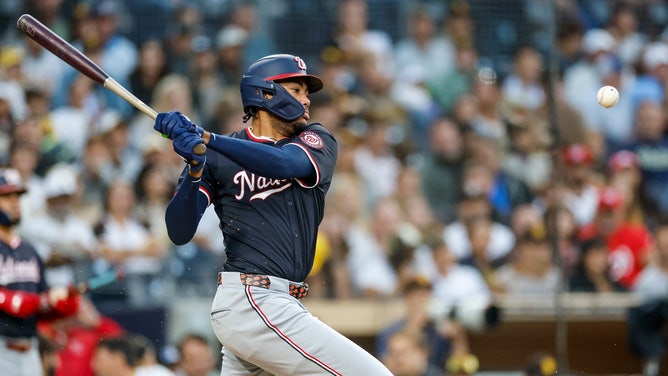
SAN DIEGO - Washington Nationals left fielder James Wood grounds out against the San Diego Padres at Petco Park on June 24, 2025. PHOTO: David Frerker-Imagn Images
Washington Nationals Struggling Due To Poor Roster Building
One of the key lessons to learn from the Nationals' continued struggles is how important it is to have quality depth throughout the lineup and pitching staff. That's something that requires significant financial investment, especially when an organization is benefitting from top contributors playing on rookie-level salaries.
Instead, the Nats have been acting, and spending, like a small market team. Despite playing in one of the largest, wealthiest, metro areas in the country. During their 71-91 2024 season, the estimated final payroll was $130 million. That sat just barely ahead of the Milwaukee Brewers, who actually play in a small market.
Still, there were reasons to hope for better heading into 2025. James Wood had shown flashes of high-level talent already. Abrams made significant steps forward. MacKenzie Gore improved and top draft pick and prospect Dylan Crews made his MLB debut and looked poised to become a full-time starter.
Sounds like the kind of roster worth building on, right? Apparently not to Nationals ownership.
Team payroll is lower this season than last season, dropping to $120 million. After Wood and Abrams, the top contributors on offense are Alex Call, Jacob Young, Luis Garcia Jr., Paul DeJong, Nasim Nunez, and Amed Rosario. One of their few offseason acquisitions, Nathaniel Lowe, has been a below-average player, offensively and overall. The situation on the pitching staff is somehow even worse.
Gore has been one of the best pitchers in the National League. Then there's Trevor Williams, Mitchell Parker, Bradley Lord, Mike Soroka, Jose Ferrer, Jorge Lopez and Jake Irvin. That's not going to work. And sure enough, it hasn't. Washington ranks 28th in team ERA, and just 23rd in team pitching wins above replacement.
And that list of names demonstrates how important roster building actually is.
The value of having players like Wood, Abrams and Gore at this stage in their careers is that they're cheap. That allows ownership and the front office to invest in more expensive veterans to build around them, while still keeping overall payroll at a reasonable level. Instead, the Nationals, whether through ownership directives or front office frugality, have spent little and made virtually no long-term commitments. There are just three non-arbitration eligible players signed for 2026: Trevor Williams, Shinnosuke Ogasawara and Keibert Ruiz.
It's just not a formula for building a competitive team.
Yes, the Nats have had their fair share of injuries, but every team deals with injuries. They won the Juan Soto trade, getting young, cost-controlled stars in return for someone they were never going to keep long-term. Yet they've done little to build a complete roster around those stars. Especially in the rotation and bullpen. It's possible to get lucky on a budget, but depth requires money. And no matter who's in the dugout or the GM suite, it won't matter if team ownership decides to act like Washington D.C. is equivalent to Milwaukee.