Soccer Players Can't Stop Complaining Ahead Of US World Cup
It’s apparently just too hot to play sports in the US
We're somehow just about a year away from the 2026 FIFA World Cup, which will be played around the United States. It'll be the second consecutive summer of soccer in the US, with this year's FIFA Club World Cup about to wrap up.
And international soccer players just can't stop complaining about how hot it's going to be.
Enzo Fernandez, who plays for English Premier League Chelsea, complained about the weather this summer during the competition, saying that he hopes tournament organizers alter game times so that temperatures are lower for the World Cup.
"The heat is incredible," Fernandez said, per The Athletic, a few days before Chelsea plays Paris Saint-Germain in the final.
"The other day, I got a little dizzy from playing, and I had to go to the ground. The truth is, playing at that time is very dangerous. It’s very dangerous.
"The speed of play is not the same. Everything becomes very slow. Let’s hope for next year they change the times so, more than anything, the football continues to be nice and attractive."
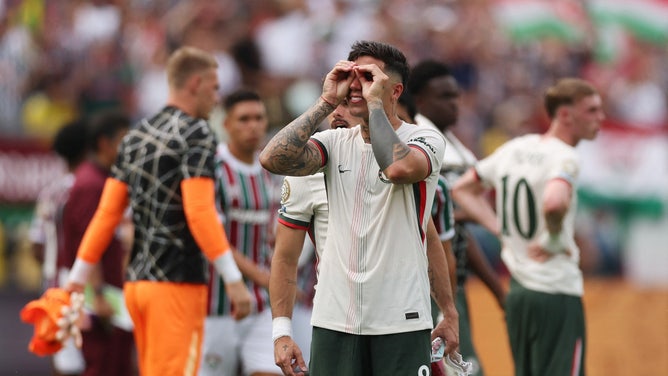
Chelsea FC midfielder Enzo Fernandez (8) celebrates after a semifinal match of the 2025 FIFA Club World Cup on July 8, 2025 at MetLife Stadium i East Rutherford, NJ. Photo: Lee Smith-Reuters via Imagn Images
World Cup Might Be Forced Into Domed Stadiums To Stop The Heat
Fernandez has a point; it was 96 degrees when Chelsea kicked off its last match at MetLife Stadium in New Jersey. But it's hot everywhere in the summer.
The high temperature in Paris this week will reach 88 degrees. When Brazil hosted the World Cup in 2014, games in Manaus hit 90 degrees. The 2022 World Cup was played in Qatar, forcing the tournament to be moved to winter. Still, games were played in 80+ degree weather that required cooling systems in the stadiums.
Playing tournaments in the summer is going to result in high temperatures virtually everywhere. Other than Australia, where summer means a winter climate, or somewhere like Scotland and far northern Europe. Even when Russia hosted in 2018, there were games in 80+ degree cities.
FIFA has already stated it intends to incorporate more cooling breaks, among other changes designed to prevent players overheating. It's just an unavoidable part of playing soccer in the summer.