SEC Teams Are Going To Lose A Lot More Games With New Schedule Requirements
Decision ends years of playing eight conference games while other top conferences played nine
College football strength of schedule continues to be a topic of conversation, and the SEC made a major step forward in that argument on Thursday.
After years of playing eight conference games, while other top conferences have played nine, the SEC announced on Thursday that it had approved a nine-game conference schedule starting in the 2026 season. This is a massive shift for the conference, for fans, for the sport, for the Big Ten, and for the future of the College Football Playoff.
And while there are obvious financial implications that will benefit the SEC; more marquee matchups, big name teams playing other big name teams more frequently, with the increasing ratings that'll bring, it's not clear that fans, especially SEC fans, fully realize what this will do to their regular season records.
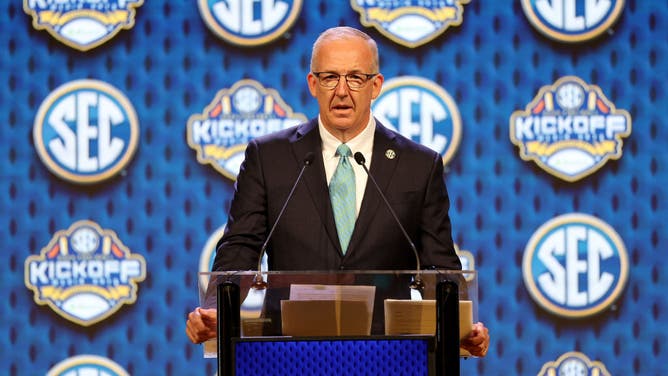
SEC's Greg Sankey says there is no rift between himself and Big Ten's Tony Petitti (Photo by Tim Warner/Getty Images)
SEC Is Going To Add A Bunch More Losses For Its Teams Moving Forward
While SEC defenders have pointed to the conference's top-to-bottom strength as justification for strength of schedule arguments relative to other conferences, the fact remains that schools like Indiana which have referred to taking an "SEC scheduling" philosophy, play the same number of games against teams from Power 4 conferences as most SEC schools. Because they play nine games against the Big Ten.
Take for example, the Auburn Tigers in 2025. Auburn's non-conference schedule has one Power 4 school, two lower-tier FBS teams, and an FCS team as an effective bye week late in the season.
- at Baylor (Power 4)
- vs. Ball State (FBS)
- vs. South Alabama (FBS)
- vs. Mercer (FCS - Nov. 22)
With eight conference games, that's nine games against Power 4 schools. Even if Indiana schedules high school teams, it too will have nine games against Power 4 schools. Obviously, not all of those games are created equal, but at its most reductive level, this is a strength of schedule argument other conferences have advanced.
That FCS game against Mercer, for example, could also serve as the "extra" non-conference game SEC teams have enjoyed. Across the conference, schools have used that extra game to give themselves an automatic win by playing an FCS school, usually late in the season before their rivalry game.
SEC schools playing just three out-of-conference games are removing either an automatic win, or a game with 95+% win expectancy against South Alabama. And they're replacing it with a game against another SEC school. Basic math will tell you that adds eight additional losses to the conference each season. It has to.
Collectively, that's going to change a lot of arguments. Replace South Alabama with say, Texas A&M or South Carolina. Suddenly, that 9-3 season is 8-4. Or 10-2 changes to 9-3. Or a victory over Vanderbilt goes from a "quality win" over a 7-5 or 6-6 team, to a much less impressive result against a 6-6 or 5-7 team.
The trickle-down effect of the nine conference games is massive. For years, SEC teams have been able to point to the conference's perceived strength and a quality record. "We played in the grueling SEC and won nine games, we deserve to get to the playoff," the argument goes.
But it's going to be a lot tougher sell when it's "We played in the grueling SEC and went 8-4."
This is undoubtedly going to make the strength of schedule arguments more difficult, interesting and help the SEC's case that it's the toughest conference in the country. It's also going to result in a lot more teams within the conference ending up with much less impressive records. Watching their fans handle it might be more entertaining than the playoff itself.