Oregon Athlete Says She Was Bullied, Denied Her Medal After Refusing To Stand Beside Trans Opponent
Oregon high jumper Alexa Anderson says her podium protest triggered months of backlash.
When Oregon high school athlete Alexa Anderson refused to take the state championship podium last spring, she knew there would be fallout. She just didn't know how far it would go.
The Tigard High School senior had just finished third in the girls' high jump at the Oregon state track and field championships. She and fourth-place finisher Reese Eckard decided to walk away from the podium rather than stand beside a trans-identifying male athlete who tied for fifth.
That moment launched a national firestorm and, according to Anderson, months of harassment that followed her through graduation.
Alexa Anderson Said Officials Wouldn't Give Her Medal
After leaving the podium, Anderson headed into the tunnel area behind the track to find out how the medal distribution would work. That's when she says she learned something was off.
"I asked after the medal ceremony concluded… ‘Hey, are we going to get our medals?’ and she said they'd be shipped to our school," Anderson explained. "And then they were never shipped to our school."
She says the medal never arrived. Not in May. Not in June. Not all summer.
Anderson told Fox News Digital that she only received her third-place medal after filing a lawsuit against the Oregon School Activities Association (OSAA), which is now ongoing. And even then, the medal was instead sent to her attorneys at the America First Policy Institute.
Anderson says the backlash started the same night she stepped off the podium.
"There were people who just kinda attacked us and were like, ‘You guys are bullies, you’re horrible people,'" she recalled.
But in the weeks that followed, she says the criticism turned far darker. Anderson alleges people contacted her high school demanding she be expelled and barred from walking at graduation.
Then came the personal messages.
"There were people messaging me personally, just saying horrible things, death threats even."
I hope you die, one message read. Another: Your parents are definitely embarrassed of you.
"It definitely hurt," Anderson said. "Part of me expected this and knew that's just what happens when you stand up for what you believe in."
After months without their medals, Anderson and Eckard finally received them publicly in November. Their medals were presented during the Fox Nation Patriot Awards, where they were honored with the Most Valuable Patriot Award for taking a stand for girls' and women's sports.
"It’s definitely frustrating that we didn’t get them in the moment… but it kinda is what it is at this point," Anderson said. "There’s more important things that we’re fighting for."
She added that while she "worked super hard" for her spot on the podium, she also believed the consequences were part of the sacrifice she chose to make.
Lawsuit Continues As Anderson Moves On To College Track
Anderson and Eckard's lawsuit against OSAA is still moving forward in federal court. A judge recently allowed key parts of their First Amendment claim to stand, and Anderson has continued to speak out about viewpoint discrimination in Oregon schools.
She said she saw other political messages routinely displayed at competitions during her four years in high school sports.
"I’ve seen a lot of speech about support and rights for the LGBTQ community, the trans community, a lot of the Black Lives Matter movement stuff," she said, "wearing shirts, flags, that kind of stuff."
Her concern isn't about whether those messages should be allowed but whether only certain viewpoints get protected.
"I think it’s really harmful to students to only allow them to express certain viewpoints that you agree with," Anderson said.
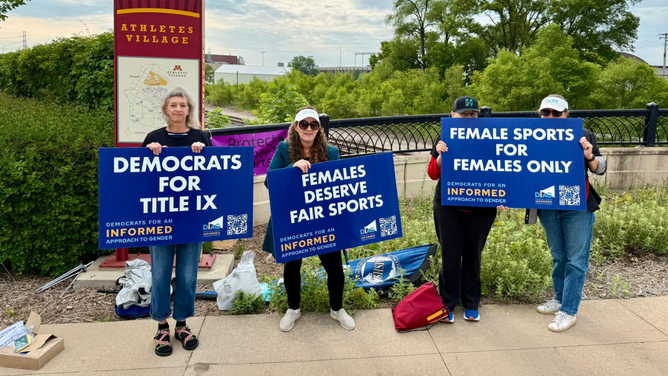
Protesters fight to save girls' and women's sports in Minnesota.
(Photo by Amber Harding)
Now a freshman at the University of South Alabama, Anderson says the fight is worth every bit of the backlash that has come with it.
"I think fighting for the rights of women’s sports to have a safe and fair environment is going to be a fight we’re going to be a part of for years — maybe even our lifetime," Anderson said. "And it’s so incredibly worth it if we can help all these girls to have a safe and fair environment."