MLB Writers Refuse To Credit Analytics For Milwaukee Brewers Success
Athletic writer credits 'old school' methods while team actually relies on data-driven decisions
After a historic run of success, going 53-17 in a 70-game sample, the Milwaukee Brewers have opened up a six-game lead in the NL Central over the second-place Chicago Cubs.
Their +162 run differential is the best in baseball, suggesting they've actually slightly outperformed their 79-48 record. They've accomplished much of this without the help of one of their best players, Jackson Chourio. Their pitching has been elite, their defense is elite, their baserunning is elite, and they've gotten contributions from unexpected, discarded players.
In short, the Brewers running away with their division has been one of the most surprising stories of the 2025 season. Unsurprisingly then, national baseball media is trying to come up with explanations for it. One such example being The Athletic's Ken Rosenthal. And while Rosenthal is hardly a "back in my day" old man yells at cloud type, even he fell for the trap of crediting some hypothetical "old school" methodology that doesn't actually exist.
"There’s a lesson here, if anyone in baseball cares to heed it," Rosenthal wrote in a column on Milwaukee's success. "The lesson is in every ball the Brewers put in play and every runner they advance, every cutoff man they hit and every extra base they take. The Brewers are not perfect – Sunday’s loss included a critical error to open the ninth by Brice Turang at shortstop and two botched bunts in the late innings. But they at least try to play the game properly at a time when most teams place too little emphasis on fundamentals and too much on the next big analytical thing."
Oh boy.
RELATED: Are The 2025 Milwaukee Brewers The Best Baseball Team Ever?
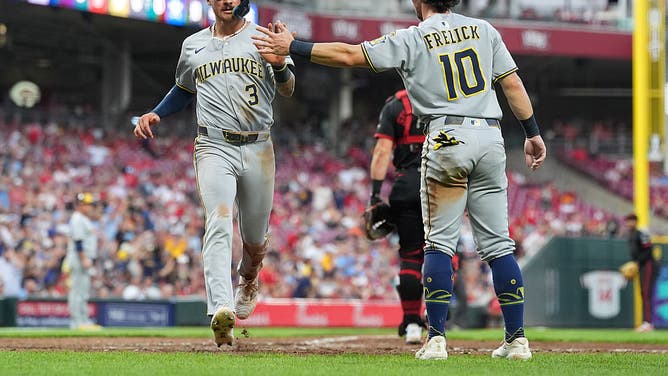
CINCINNATI - Joey Ortiz of the Milwaukee Brewers celebrates scoring a run with Sal Frelick of the Milwaukee Brewers during the fourth inning against the Cincinnati Reds at Great American Ball Park on August 15, 2025. (Photo by Jason Mowry/Getty Images)
Yes, Brewers Are Using Analytics To Build Their Team
The Brewers have not had this extraordinary season because they are taking the extra base or playing baseball "the right way." They've had this extraordinary season because of a combination of finding value in unheralded players that other teams have not seen, a top-tier farm system that drafts, signs, and develops extremely well, and good luck.
How have they found value in unheralded players? Analytics. How have they made quality trades to get those players in the first place? Taking emotion out of decision-making and using analytics instead. Where did the increased value on defense, run prevention and baserunning come from? Analytics that put more value on baserunning than simply counting stolen bases.
Here's an example. One of the most prominent "analytics" lessons that teams have learned over the past 10-20 years is that relief pitching is inherently inconsistent and unreliable. It's extremely rare to find say, Mariano Rivera, Kenley Jansen or Trevor Hoffman. It's much more common that relief pitchers battle inconsistency, injuries, and poor luck in part due to small sample sizes.
How does that relate to the Brewers? Well, some of their highest-profile trades in the past few years have been sending dominant, homegrown closers to other teams instead of keeping them through free agency.
Just this past offseason, the Brewers dealt Devin Williams, one of baseball's best and most consistent closers, who'd had five straight seasons of exceptional relief pitching. "Old school" thinking would have frowned upon trading someone with his track record. Analytics say to be wary of relief pitching and understand that past performance among closets doesn't guarantee future success. What's the result? Well, Williams has a 5.21 ERA in New York, though he's dealt with plenty of small sample size bad luck himself.
In return, the Yankees got Nestor Cortes and Caleb Durbin. Cortes was flipped to San Diego and Durbin has been worth 1.6 WAR and won't hit free agency until 2032. Oh, and Williams' replacement, Trevor Megill, has a 2.09 ERA and 29 saves. That's analytics working, not "old school" thinking.
It's ok to credit analytics for a team having unexpected success. If anything, analytics has made closing the competitive, spending gap easier than ever. The Brewers can take chances on players their scouting and development group identify, because they have to. They've done an exceptional job of it. They've also benefited from an enormous amount of batted ball luck that's unlikely to continue. Of their 11 hitters who've qualified, seven have exceeded their expected statistics based on quality of contact, and two more have basically equaled it. There's no way to plan for that level of fortune, and if and when it changes, the Brewers will stop scoring as many runs as they have.
But by then, the narrative will be created, they did things the "right way" before, and the "wrong way" when it stops working. It got too analytics heavy.
This is how narratives work though. Jacob Misiorowski was the most unhittable pitcher who's ever lived through his first few starts. Now the command issues that were common in the minor leagues are back. He has allowed 11 runs in his last 9.1 innings, and his ERA has ballooned to 4.19 ERA.
Baseball seasons are long, the gaps between teams are small, and narratives die quickly. Thank goodness.