Michigan Punishment Is Just Another Embarrassment For Unimportant NCAA
USC, Ohio State Fans Should Be Furious About NCAA Inconsistency
The NCAA is a joke.
Well, it's always been a joke. A deeply flawed organization made up of partisan actors who showed favoritism toward certain schools, while deciding that others needed to be taught a lesson. But the Friday release of the results of the investigation into the Michigan Wolverines' sign-stealing scandal put the final nail in the coffin of the NCAA's credibility and importance.
Especially when contrasted with the handling of similar situations and its interpretation of its own laws and bylaws in this investigation.
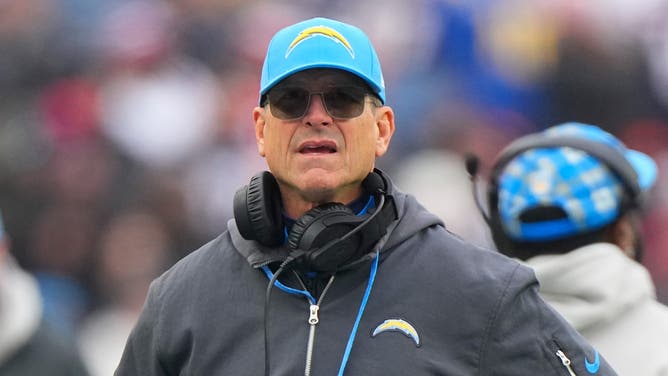
Los Angeles Chargers and former Michigan head coach Jim Harbaugh. Photo: Gregory Fisher-Imagn Images
USC, Ohio State Punishments Look Even More Absurd Now
As part of Friday's press release, the NCAA explained that it specifically decided against a postseason ban for the current Wolverines because it didn't want to damage the careers of current players. Those current players have had nothing to do with the actions of Jim Harbaugh and other members of the Michigan coaching staff.
Despite finding that the Wolverines should have faced a "multiyear" postseason ban, the punishment was much lighter. "However, the panel determined that a postseason ban would unfairly penalize student-athletes for the actions of coaches and staff who are no longer associated with the Michigan football program."
Wait, what? That's the standard now?
Just a few years ago, the NCAA had the exact opposite viewpoint when determining punishment for programs like USC and Ohio State.
The organization's sham investigation into Reggie Bush receiving improper benefits from an outside agent was already a joke, as anyone who read the documents can attest to. Regardless of the quality, the results were even more ridiculous. The NCAA didn't even necessarily claim that Pete Carroll or the USC administration knew that Bush was receiving benefits. But the punishment was based on its belief that SC should have known.
That supposed "lack of institutional control" was the basis for banning USC from the postseason for two seasons. And taking away 30 scholarships over three years. And a decade of probation. A decade.
Soon afterward, it became widely accepted that the NCAA had no basis for its punishment, it just didn't like USC.
"It's become an accepted fact among informed college football observers that the NCAA sanctions against USC were a travesty of justice, and the NCAA's refusal to revisit that travesty are a massive act of cowardice on the part of the organization," wrote ESPN's Ted Miller.
Miller also reported that a competitive administrator admitted that the NCAA simply wanted to punish USC, because the program was popular in a major city, and found an excuse to do so.
Pete Carroll said as much: "I thought (the NCAA's investigation into USC) was dealt with poorly and very irrationally and done with way too much emotion instead of facts. I sat in the meetings. I listened to the people talk. I listened to the venom that they had for our program... They tried to make it out like it was something else. They made a terrible error."
Emails uncovered as part of running backs coach Todd McNair's lawsuit against the NCAA also showed that the organization wanted to get USC by any means necessary. Then Oregon and Miami got off far lighter with more substantial recruiting violations.
But beyond the inexcusable aggression, the NCAA happily punished student-athletes at USC from 2010-2011, some of whom were likely in junior high school when Reggie Bush played at USC.
They did the same with Ohio State, punishing the 2012 team for the actions of players on the 2010 team. Like, trading autographs for tattoos, an "offense" so laughable it's hard to believe.
This Michigan announcement is proof that not only is the NCAA an inconsistent national embarrassment, but it's no longer meaningful. Its "punishments" are a joke, its rules are ever-changing and selectively enforced, and there's zero standard for anything it does or decisions it makes. It's all just made up on the fly.
What's the point of the NCAA in 2025? It doesn't seem like anyone knows the answer. And maybe that's because there isn't one.