Alabama Never Should Have Been In The Playoff; Rose Bowl Loss Hurts ESPN, SEC's Reputation
Crimson Tide's 193-yard offensive output against Indiana follows Tennessee, LSU, Missouri losses in bowl games
It's been brewing for a while, but the Indiana Hoosiers' absolute demolition of the Alabama Crimson Tide at the Rose Bowl on Thursday felt like a turning point.
Without question, this postseason period has been an abject disaster for the SEC. No conference talks as much as the SEC about its sense of self-importance. No other conference's coaches exert as much energy pounding the table for their teams to be viewed differently than other, "lesser" programs. No other conference chants its abbreviation at other fans. No other conference has so successfully influenced the most important entity in the sport, the College Football Playoff selection committee, by using the word "gauntlet" to describe playing mediocre 7-5 teams. No other conference has weaponized its television partnership, in this case with playoff broadcaster ESPN, to receive preferential treatment.
RELATED: Is The SEC Actually Bad? Conference Drops To 0-5 Against Power 4 Teams After Vanderbilt Loss To Iowa
The bar for the SEC then, is significantly higher than it is for other conferences. "It just means more," is their core marketing strategy, after all. The 2025-2026 Alabama team is the perfect example of how outdated and patently absurd that slogan is in the modern era.
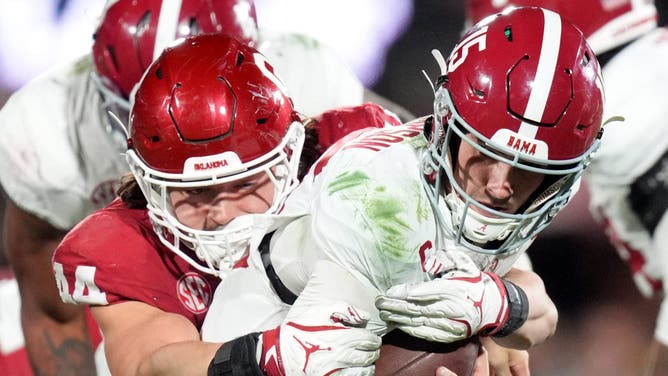
OklahomaÕs Taylor Wein (44) sacks Alabama's Ty Simpson (15) in the second half of the College Football Playoff game between the University of Oklahoma Sooners (OU) and the Alabama Crimson Tide at the Gaylord Family - Oklahoma Memorial Stadium in Norman, Okla., Friday Dec. 19, 2025. (© SARAH PHIPPS/THE OKLAHOMAN / USA TODAY NETWORK via Imagn Images)
SEC, ESPN Exposed by Alabama Humiliation
Alabama made the playoff because the Tide reached the SEC Championship Game and beat Georgia in the regular season. As soon as they clinched their spot, thanks to tiebreakers, ESPN personalities spent the entire week yelling that no team could be punished for losing in the SEC Championship Game. The committee listened, even though that argument makes little sense and unjustly elevates one conference above all others. That's it. That's the whole reason they made it; a predetermined outcome based on inaccurate propaganda by biased media figures.
Had anyone involved taken the time to do roughly 14 seconds of research, they'd have learned that Alabama's win over Georgia was a fluky outcome, part of a pattern of the Tide winning games they had no business winning. Analytics rating system SP+, ironically headquartered at ESPN, generates a "postgame win expectancy" percentage that's updated weekly. Essentially, it measures, based on the efficiencies in the game, which team was more likely to win based on its success rate on offense, defense, and special teams.
Alabama had 19.4 percent win expectancy in its regular season matchup against Georgia. The Bulldogs dominated, averaging 6.7 yards per play to Alabama's 5.2. But Alabama won anyway, in part because of a fumble deep in Georgia territory that led to a field goal. It wasn't the last time they would win a game they were unlikely to win.
Their win expectancy against Missouri was just 26 percent, then 44 percent against Auburn. They were unlucky to lose to Oklahoma, but they could easily have been a three-or four-loss team in the regular season. Then they were obliterated by Georgia, with -3 rushing yards and 0 percent postgame win expectancy. But because the committee members had already encoded the conference's arguments and made up their minds, the Tide got in ahead of Notre Dame or BYU. BYU, of course, was punished for losing in its conference championship game to a playoff-caliber top-5 team because they do not have ESPN and Greg Sankey to create narratives for them.
This postseason period, and Bama's performance in Pasadena, has confirmed the turning point every non-SEC fan had noticed in recent years: the conference no longer deserves the benefit of the doubt or the assumption of superiority. Yes, Nick Saban's Alabama teams were a dynasty in the 2010's. It's now 2026, and the 2011-2017 run is a long, long time ago.
Just this bowl season alone, Tennessee lost to Illinois. LSU lost to Houston. Missouri lost to Virginia. Vanderbilt lost to Iowa. That loss came after Diego Pavia said the Big Ten was weak compared to the weekly challenge of the SEC and said it would take just seven points to beat the Hawkeyes. His head coach at Vandy said SEC teams should make the playoff over teams from other conferences with the same record because the SEC is an impossible gauntlet. For context, Missouri and Tennessee never beat a P4 team with a winning record, with the Volunteers ranked every regular season week regardless.
Texas A&M, which went 7-1 in the SEC, scored just three points at home against the lowly ACC-based Miami Hurricanes. While Texas at least beat Michigan after the Wolverines saw their program melt down in December, Alabama-Indiana provided the conference's biggest opportunity to regain some bragging rights.
Instead, the Hoosiers made Alabama look like a high school team.
Indiana Demolishes Alabama, Ty Simpson
Indiana had 407 yards on offense, with 6.2 yards per play. Alabama had 193 yards on 3.9 yards per play. The Hoosiers had 215 rushing yards and allowed just 23. They had six tackles for loss and frequently blew the Tide's plays up at the line of scrimmage. This is after the selection committee referenced Alabama's improved rushing game, averaging 4.2 yards per carry against a bad Auburn team, as a reason to make the field.
The same broadcast team called the Rose Bowl game that called Indiana-Notre Dame in last year's playoff. In that game, Kirk Herbstreit went on a rant essentially demanding the committee include more three-loss SEC teams to increase the level of competition. In a game the Hoosiers lost by 10. While Herbstreit did say Bama's reputation took a hit and their performance was "embarrassing," there was no demand for the SEC to be treated like every other conference moving forward. There was no complaining about the lack of competitive balance as an SEC team was run off the field. Of course not, because that would hurt the ESPN partnership and bring an angry phone call from Sankey.
What makes this demolition even more satisfying is that it came just weeks after Alabama quarterback Ty Simpson said his team had the best offense in the country. Literally. "Yeah, we have a standard, right, as an offense," Simpson said after losing to Georgia. "In general, we think that... actually we know we have the best offense in the country. And then when we don't show it, right, like it is very frustrating."
Alabama over its last four games, collectively, averaged 4.0 yards per play. The most yards they gained in a single game over their final four was 280. If ESPN wasn't in the business of promoting the SEC and influencing the committee, this probably would come up at some point in the playoff postmortem. It won't. If ESPN wasn't in the business of promoting the SEC and influencing the committee, it would call Sankey out for saying that his conference deserved to have seven, SEVEN! teams make the playoff. Because, according to him, the "standard" in the SEC is just higher than everywhere else, and the SEC should get more respect for it.
But the Rose Bowl humiliation seems to be the final blow to all of these marketing efforts. At least among fans willing to be intellectually honest. Alabama was only in the playoff in the first place because of posturing, lobbying, and an unjustified reputation based on an unearned sense of superiority. That all came crashing down against the best team in the country.
Yes, the SEC will continue to have very good teams, and will certainly win titles. But the automatic assumption that the conference patch, big fanbase and large home crowds make teams good and special is officially over. A&M had 105,000 people at Kyle Field and scored 3 points, deservedly losing to an ACC team that often can't cross the 75 percent attendance threshold. Crowd size doesn't matter. Having passionate fans doesn't matter. NFL draft picks and recruiting rankings don't matter. Nick Saban's Alabama teams of the 2010's don't matter. Laughable preseason polls creating "ranked games" and "ranked wins" between mediocre SEC teams don't matter. ESPN's self-interested lobbying doesn't matter.
The committee is already on shaky ground thanks to a series of completely illogical, inconsistent statements. If it keeps forcing undeserving SEC teams down our throats after that game? The other major conferences might band together to push back and prevent Greg Sankey from using his media partners to gain an unwarranted advantage.