Notre Dame Lied About Wanting To Keep USC Rivalry Going
It's all about the W's...
The college football world was left stunned this week when news broke that the long-standing intersectional rivalry between the USC Trojans and Notre Dame Fighting Irish, which began in 1926, would not be played for at least the next few seasons. Stunned because the game had been played every year, outside the COVID-lockdown shortened 2020 season and World War II, and because both fanbases wanted the rivalry to continue.
Yet the two sides could not come to an agreement on extending the series for the 2026 season, ensuring that the game won't be played until 2030 at the earliest. It's shocking, and frustrating, that one of the sport's greatest historical rivalries has been pushed aside by the realities of conference realignment and expansion.
Who you blame for this "temporary" pause is likely down to which team you root for.
Many have pointed the finger at Lincoln Riley, saying that he, as someone with little prior connection to USC, had no interest in continuing the tradition. Others, including some Trojan fans and players, have said that USC should have continued the series as is, playoff be damned. Then there's another side that's made the case for Notre Dame engaging in a pattern of pettiness, immaturity and selfishness.
But whatever other statements may have been made, the public face of the Irish program, earlier this year, clearly was not telling the truth when discussing the USC-ND rivalry.
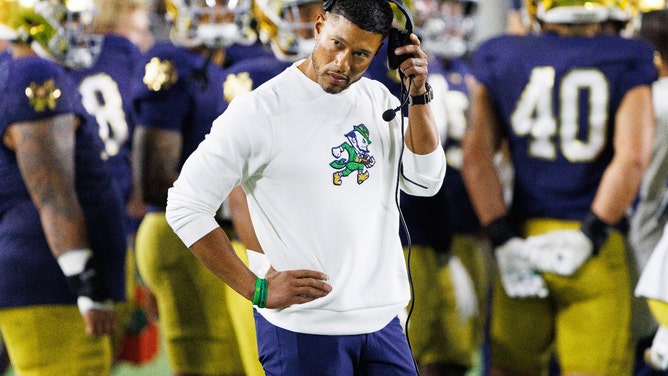
Marcus Freeman, head coach of the Notre Dame Fighting Irish, on the sidelines during a Notre Dame football game. MICHAEL CLUBB/SOUTH BEND TRIBUNE / USA TODAY NETWORK via Imagn Images
Notre Dame Didn't Follow Through On Its Word
Here's what Notre Dame head coach Marcus Freeman had to say, just a few months ago, about continuing the SC-Notre Dame game into the future.
"It’s pretty black and white for me," Freeman said, per Blueandgold.com. "You want my opinion? I want to play them every single year. When? I don’t care. I don’t care when we play them. Start of the season, middle of the season, end of the season — I don’t care. I want to play USC every year because it’s great for college football."
RELATED: Notre Dame Head Coach Marcus Freeman Throws Down Gauntlet On USC Rivalry Game
"I don't care when we play them."
"Start of the season, middle of the season, end of the season - I don't care."
That's what the head coach of Notre Dame said about the rivalry. Anytime, anywhere. Well, Notre Dame had an opportunity to follow through on those statements, and according to new reports, the Irish declined to do so. Wonder what happened!
According to Ryan Kartje at the Los Angeles Times, "USC was ready then to compromise and stick with the rivalry’s usual cadence over the next two seasons, with Notre Dame coming to the Coliseum in 2026." Then, USC wanted the series to shift to Week 0, which would be more aligned with the traditional non-conference timeframes.
As SC Athletic Director Jen Cohen explained in a recent letter, the Trojans were the only Big Ten team to play a non-conference opponent after Week 4, and the only one to make a non-conference road trip after Week 4. Moving the game to earlier in the season shouldn't matter to Notre Dame, right? Anytime, anywhere, start of the season, middle of the season, end of the season, right?
Turns out, that was completely false. Notre Dame turned down the offer this week, implying that it did actually have strong preferences on when to play the game. Who knew?
There Is New Reality In College Football For Both Sides
Fans from both teams are playing the blame game in the aftermath of the announcement this week. And justifiably so. But when the most prominent public face of the Notre Dame program says the team will play the game anytime during the season, then the Notre Dame program says it will not continue the rivalry because USC wanted to play it earlier in the season, it seems like a pretty open and shut case.
Obviously, some of the blame also falls on USC. The Trojans joined the Big Ten conference, meaning the Trojans now have multiple roadtrips to the Midwest or East Coast each season. That made the additional travel to South Bend in the middle of the season a much tougher sell than it previously had been. They also have realized that making the College Football Playoff, despite what the committee claims, comes down to wins and losses. Making the playoff also comes with massive financial rewards.
And the new realities of the expanded superconferences and NIL mean that winning 10 games is harder than it's ever been. Making the playoff has become the goal, because of the monetary incentive, not winning rivalry games that look nice in game notes but don't matter much in the new world of college football.
Notre Dame has realized its best path forward to reaching the playoff, and not having to pout and sulk about the Pop Tarts Bowl, is by winning 11 games each season. The guarantee it signed with the selection committee ensures that the Irish will reach the playoff moving forward if they're in the top-12 of the final rankings. Well, the best way to guarantee that is by winning 11 games. USC, despite its recent struggles, remains a big program that just pulled in the No. 1 recruiting class in the country. And 50/50 games, like rivalry often is, remove the margin for error in getting to that 11th win.
For USC's side, just look at some of its opponents on the schedule for 2026:
- Ohio State
- Oregon
- Washington
- Indiana
- Penn State
- Wisconsin
- UCLA
Now add Notre Dame. Per ESPN's FPI rating system, that would mean SC played literally the top-4 teams in the country during the 2025 regular season in the same year. Oh, and then Penn State, who ranked 17th in FPI, and Washington who ranked 22nd, along with the several other programs like Wisconsin and UCLA that are historically better than their 2025 seasons, and likely to improve in 2026.
This isn't sustainable for a program looking to reach the playoff. Like the arguments SEC boosters like to make, this schedule is an actual gauntlet. SC could wind up being a top-5 team in 2026, by the underlying metrics, and still lose three games. Because when you're playing games that are 60-40 or 50-50, one bounce here or there changes the outcome. And changes your season.
And USC offered to play the 2026 game exactly as it's traditionally scheduled anyway! The Trojans don't need the Irish to build a playoff worthy resume. Win 10 games and beat some of the big names on that list, and they're in. Here's Notre Dame's 2026 schedule now:
Sun, Sept. 6 — vs Wisconsin (Shamrock Series at Lambeau Field — Green Bay, WI)
Sat, Sept. 12 — Rice (South Bend, IN)
Sat, Sept. 19 — Michigan State (South Bend, IN)
Sat, Sept. 26 — at Purdue (West Lafayette, IN)
Sat, Oct. 3 — at North Carolina (Chapel Hill, NC)
Sat, Oct. 31 — vs Navy (neutral site at Gillette Stadium — Foxborough, MA)
Date TBD
vs Miami (FL) (South Bend, IN)
vs Boston College (South Bend, IN)
vs SMU (South Bend, IN)
vs Stanford (South Bend, IN) (TO BE CONFIRMED)
at Syracuse (Syracuse, NY)
at BYU (Provo, UT)
And that's the reason why the Irish backed away from "we'll play SC anytime."
Notre Dame will be favored in all 12 of those games, most by a wide margin. Winning at least 11 should be the expectation. Why? Because that's their path into the playoff. They don't have to worry about a meaningless conference championship exhibition game. They don't have to deal with Oregon, Ohio State, Indiana and the like, unless they want to. They don't have to worry about strength of schedule if they win 11 games, because they'll be in the top-12 regardless and guaranteed a playoff berth.
Marcus Freeman wasn't telling the truth about the Irish's position on the rivalry game. Because Notre Dame's actions show that making the 12-team field comes first. Just like everyone else.