Would A Salary Cap Fix Major League Baseball? One Manager Says 'Bottom Feeders' Need To Be Fixed First
LA manager criticizes 'bottom feeder' teams as league pushes salary cap discussion ahead of potential 2026 lockout
The Major League Baseball offseason is off to a fast start, with high-priced deals flying left and right, trades between big market teams, and further speculation that a lockout is coming in the 2026-2027 offseason. Why?
Because ownership and the league is pushing for a salary cap in order to lower their costs and pocket more in profits. And players have made any discussion of a salary cap an essential non-starter. Much of the debate around the cap has focused on the Los Angeles Dodgers, who have now won back-to-back World Championships. Partially due to their ability to spend as much or more money as any other team, and partially because fans have short memories and have forgotten that the Dodgers were perpetually mocked as "chokers" with a Mickey Mouse ring until about 13 months ago.
After beating the Toronto Blue Jays in the 2025 World Series, the Dodgers went out and added the top-available free agent closer Edwin Diaz. There's reports flying left and right that there's serious interest and discussion going on between LA and the Detroit Tigers over a trade for American League Cy Young winner Tarik Skubal
RELATED: Reports Confirm Serious Dodgers-Tigers Trade Discussions For Cy Young Winner Tarik Skubal
Even though the New York Mets have outspent the Dodgers collectively the past few years, with little to show for it, fans are convinced spending is the only path to winning. Dodgers manager Dave Roberts, disagrees. And explained why.
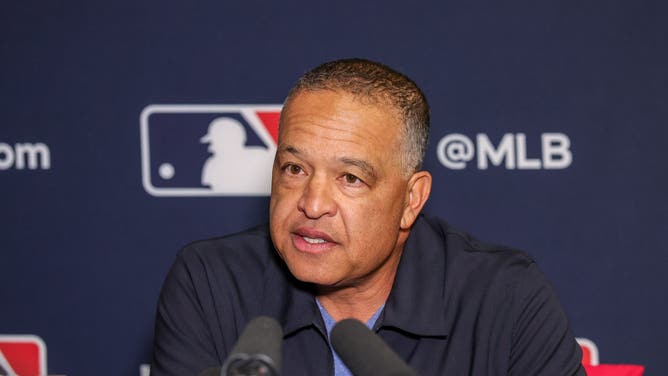
Los Angeles Dodgers manager Dave Roberts speaks with the media during the 2025 MLB Winter Meetings at Signia by Hilton Hotel. Photo: Mike Watters-Imagn Images
Dave Roberts Roasts ‘Bottom Feeders,' Says Salary Cap Won't Stop LA
When asked recently if he believes that a salary cap would hurt his organization, Roberts gave the correct answer: "I just think we have an organization that whatever the rules and constrictions are, we're going to dominate."
In another recent discussion on a potential cap, Roberts said that suppressing spending at the top is only justifiable if you force the "bottom feeders" to spend more money too.
And he's right on both counts.
The Dodgers would continue to excel in a salary cap era, because they have the best front office in the sport. They've created a culture and track record of winning that few teams, if any, can match. If spending on salaries is suppressed, players will look to maximize their off-field income. How would they do that? By going to the largest markets and biggest brands available. Which are, of course, teams like the Dodgers and New York Yankees.
LA routinely has one of the best handful of farm systems in baseball, despite drafting at the end of the first round, or out of it entirely, virtually every year. That farm system supplies talent to the major league roster, like Andy Pages or Will Smith, who had key roles in the decisive Game 7. Or Justin Wrobelski and Emmett Sheehan, who had scoreless outings in Game 7. Their scouting department is the best of the best, allowing them to find underrated talent like Max Muncy, who hit a massive home run in the 8th inning of Game 7. Or Tommy Edman, who was available, basically for free, in trade during the 2024 season and then won the NLCS MVP Award in 2024, and played a substantial role in the 2025 World Series. Or Miguel Rojas, who for $5 million this past year, hit one of the biggest home runs in World Series history to tie up Game 7 in the ninth inning.
A salary cap won't stop how good LA is on the margins of roster construction. And that's their biggest advantage.
Forcing the "bottom feeders" to spend more money isn't what the league wants, and that's where Roberts is also right. MLB wants to allow small market teams to act poor and make excuses to their fans. They don't want to bring everyone up, they want to bring down the top. Never mentioned is that the biggest spender this offseason, by far, is the Blue Jays.
They spent $210 million for Dylan Cease, $37 million for Tyler Rogers. $30 million for Cody Ponce. And they're not done; they've already met with Kyle Tucker, the biggest free agent available, and are rumored to be looking to resign Bo Bichette. Other teams can spend money too, and can include deferrals. They choose not to.
Baseball isn't broken, but if there is a problem, it's that small market teams spend a lower percentage of their revenue on payroll, because ownership needs to pay themselves tens of millions per year in profit. Fix that, then start complaining.