Would This Idea Fix The College Football Playoff Rankings?
BYU and Notre Dame would benefit while Alabama drops in proposed system combining multiple metrics
It seems like virtually everybody is upset about the latest iteration of the College Football Playoff poll.
Fans of the Notre Dame Fighting Irish are furious that the Irish were jumped in this week's release by the Alabama Crimson Tide, despite Alabama looking very shaky against a mediocre Auburn team. Miami Hurricanes fans are mad that it seems possible that they're on the outside looking in, thanks in part to missing out on the ACC Championship Game.
Texas Longhorns fans are mad that their three-loss team is also likely to miss out on the 12-team field, because they've apparently forgotten that Florida finished 4-8. Vanderbilt Commodores coach Clark Lea was so mad, he said the SEC should get preferential treatment over other conferences. Vandy even reportedly considered trying to schedule an extra game to convince the committee it deserves to be included.
RELATED: SEC Coach Says Other Conferences Should Be Denied CFB Playoff Spots
But there's one team that has a very strong case to be included in the College Football Playoff that's being underrated by the committee and has received little attention for it: the BYU Cougars. BYU's resume is undeniably impressive, and its one loss was to a consensus top-5 team, the Texas Tech Red Raiders.
But one of the big issues with the committee format is that it's influenced heavily by what individual people prefer. What they value in terms of strength of schedule, resume, and conference affiliation. So is there a way to improve on this format, and potentially remove some bias from the equation?
It's not exactly the BCS, but there might just be a way.
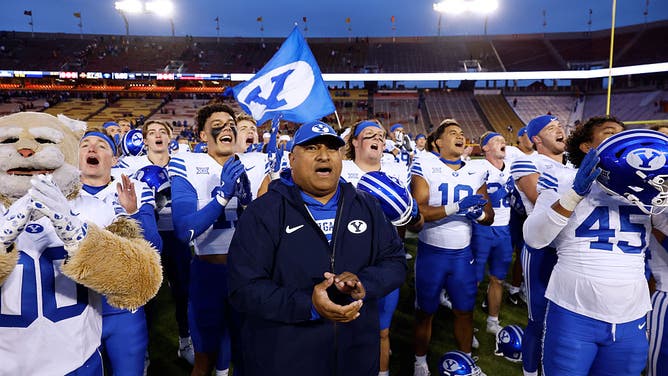
BYU Cougars head coach Kalani Sitake on the field with his players after a game during the 2025 college football season. (Photo by David K Purdy/Getty Images)
Combining Metrics To Fill CFB Playoff Field Yields Interesting Results
Bill Connelly, creator of the SP+ advanced ranking system housed at ESPN, posted on X this week with an idea of how to blend rankings and ratings to form a mix that would remove much of the inherent bias in human-based ranking systems.
He created a computer average that combined: 40 percent of Resume SP+, essentially a ranking of how well teams played relative to how a top-5 team would be expected to play, 40 percent strength of record from ESPN's FPI ranking system, 10 percent of SP+, a forward-looking predictive metric, and 10 percent FPI, another metric designed to measure future performance.
The goal here is to combine how well a team has played against its competition with how well we'd expect it to play moving forward. And while there are some similarities with the committee's rankings, there are some notable differences.
Here's how this list works out:
Rank | Team | Record | Comp Avg | Comp Rk | CFP rk | Comm. Diff. |
1 | Indiana | 12-0 | 0.982 | 1 | 2 | -1 |
2 | Ohio State | 12-0 | 0.980 | 2 | 1 | 1 |
3 | Oregon | 11-1 | 0.971 | 3 | 5 | -2 |
4 | Texas Tech | 11-1 | 0.966 | 4 | 4 | 0 |
5 | Georgia | 11-1 | 0.958 | 5 | 3 | 2 |
6 | Texas A&M | 11-1 | 0.957 | 6 | 7 | -1 |
7 | Ole Miss | 11-1 | 0.953 | 7 | 6 | 1 |
8 | Notre Dame | 10-2 | 0.950 | 8 | 10 | -2 |
9 | BYU | 11-1 | 0.947 | 9 | 11 | -2 |
10 | Alabama | 10-2 | 0.945 | 10 | 9 | 1 |
11 | Miami-FL | 10-2 | 0.941 | 11 | 12 | -1 |
12 | Vanderbilt | 10-2 | 0.939 | 12 | 14 | -2 |
13 | Oklahoma | 10-2 | 0.938 | 13 | 8 | 5 |
14 | Utah | 10-2 | 0.935 | 14 | 15 | -1 |
15 | USC | 9-3 | 0.900 | 15 | 16 | -1 |
16 | Texas | 9-3 | 0.898 | 16 | 13 | 3 |
17 | James Madison | 11-1 | 0.894 | 17 | 25 | -8 |
18 | North Texas | 11-1 | 0.891 | 18 | 24 | -6 |
19 | Michigan | 9-3 | 0.876 | 19 | 19 | 0 |
20 | Iowa | 8-4 | 0.860 | 20 | 23 | -3 |
Several major differences jump out immediately.
Notre Dame is immediately well within the playoff field at No. 8. Alabama is behind that at No. 10. Vanderbilt jumps into the top-12, though remains on the bubble. As you'd expect, smaller programs like BYU, James Madison and North Texas are a bit underrated. In fact, the Cougars might put themselves in position to make the 12-team field, regardless of the outcome of the Big 12 Championship Game against Texas Tech. Oh, and Oklahoma's series of underwhelming performances, even in wins, are punished. Significantly.
So why is this better? Well, the committee says it intends to incorporate these factors, how well a team has played, and how well we expect it to play, into its rankings. But with nebulous concepts like "top 25 wins," or the small sample size of head-to-head playing an outsized role, the outcomes are rarely consistent.
Alabama's running game mattered, per the committee chairman, until the Tide averaged a very mediocre 4.2 yards per carry against Auburn, which was apparently so impressive it warranted jumping Notre Dame. The logic changes week-to-week instead of remaining consistent. Of course, computer rankings don't make everyone happy either, and the importance of head-to-head is removed because it's treated as just another data point.
But that might be exactly what the sport needs to remove biases, treat teams from various conferences similarly, and account for actual strength of schedule and ranking. Not the assumed and hypothetical difficulty of certain big-name conferences.