College Football Playoff System, Committee, Is A Joke And Needs A Complete Overhaul
End human based ranking systems and move to objective standards to end ridiculous playoff committee arguments
This year's College Football Playoff committee and its selection process has proven one thing beyond a shadow of a doubt: the entire system is broken.
The way it ranks teams. The laughable weekly television show. The absurdity of its choices this year, the lack of consistency. It's a farce. And it needs to be completely overhauled to remove the overwhelming human bias, the prolific influence of ESPN, its broadcasters, its conference partners, and the almighty SEC.
What might be the most galling part of the embarrassing process that we just witnessed was the disgraceful choice to include the Alabama Crimson Tide in the 12-team playoff after they were humiliated by the Georgia Bulldogs in the SEC Championship Game. Though it wasn't just the choice itself that was indefensible. It was how ESPN handled it. How the committee handled it. Along with the obvious lobbying and propaganda campaign designed to influence voters.
It was the complete lack of logical consistency in how the committee handled Alabama's blowout loss, relative to previous conference championship games, and other ones held on literally the exact same day. It was the complete lack of rigor in the committee's reasoning, and how ESPN's announcing teams handled Bama's high school-level performance.
And it demonstrated once and for all that this system cannot be fixed if it remains the way it is today.
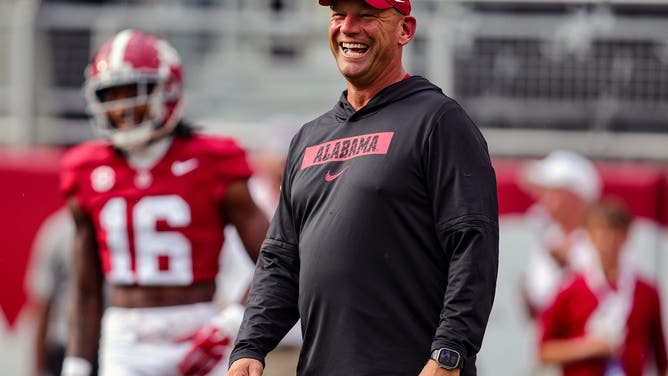
TUSCALOOSA, Ala. - Head coach Kalen DeBoer of the Alabama Crimson Tide is all smiles prior to kickoff against the Western Kentucky Hilltoppers at Bryant-Denny Stadium on August 31, 2024. (Photo by Brandon Sumrall/Getty Images)
College Football Playoff Committee Humiliates Itself
There's blame to go around, but let's start with how the selection committee handled Alabama in the last few weeks of the regular season and conference championship weekend.
In Week 12, after Oklahoma upset the Crimson Tide in Tuscaloosa, the Tide dropped from No. 4 to No. 10. Sure, makes sense. Alabama actually outplayed the Sooners in that game, but consistently turned the ball over in Oklahoma territory, leading to a close home loss. The Tide stayed at No. 10 when they played their traditional SEC November bye week game against a high school program in Week 13. Then they went to Auburn, playing a 5-6 Tigers team so bad they'd already fired their head coach. And Alabama was comprehensively outplayed.
Despite possessing the ball for over 34 minutes and running 73 plays, the offense generated just 280 yards, good for 3.8 yards per play. Auburn, meanwhile, had 5.5 yards per play against what's ostensibly a top-10 level defense. It's no surprise then, that the postgame win expectancy favored the Tigers, roughly 56 percent to 44. In short, Alabama was "lucky" to win.
What did they do with Alabama in the rankings after it won a game against a bad team and was outplayed? It moved the Tide up a spot to No. 9. What was the logic behind it? Because committee head Hunter Yurachek said they were impressed with the Tide's run game, which averaged a whopping 4.2 yards per carry against a bad team.
This is absurd. It's so purposefully ignorant, so willfully dumb it beggars belief. Only an SEC team with Alabama's brand name would be rewarded after looking so bad against a 5-6 team on the road. Imagine, for example, say, a Washington Huskies team with an identical top-10 ranking to Bama beat a 5-6 Minnesota team with an interim head coach in a game in which it was heavily outplayed. Does anyone believe UW would move up in that situation? Of course not. But the committee had predetermined that because Alabama made the SEC Championship game with that win over Auburn, the Tide would be in the playoff, no matter what. So they moved them up to make that decision more justifiable.
Sure enough, no matter what is exactly what we got.
Alabama was obliterated by Georgia in Atlanta. Alabama's postgame win expectancy in that game was 0.2 percent. Put differently, Georgia's postgame win expectancy was 99.8 percent. Alabama didn't belong on the same field. The Tide had -3 yards rushing. With 10 minutes remaining, they had 143 total yards of offense. But the committee had predetermined that they were in, so they were. Because of their game against Georgia in the regular season.
This is insanity. If that one game mattered so much, what happened to the meaning of their one-game result against Florida State? An awful team that went 2-6 in the ACC? SEC boosters are obsessed, to the point of parody, with hypothetical results. Social media is filled with nonsensical posts saying things like, "Alabama would go undefeated in the ACC!!221212!" How then do they explain the Crimson Tide getting dominated by a bad team that went 2-6 in the ACC?
They don't. They don't have to. They have the correct conference patch on the front of their jersey. They have the benefit of assuming that every SEC team, no matter how bad they are, or no matter how many ugly games they play, is automatically superior. Every win over a bad SEC team is proof of the conference's depth, while ACC wins over bad teams are proof of how weak that conference is relative to the SEC. SEC teams are just better because they sell a lot of tickets, or something. Who knows. It doesn't have to make sense.
As a result of their predetermined decision-making, the committee essentially turned the SEC Championship game into a meaningless exhibition. Both teams were in, regardless of what happened or how ugly it got. The results literally could not matter. Other conference championship game results did matter though, because the teams involved did not have the correct patch on the front of their jersey.
So this is how we get the insanity that played out in the final three weeks of the rankings:
Week 13:
9. Notre Dame
10. Alabama
11. BYU
12. Miami
Week 14:
9. Alabama (beat Auburn 27-20)
10. Notre Dame (beat Stanford 49-20)
11. BYU (beat UCF 41-21)
12. Miami (beat No. 22 Pittsburgh 38-7)
Week 15:
9. Alabama (lost to No. 3 Georgia 28-7)
10. Miami
11. Notre Dame
12. BYU (lost to No. 4 Texas Tech 34-7)
So Alabama's loss didn't matter, but BYU's loss mattered. Notre Dame dropped two spots in two weeks after blowing out a bad opponent on the road, then not playing. Alabama moved up a spot after being comprehensively outplayed by a bad team on the road in a close win. Miami jumped Notre Dame because of reasons, apparently head-to-head, which didn't matter all season until it mattered in the final poll. Notre Dame dropped behind Bama because a week one loss to a top-10 quality opponent on the road mattered for Notre Dame, but a week one loss on the road to a woeful FSU team didn't matter for Alabama. Makes perfect sense.
The Big Ten Championship game mattered to Ohio State, which moved from No. 1 to No. 2 after losing, but the SEC Championship game didn't matter to Alabama. This came after every single conference championship game loser in the past three years of the committee's poll system had dropped at least one spot. Until now.
Let's go back briefly to 2022 to look at how the committee handled prior results. USC had finished out an 11-1 regular season. The Trojans one loss was on the road to a ranked team in the final minutes by one point. They were No. 4 in the committee poll, headed for a spot in the playoff. They were up 17-3 on the Utah Utes in the Pac-12 Championship game, seemingly just 45 minutes from their first ever playoff berth. Then Caleb Williams got hurt, the offense collapsed, and the Utes stormed back to win 47-24. After that game, USC dropped six spots in the CFB Playoff Poll and was out.
Six spots. Alabama loses, by a bigger margin, and doesn't move. That's the protection that playing in ESPN's favorite conference offers.
This is where the committee is so broken. We have data now that gives us an idea of which teams are the "best," and which teams did the best against their schedules. No one system is perfect, but it's significantly better than just guessing, going off awful preseason polls, and being influenced by ESPN talking heads. For example, Kirk Herbstreit said on Saturday that BYU should be penalized for losing to No. 4 Texas Tech. Then, not two minutes later, said that Alabama couldn't be penalized for losing to No. 3 Georgia. It doesn't make sense because it doesn't have to. That's the SEC. That's ESPN. The ESPN-controlled ACC Network played the Miami-ND game on repeat, for days, hoping to influence the committee. It worked. That's the power of their partnership.
And that data, by the way, is overwhelmingly against Alabama, and in favor of Notre Dame.
By SP+, which is a forward-looking metric system that measures opponent-adjusted efficiency on offense and defense, Alabama is the 13th best team in the country this season, one spot ahead of Iowa and two ahead of USC. By Resume SP+, which compares game outcomes to what an average top-five team would be expected to generate against a given opponent, Alabama is 16th, one spot ahead of USC, and behind BYU, Vanderbilt, and Utah. Those three teams were left out of the field. Alabama is in.
The Tide's strength of schedule was seventh. They played a tough schedule. But for the most part, they were inconsistent against it, which is why their "second order" win total, or "deserved" win total was just 8.5 when they won 10 games. What makes elite teams elite is playing well, consistently, against your competition. That's why Texas Tech had the second-highest Resume SP+ ranking, despite a much easier schedule. Because they dominated, consistently, week in and week out. Alabama didn't.
Notre Dame, meanwhile, was No. 7 in Resume SP+ and No. 6 in SP+ predictive rankings. They deserve to be in. Alabama doesn't. But again, the SEC's propaganda machine and self-obsession wins out. It usually does.
When you allow humans, who are biased, easily influenced, and unable to examine data critically, to make important decisions, this is what you get. There should be clear criteria that informs the rankings. We could use a blend of forward-looking and resume-based ranking systems, that are public and updated weekly. That'd provide clarity and consistency. Instead of obsessing over the SEC's supposed superiority, it would measure teams on a level playing field, without the hypocrisy and logical fallacies. Create a rating system that uses objective data to rank teams, instead of allowing SEC message board level arguments to influence the most important poll of the season.
That's the only way to lend credibility to the selection process, because this year's farce completely destroyed it.