College Football Teams Are Firing Coaches More Quickly Than Ever - But Should They?
Brian Kelly, James Franklin among high-profile casualties as 2025 season produces unprecedented early firings
It's been an extremely volatile start to the 2025-2026 college football coaching carousel, and we're not even into November.
Big name jobs in several major conferences have suddenly come open. Some firings have come for teams that were in the top 5 or reached the top 5 after what seemed to be an exceptional start to the 2025 season.
Brian Kelly is out at LSU after a season-opening win over the Clemson Tigers catapulted his team into the top-5 of the AP Poll. James Franklin is out at Penn State after reaching the College Football Playoff semifinal last season. And entering this season in the top-2, with legitimate hopes of winning a championship. The Florida Gators are looking for a new head coach, firing Billy Napier even after upsetting the Texas Longhorns in Gainesville.
So are programs handling their process the right way?

Oct 11, 2025; University Park, Pennsylvania, USA; Penn State Nittany Lions head coach James Franklin stands on the field following the game against the Northwestern Wildcats at Beaver Stadium. Mandatory Credit: Matthew O'Haren-Imagn Images
(Matthew O'Haren-Imagn Images)
Early Season Firings Are Becoming The Norm In College Football
After years of letting coaches finish out the season, programs are moving faster than ever to replace the current staff.
The Athletic took a look at how this trend has developed over time. And 2025 has reached a new level of speed when it comes to making a change at the top. From 2010 through 2013, there were 10 head coaches fired between Week 1 and November 1 of each individual season. In 2025 there's already been 10.
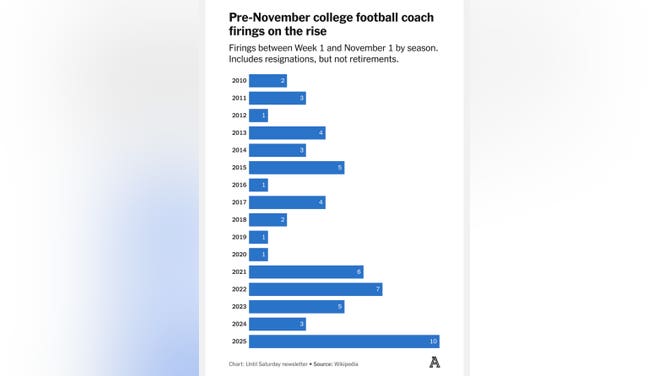
What's behind this? And does it make sense?
The obvious explanation is that administrations have simply not adjusted to the reality of modern college football. NIL and the transfer portal have made consistent success more difficult than it's ever been. Teams are more closely matched than ever before. Vanderbilt, out of nowhere, has become a top-10 caliber team. One that, despite the program's lackluster history, is evenly matched on the field with powerhouse teams like LSU or Alabama.
When the gaps between teams shrink, variance grows. That's why you rarely see baseball teams win even 65% of their games, while NFL seasons will frequently see the best team or teams win 85+%.
Instead of having schedules where every the "bigger" program has 80-90% win expectancy, there are more games than ever where it's 50-50 or 60-40%. With odds like that, losses are going to become more common. They have.
No team wants to be left behind either, if there are top coaches available in the market. Waiting until December or January might mean that say, Lane Kiffin has already been hired elsewhere. If an AD is convinced the head coach won't start the next season on the sidelines, it makes sense to move quickly.
Still, the early firings remove the possibility for a coach to salvage a season. LSU is 5-3. What if Kelly had beaten Alabama? Two easy games follow, so the Tigers could have headed into the season-finale at 8-3. Instead, he's gone.
Welcome to the new world of college football. At some point, maybe athletic department administrators will realize it is a new world.