Is Bowl Season Effectively Dead, Or Can It Be Saved?
Fighting Irish choose to forgo postseason play after being left out of College Football Playoff, as LA Bowl attendance drops
Remember the good old days of college football bowl season?
Almost every day throughout December, there were good, fun bowl games pitting quality teams against each other. There was no debate over whether star players would be involved, no "opt outs," no teams turning down invitations. Lesser games still had big attendance figures, as fans built winter vacations around warmer destinations. It built up throughout the month, culminating in the key bowl games around New Year's Day. The Rose Bowl served as a de facto end of the season, with the biggest and most historic stage.
Now? That's all a distant relic of a difficult-to-remember past. And it's only going to get worse.
The start to the 2025 bowl season has been a strong reminder that the old days of college football are never coming back. In some respects, that's for the better. In some, it's for the worse. For example, in the days after the end of the conference championship games, discussion focused primarily on the Notre Dame Fighting Irish.
The Irish were left out of the College Football Playoff in favor of the Alabama Crimson Tide and Miami Hurricanes. The committee, as it so often does, simply made up its criteria on the fly, engaged in its usual lack of logical consistency, and predetermined the outcomes it wanted. In short, Notre Dame was treated unfairly. Instead of accepting that, however, the Irish took their ball and went home.
RELATED: Would This Proposal Fix College Football And Broken Playoff Committee?
They announced on social media they would decline any bowl invitation, choosing to forgo important postgame practices and more development time as a team. And while it's easy to criticize, that type of decision is only going to become more common. Because there's simply no point to most bowls anymore.
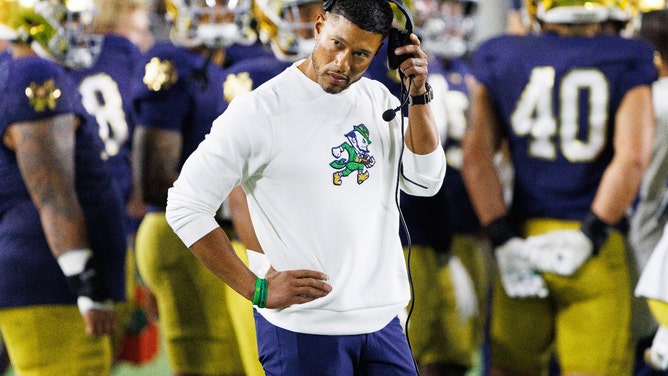
Notre Dame head football coach Marcus Freeman. MICHAEL CLUBB/SOUTH BEND TRIBUNE / USA TODAY NETWORK via Imagn Images
College Football Playoff, NIL, NFL, Ending Bowl Season For Good
It wasn't just Notre Dame. One of the first higher-profile bowl games of the season was the LA Bowl pitting the Washington Huskies against the Boise State Broncos at SoFi Stadium. Warm weather destination, two schools with large, dedicated fan bases, a gigantic brand-new state-of-the-art venue, and…nobody showed up.
The official announced attendance was just more than 23,000, but it sure seemed like less than that. Crowd shots before kickoff showed dozens of fans sprinkled around the lower bowl, with the middle and upper sections virtually empty.
It filled in more as the game started, but just barely.
Then there's the Alamo Bowl, with 9-3 USC taking on 8-4 TCU in San Antonio. In prior decades, it wouldn't be a point of discussion how many big-name players for SC would be available. Yet sure enough, head coach Lincoln Riley announced over the weekend that several starters would not be participating.
Safety Kamari Ramsey is out after declaring for the NFL Draft. So is Biletnikoff Award winner Makai Lemon. And circus catch specialist Ja'kobi Lane. Starting tight end Lake McRee won't play, neither will starting linebacker Eric Gentry. This isn't an outlier, it's become common practice across the sport. Starting players heading for the NFL sitting out instead of playing in a relatively decent bowl game. And the reasons make sense; why jeopardize your health for an exhibition game that isn't the College Football Playoff?
It's the same for fans too. Why buy tickets for an exhibition bowl game where half the starters from the regular season aren't playing? These are valid questions, and it raises the more important overarching one: what is the future of bowl games?
Notre Dame, one of the game's biggest brand names isn't going to play in a bowl game at all. Star players left and right won't be playing. Nobody's buying tickets to half these games anymore to see backups taking on backups. NIL and the transfer portal makes it so that many players will avoid bowls, since they're halfway out the door already anyway.
It's just not sustainable, and with the game trending in the direction it's going, there's little to suggest it's ever going to go back to the way it was.
Expanding the College Football Playoff isn't a popular choice, for good reason. But it might be the only path forward to allow more teams, players and fanbases to continue after the regular season. Home playoff games in a 16-team or 20-team or whatever it is field would sell out stadiums and keep players engaged. Bowls could be revived in importance. Ratings would be huge. And most importantly, more money would get infused into the sport.
Like it or not, that's what college football runs on these days. And the current bowl system isn't printing enough of it.