Browns’ Baffling 2-Point Call Fuels Questions About Intent
Inside the Browns’ failed two-point call that overshadowed Shedeur Sanders’ big day.
I apologize for the click-baity headline. Let me get this out of the way immediately: No, I do not think the Cleveland Browns lost to the Tennessee Titans on purpose to improve their position in the 2026 NFL Draft. That being said, I know there's a section of people who believe that could be the case.
To be fair to those people, the Browns' potential game-tying 2-point conversion try certainly did not look like a team trying to actually, you know, convert the 2-point conversion.
I mean, what were they even thinking? They took quarterback Shedeur Sanders (who was having the best game of his young career) off the field and ran a direct snap to rookie running back Quinshon Judkins. Wildcat formations are not new to the NFL, and teams often still use them in short-yardage situations to get an extra blocker in the game.
But to go into the Wildcat, snap the ball to Judkins with (apparently) instructions to flip the ball on a reverse to rookie receiver Gage Larvadain (who had seven total NFL touches, with one fumble, prior to that play), invites questions about the team's intentions to actually win the game.
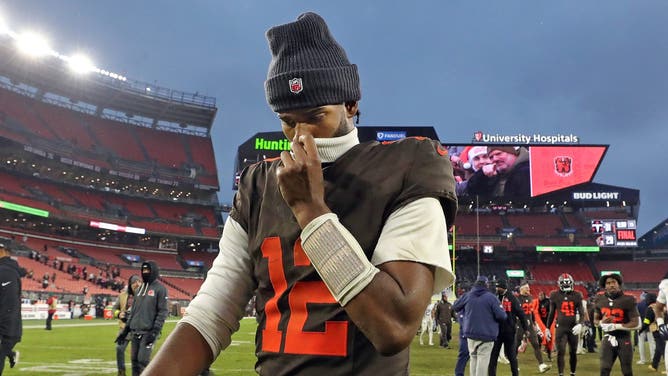
After a career performance from rookie QB Shedeur Sanders, the Browns pulled him for a trick play on a potential game-tying two-point conversion against Tennessee.
(Jeff Lange / USA TODAY NETWORK via Imagn Images)
Now, if the Browns had perfected that play in practice and really felt like it couldn't fail, great! Except that clearly wasn't the case. Judkins wasn't even sure whether he was supposed to pitch the ball or wait and throw it back across the field. Sending out two rookies to execute a trick play, one that required everyone to be on the same page, without clear instructions on what was supposed to happen, seems like coaching malpractice.
Unless the goal wasn't to actually score two points.
Was Avoiding Overtime Part of Cleveland's Plan?
The more I think about it, the more I talk myself into the idea that the Browns didn't want to score. It might not necessarily have had anything to do with draft position, though.
We've seen it before in the NFL, where teams out of playoff contention go for two to try and win a game rather than kick an extra point to force overtime simply because they don't want to have to play an overtime period. NFL games are already taxing on players, and adding an extra ten-minute period isn't ideal, particularly for a team not jockeying for postseason position. Had the Browns converted that two-point try, overtime was all but assured.
I'm not saying that's what the Browns were doing. However, it's fair to at least ask the question. Sanders led the team on two touchdown drives in the final six minutes to get the team in a position to tie or win the game. The rookie quarterback threw for a career-high 364 yards and three touchdowns. Sanders hadn't thrown for more than 209 yards or one touchdown in a game prior to Sunday. He also ran for another score.
Taking him out with the game on the line seems strange. To be fair to the Browns coaching staff, though, Cleveland attempted a 2-point conversion after their first fourth-quarter touchdown and Sanders fumbled the snap. They might not have wanted a repeat of that disaster.
Ultimately, I don't believe the Browns tried to lose the game. But that two-point conversion was one of the ugliest plays I have ever seen.
Both things can be true.