Former Notre Dame QB Brady Quinn Says ESPN Is Controlling College Football Playoff
Brady Quinn argues selection process changed to benefit SEC teams after Big Ten won last two national championships
The College Football Playoff field is set, for better or for worse. And for a process that's almost entirely opaque, confusing, and often, completely contradictory, this year resulted in yet another controversial outcome.
The selection committee, seemingly on a whim, went from ranking the Notre Dame Fighting Irish No. 9 to ranking them No. 11, with their one result over that time frame being a blowout win over the Stanford Cardinal. The Miami Hurricanes went from No. 12 to No. 10, with their one result being a win over Pittsburgh. Alabama moved up from No. 10 to No. 9, after winning a game against Auburn the Tide had no business winning, then being completely humiliated by Georgia in the SEC Championship Game.
Alabama's loss and poor play (the Tide averaged 3.8 yards per play combined in their final two games of the season, including garbage time) didn't matter. Miami's losses to mediocre Louisville and SMU teams stopped mattering, because the Hurricanes had one good win over Notre Dame. Notre Dame's dominance against its schedule after two losses by a combined four points against top 5-10 opponents no longer mattered.
There's little logical consistency to any of it. Results matter, until they don't. Some early season losses matter, like Notre Dame's, but don't if you're Alabama and the loss was to an awful FSU team. These issues, and who consistently gets the preferential treatment, have given rise to complaints about the influence of conference media partners on the committee. Like, say, ESPN, which relentlessly promotes the SEC, and when it suits its purposes, the ACC too.
RELATED: Chris Fowler Addresses Whether ESPN Controls College Football Playoff Field
One commentator, former Irish QB Brady Quinn, has a pretty clear view on how much influence ESPN wields.
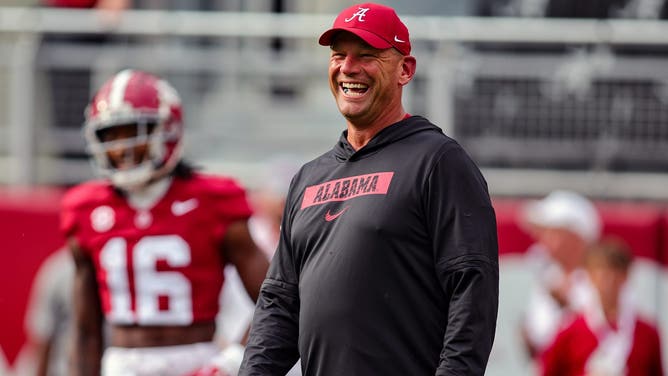
Head coach Kalen DeBoer of the Alabama Crimson Tide. (Photo by Brandon Sumrall/Getty Images)
Brady Quinn Thinks ESPN Is Pulling The Puppet Strings
On a new interview for the "Sturgotz and Company" show, Quinn said that the "entire process" of the playoff committee and their selection is dominated by ESPN and Disney.
"This entire process is controlled by ESPN and Disney," he said. "And just to compare it to the NFL — because that’s where college football is going, it’s more of a professionalized model — what you have is an NFL that controls all of it. And they kind of say, ‘Hey, we decide who gets access on this and who doesn’t,’ it’s entirely different with college football. This is all an ESPN creation, a Disney creation, so I think that’s where they think there’s a big sense of bias."
He's right; the NFL is ruthless in its control of the product, its perception, and public discussion.
"I mean, let’s just go back before the season. [ESPN] talked about the committee changing the criteria in how they evaluate schedules, because what did we have last year in the playoff? Only three SEC teams and they all got stomped for the most part, besides Texas, that at least made its way to the semifinal round. And, by the way, barely made it there," Quinn said.
Essentially, his argument is that the entire selection process was changed in order to benefit the SEC, because that would be financially advantageous for both ESPN and its most important conference partner. The baked-in belief is essentially now that the SEC is automatically superior to other conferences, meaning losses or wins among SEC teams carry more weight in the committee's evaluation. Their schedules are assumed to be harder, because SEC fans and ESPN say they are.
To Quinn, the fact that the Big Ten won the last two titles influenced the decision to reevaluate criteria and push for more SEC teams to get in.
"So, when you look at the landscape, I think the SEC was watching the Big Ten now win the last two national championships, there’s a lot more money in some of these Big Ten programs that are starting to distance themselves," Quinn said. "And you look at their media rights deal, same thing, they keep kind of distancing themselves. I think there’s a concern for the products that ESPN has and the SEC and ACC."
Does that mean ESPN is calling Hunter Yurachek and saying, "put these teams in?" No. But it's clear that ESPN's influence, and its advocacy in the lead up to the final poll, had a massive role in the inexplicable absurdity that just played out over the final weeks. Quinn thinks so too.
"As much as you know, I sit there and say, is there separation between the committee and ESPN? Sure," he added. "But it also lends itself to the conspiracy theories that are out there because it’s hard to make a case for a team that went 2-2 in its last four, got absolutely drummed in the SEC championship game, and watched every other team conference championship weekend dropped that lost but them."
Quinn also said he believes "they're making it up as they go along," which is inarguably true. And that's the bigger problem.
There's no set of strict, objective criteria that matters. Alabama's win over Georgia matters the most of any win in the country, for some reason, even though the Tide were objectively outplayed by the Bulldogs. But their loss to FSU doesn't matter. Notre Dame's close losses to Miami and Texas A&M are heavily punished, but Alabama losing at home to Oklahoma is ignored. Miami's weak ACC schedule and losses to mediocre teams aren't important, but Notre Dame's weak schedule is important. Alabama's running game matters, according to the committee chairman, until it puts up -3 rushing yards against Georgia. Because the SEC Championship Game was actually a meaningless exhibition, unlike the Big Ten or Big 12 Championship games.
It makes no sense, because it doesn't have to. It just has to make ESPN happy.