The Big One: College Athletes File Lawsuit Against NCAA To Change The 'Redshirt Rule'
Athletes claim the NCAA’s redshirt rule unfairly restricts competition and violates their rights, filing suit to expand eligibility to all five years.
A group of athletes has filed a lawsuit against the NCAA looking to change the rules relating to how many years of eligibility they are granted, taking aim at the ‘redshirt rule’ in college athletics.
Vanderbilt LB Langston Patterson, along with four others, filed a lawsuit today in Middle Tennessee that challenges the current NCAA rule pertaining to how many years a player is eligible for competition, which currently includes his or her redshirt year.
Right now, the five-year rule that is currently in place only allows athletes to compete in four years of the five years granted to them, with plenty of athletes in football, basketball, baseball and other sports only being part of a team if they use a ‘redshirt year’ as part of their clock. Athletes are not given that opportunity to play in all five years, only four, with a set number of games during the redshirt year in place.
If an athlete wanted to maintain their ‘redshirt year’, they could only compete in four games during that initial redshirt season. If they were to compete in a fifth, it would count towards their eligibility clock.
High Road Pays Off: Rashul Faison Eligible To Play For South Carolina 2025 After NCAA Grants Waiver
In the new lawsuit filed by the ‘Texas Trial Group’ on Tuesday, they are challenging the NCAA's right to allow these athletes to participate in workouts, practice and other daily activities, but not allowed to play in the actual games.
"For almost fifty years, the NCAA has enforced a rule providing Division I college athletes with a five-year window to exhaust their competition eligibility (the "Five-Year Rule").2 However, within those five years, the NCAA limits college athletes to competing in only four seasons of intercollegiate competition (the "Four Seasons Rule")3 and otherwise dictates that a college athlete may use the fifth year only to compete in team activities without, or with limited, participation in intercollegiate competition (the "Redshirt Rule")."
Five Years To Play Five Years Is What Plaintiffs Want From NCAA
In essence, the attorneys are arguing that these athletes should be given the chance to play all five years, which the NCAA technically gives them with the ‘eligibility clock’ that is currently used to dictate their time in college.
"These overlapping Rules distort the market for Division I athletics by penalizing academically eligible high-performing college athletes who choose to compete instead of redshirting, thereby forcing them to forfeit a year of potential competition and market value without any legitimate procompetitive justification," the lawsuit reads.
This is also clearly about the financial ramifications that come with having to sit out a season while they are on the team.
"We are not challenging the NCAA’s rule limiting players to five years of eligibility to play college sports or the concept of a defined eligibility period generally," attorney Ryan Downton of the Texas Trial Group stated. "But the NCAA has no basis to prohibit a player who is working just as hard as all of his teammates in practice, in the weight room, and in the classroom, from stepping on the field (or court) to compete against another school in one of those seasons.
"Five years to practice, five years to graduate, five years to play."
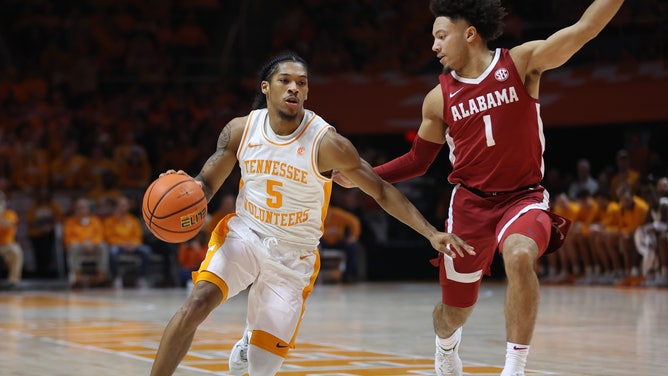
Tennessee Volunteers PG Zakai Zeigler drives past Alabama Crimson Tide PG Mark Sears at Thompson-Boling Arena at Food City Center. (Randy Sartin-USA TODAY Sports)
This is the latest lawsuit filed against the NCAA that challenges the current rules, which have been tested before. There are lawsuits currently being argued in courtrooms across the country pertaining to the eligibility of student-athletes.
In this specific case, there will be plenty of people who support these athletes in their fight, given that the NCAA already has the ‘five-year clock’ in place, but it includes their redshirt season.
Expect this particular case to be argued in a courtroom for an extended period of time, if the NCAA does not give in, and change the current rules.