Why Ozzy Osbourne Was The Most Important Heavy Metal Musician Ever
Man, did we get some sad news Tuesday: just over two weeks after his farewell show as a solo artist and as a member of heavy metal pioneers Black Sabbath, Ozzy Osbourne — the Prince of Darkness — has died.
He was 76.
"It is with more sadness than mere words can convey that we have to report that our beloved Ozzy Osbourne has passed away this morning. He was with his family and surrounded by love," the Osbourne family said in a statement.
For heavy metal fans, this is a tough one. I don't think there is any artist as important and as omnipresent throughout the history of heavy metal from its start until right now as John Michael "Ozzy" Osbourne.
Sure, Lemmy Kilmister may have embodied it more, Metallica may have sold more records, but Ozzy has been part of it all since the moment people dropped the needle on Black Sabbath's debut album and listeners heard an ominous thunderstorm followed by what is to this day, one of the heaviest riffs ever written; the main riff to the title track "Black Sabbath."
Ozzy Put A Spotlight On Some Of The Greatest Musicians In Rock History
Sure, Ozzy gets a lot of attention for his antics over the years. Biting the head off a dove in a meeting with record executives. Biting the head off of what he thought — incorrectly — was a rubber bat. Getting arrested for peeing on the Alamo. Even shuffling around his house on The Osbournes.
But I hope people understand how important Ozzy was as a musician and as someone who, like a successful NFL coach, developed a tree of other musicians who shaped heavy music.
Obviously, this starts in the 1960s with Sabbath. While guitarist Tony Iommi supplied the iconic riffs, drummer Bill Ward brought the bombastic drumming, and bassist and lyricist Geezer Butler brought the thundering bass lines and the dark imagery that became the band's hallmark, as the frontman, Ozzy was the face of the band and had a voice that was unlike anyone before him.
He also played some mean harmonica, too. Go listen to the Sabbath song, "The Wizard," and thank me later.
While Sabbath's discography from the Ozzy days built the groundwork for heavy metal, it was Ozzy's solo career that cemented him as a heavy metal icon, and where his influence on music started growing.
On his first two solo records — Blizzard of Ozz and Diary of a Madman — Ozzy released some of his biggest hits, including what is inarguably his signature tune, "Crazy Train." Both of these records featured late guitarist Randy Rhoads, who, through those albums, became one of the most influential guitar players ever, and while that's mostly because of his incredible technical abilities on the instrument, it's also thanks to the spotlight that Ozzy — as well as his wife and manager, Sharon — gave him.
The same can be said for Jake E. Lee, who played with Ozzy in the mid-eighties, as well as Zakk Wylde, who was Ozzy's longest-serving guitar player, and the great Gus G., who appeared on Osbourne's 2010 album, Scream.
These guys got the job because they were great players, but they became household names in the world of heavy metal because they received the Ozzy stamp of approval.
Furthermore, he had his own touring festival, Ozzfest, which went on for many years, and was a showcase for a lot of new up-and-coming bands.
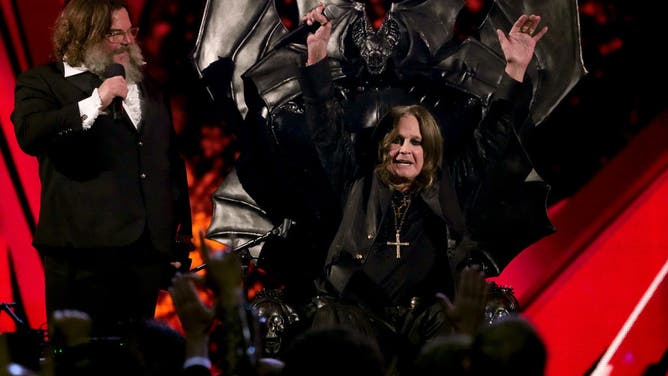
Ozzy Osbourne with Jack Black at his Rock And Roll Hall of Fame induction in 2024. Osbourne is inducted twice; with Black Sabbath and as a solo artist. (Photo by Jeff Kravitz/FilmMagic)
Ozzy's Farewell Show Is A Reminder Of How Much He Means To Heavy Metal
Back on July 5 —‚ just over two weeks before his death, Ozzy played his final show as a member of Black Sabbath and as a solo artist in front of a full Villa Park stadium in his hometown of Birmingham, England, with millions more watching a livestream around the world.
The show brought in $190 million — all for charity — making it the most successful benefit concert in history.
Ozzy performed some of his and Sabbath's biggest hits while sitting in a large throne due to his battle with Parkinson's disease, but he still sounded good and could still hold a stadium in the palm of his hand.
But what I thought was most powerful was how many big-name acts dropped everything to play a benefit with Ozzy.
I mean, Metallica hasn't been a support act for anyone in decades. But for Ozzy and Sabbath? They were all over it, as were Slayer (who recently reunited), Tool, Anthrax, Mastodon, Rival Sons, and numerous musicians others including from Ghost's Tobias Forge, Smashing Pumpkins frontman Billy Corgan, Tom Morello, Extreme's Nuno Bettencourt, Living Color's Vernon Reid, and more.
Why? Because they know as well as the rest of us that if there were no Ozzy Osbourne and Black Sabbath, there'd be no heavy metal music.
So, from one fan who has loved heavy music for most of his life — and carried Ozzy's memoir I Am Ozzy in his backpack through a good chunk of middle and high school — thank you for everything, Ozzy.
Rest in peace.