Let's Debate Working From Home⎮Bobby Burack
Jamie Dimon is the latest CEO to dismiss work-from-home employees as bum-ish slackers who take advantage of their employers. Granted, he made his comments privately before they were leaked to the press this week.
"Don’t waste time on it. I don’t care how many people sign that f—–g petition," Dimon said of a petition — signed by nearly 1,300 workers — over the axing of Covid-era hybrid policies that allowed employees to work from home two days a week.
Last year, Elon Musk called the idea of working from home "morally wrong" in an interview with CNBC. "I mean, I see it more as a productivity issue but it's also a moral issue," Musk said.
Dimon and Musk are two of the greatest business minds of this generation. And maybe in their experiences, work-from-home employees were less productive.
We don't doubt that many employees all across America have taken advantage of the option to work in their pajamas while binge-watching a true-crime documentary on Netflix. But is working from home truly the inherent net negative they claim?
To find that answer, OutKick asked both readers and friends of the site for their perspectives. Our respondents were quite split on the topic.
Ryan Glasspiegel has been working from home, writing for various websites, for the past decade. He believes the home setting has elevated him throughout his career.
"I’ve personally been working from home since 2010, first for an online furniture company and for the past 12+ years as a writer for media outlets including Sports Illustrated, The Big Lead (owned by USA Today and later Minute Media), OutKick, the New York Post, and now Front Office Sports. While I’ve encountered a number of people in the business who swear by the magic of the newsroom, and I’m sure that there are people who take advantage of the situation to the detriment of their employer, I’ve found working from home to be ideal for writing and reporting," Glasspiegel tells OutKick.
"Any job should have tangible, objective performance measures and that’s especially true in online writing. How many stories one produces and how much impact they have are easily identifiable. Any workplace with quantifiable performance should evaluate employees on those metrics and figure out if workers can be trusted at home, or must be in the office, or a hybrid of both."
He emphasized that, whether you work from home or in an office, professionalism will ultimately determine your worth. "Jamie Dimon was talking about not being able to get employees on the phone on a Friday. You’re either a professional or you’re not," Glasspiegel adds. "I can’t fathom not taking a call from one of my bosses today."
(No, Clay, that doesn't mean you can call me at 9 pm on Friday.)
Evita Duffy-Alfonso hosts one of the fastest-growing podcasts in the country, "Bongino Report Early Edition." She has worked both remotely and in an office. She explained to OutKick how she has come to value how working from home can enhance one's personal life.
"I’ve had the opportunity to work both in person and remotely. Remote work has shown me the immense value of flexibility—not just for myself, but for so many others, especially mothers," Evita noted.
"One of the things I love most about remote opportunities is how they empower women to pursue meaningful careers while remaining present for their children. I saw this firsthand with my mom and with many women at The Federalist, who seamlessly balanced work and family life without sacrificing professional ambition. That kind of freedom isn’t just a perk; it’s a shift in the way we think about work, making it more sustainable and humane for mothers."
For context, Evita's mother is Rachel Campos-Duffy, a great mother, wife, Fox News host, and sports expert:
Opinions Vary On Working Remote
The above is why we did not interview Clay Travis or Will Cain for this topic.
Brad Range, the producer of the "Annie Frey Show", sees it differently. He says the blending of work and home life inherently leads to less productivity.
"I can’t do my job from home, so I have to go in," Range explains. "But I don’t think I could work from home. I spent my life building up a separation between work and home life. When I am home it is home time and I wouldn’t be productive. It’s a state of mind thing for me."
But what about the commute?
Every day, workers across America spend hours stuck in traffic as they commute back-and-forth from work. Would those hours not be better spent working if their jobs permitted out-of-office employment?
Amber Harding is an OutKick writer who has worked remotely, in an office, and in hybrid employment. She cited her former commute in Nashville as the reason she found herself more productive working from home.
"I used to have a hybrid job - two days in the office, three working from home. I was substantially more productive on the days I didn’t have to spend 2 hours in traffic and wasn’t constantly being interrupted by people stopping by my desk to chat," she explained.
"On the days that I had to work from the office, I would literally pack up my laptop, drive for usually an hour in Nashville traffic, sit at my desk, work from the same laptop I use at home, doing the exact same thing I did at home, often still taking Zoom meetings because not everyone was in office at the same time and many of the people I dealt with didn’t work in our building to begin with. And then, at 5pm, I’d pack up that laptop and sit in traffic for an hour or more on the way home. It was so silly for me to have to do that.
"I don't care what anyone says, work-life balance is important. 2-hour+ daily commute, 5 days a week doesn’t leave a lot of time for family and life. That’s how people get burnt out and miserable."
Remote Work Remains A Hot Topic
You might think a media bias exists toward working remotely. However, we didn't find that to be the case.
Aidan McLaughlin is the editor-in-chief of Mediaite, a site to which nearly every media executive pays attention. McLaughlin makes it a priority to head to the office every day and thinks aspiring journalists should hope to do the same.
"Even before the pandemic, Mediaite has always operated a flexible newsroom when it comes to working from home," McLaughlin tells OutKick. "We currently have staffers in Florida, North Carolina, New York, New Jersey, Kentucky, California, and Oklahoma. Hell, we have one staffer in Belfast, Ireland. Still, there’s something electric about being in a newsroom. I try to go in every day and would encourage young journalists in particular to do the same."
Patrick Hatten, the executive producer of "The Will Cain Show", found the answer more in the gray. "I will say, collaboration among a writers' room would be better in person," he began. "But there are a lot of distractions in the office in general."
Landry Locker hosts a daily radio show in Houston, Texas. Put simply, he isn't looking to clock-in from his bedroom.
"One of the most taken advantage of, industry-killing things that happened since 2020," he said about remote working. "In sports terms, there are some elite players that don’t need to practice all the time, those are exceptions. Making it to where nobody has to practice would kill any team, that’s what happened."
Translation: don't discuss politics, religion, or the topic of remote work at a family gathering. The topic is contentious.
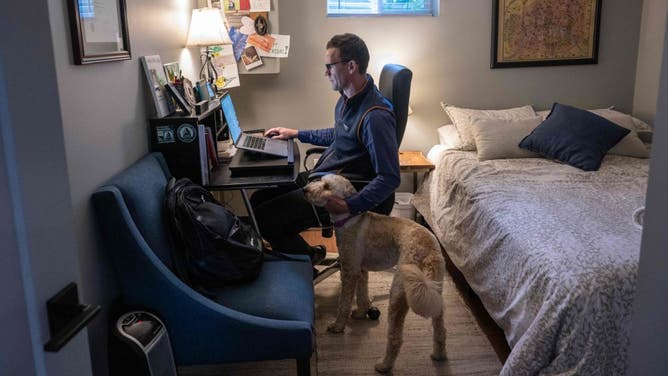
Danny Crouch pets his dog as he sits in his basement working from home in Arlington, Virginia, on May 25, 2023. The pandemic forced Americans to work from home. And now, more than three years on, employers are struggling to bring them back to the office. A third of employees in the US currently have complete freedom about where they work, compared with just 18 percent in France, according to a recent ADP study of 17 countries. (Photo by ANDREW CABALLERO-REYNOLDS / AFP) (Photo by ANDREW CABALLERO-REYNOLDS/AFP via Getty Images)
For me, working in an office would seem to complicate matters. So much of my job is about looking into a topic, researching a topic, and gathering my thoughts about a topic. This process can lead to me working random hours that are inconsistent day to day. Not to mention, I spend chunks of the day communicating with sources and their hectic schedules.
All of this would be more challenging in an office, especially considering the time I'd have to spend commuting. But that's just me. I am not part of a wider writing staff.
Further, you have to wonder how many of these executives who demand in-person work just want to be able to flex their power and shout any time they see an employee swiping right on Hinge.
But that's just me.
For what it's worth, a close friend of mine just texted me saying she would "never, ever, ever marry someone" who works from home. So, there's that, too.