World Series Crushes NBA Finals In The Ratings -- Again
This marks the second consecutive season in which the World Series has outdrawn the Finals
In recent years, OutKick has challenged the notion that the NBA is more popular than Major League Baseball.
"But, Bobby, look at the NBA TV deals," the Bill Simmons fanboys say on Reddit.
Yes. The sheer volume of regular-season baseball games naturally reduces demand for nationally televised broadcasts. On most nights during the regular season, baseball fans can choose between watching their local team or a national broadcast — and they usually pick the former. What’s more, in most markets, local MLB teams consistently attract higher viewership than their NBA counterparts – and it’s not particularly close.
Perhaps the most notable comparison between the two leagues comes during their championship rounds. In 2025, both the World Series and NBA Finals extended to seven games. According to Nielsen, Game 7 of the Dodgers–Blue Jays World Series on Fox averaged 25.9 viewers. By comparison, Game 7 of the Thunder–Pacers Finals averaged 16.4 million viewers on ABC.
The baseball audience was far larger, despite competing against marquee college football matchups. The Finals aired in June, with minimal television competition.
While final calculations are pending, the World Series is projected to average around 15 million viewers, combining the 12.38 million average from Games 1–5 with Game 7 — well ahead of the 10.27 million the NBA Finals averaged, the second-lowest on record.
For context, Nielsen adjusted its television measurement methodology in September to a system called Big Data + Panel. So far, this change has increased estimated audiences for most live sporting events, but not by nearly 10 million viewers — the margin by which the World Series outperformed the NBA Finals.
Moreover, this marks the second consecutive season in which the World Series has outdrawn the Finals. In 2024, the Dodgers–Yankees World Series averaged 15.1 million viewers, compared to 11.2 million for the Celtics–Mavericks Finals.
The past two seasons likely reflect both MLB’s resurgence and the NBA’s ongoing decline. The NBA has lost popularity every season since 2020, while baseball has recorded gains in both national and local markets.
Notably, the challenges facing the NBA are not concerns for MLB. Despite each MLB team playing 80 more regular-season games, the baseball season carries greater competitive weight. Fewer teams make the playoffs, and the early rounds are shorter, making division titles and seeding more meaningful. In contrast, the NBA’s long postseason and expanded play-in format have diminished the significance of its regular season.
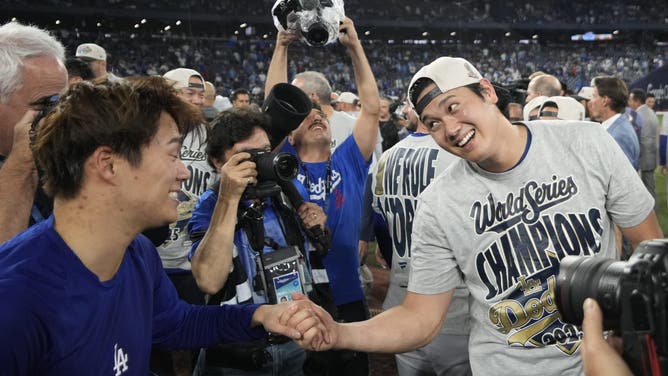
Nov 1, 2025; Toronto, Ontario, CAN; Los Angeles Dodgers two-way player Shohei Ohtani (17) celebrates with pitcher Yoshinobu Yamamoto (18) after defeating the Toronto Blue Jays during game seven of the 2025 MLB World Series at Rogers Centre. Mandatory Credit: John E. Sokolowski-Imagn Images
The NBA has also become less aesthetically pleasing, relying heavily on 3-point shooting and offering fewer highlight-worthy plays, like dunks and drives. Baseball, meanwhile, has shed its reputation for sluggishness thanks to the introduction of the pitch clock, which has made games faster and more engaging.
Finally, the NBA has struggled to cultivate new stars. LeBron James remains the face of the league as he nears age 41. Elsewhere, a new generation of stars in baseball has energized fans across the sport — including Shohei Ohtani, Aaron Judge and Paul Skenes.
MLB’s newfound popularity may come as a surprise to casual sports fans. The NBA holds more cachet with the media, celebrities, television networks and on social media. For example, ESPN devoted more airtime last week to the NBA regular season than to the World Series. But as we’ve learned in recent years, the interests and preferences of the media and Hollywood are far from indicative of society at large.
As Fox Sports Radio host Colin Cowherd explained in December, the NBA has become a league more concerned with impressing elites than connecting with regular fans, much like the Democrat Party.
"The NBA ratings are down 48 percent in the last 12 years and they have fallen off a cliff this year," Cowherd said. "Adam Silver’s solution is, ‘Let’s make the courts brighter.’ It’s a really bad look for a family of four to go to a game and the stars don’t play. Go ask the Democrats — be warned, once you detach from regular people in America, you will pay a price."
And the NBA has paid a price.
While the NBA might be the socially progressive league with celebrities sitting courtside, it’s no longer the second-most popular sport in America. In fact, college football now holds that distinction.
In America, it’s the NFL first, college football second, and MLB third. The NBA sits in fourth place.
Regular people matter.