A Supreme Court Test For Women's Sports | Payton McNabb
Will biological reality be ignored at the expense of women and girls?
As a young girl, I was told that I should always trust the adults in charge. I followed the rules, listened to authority, and even tried to model my life after some of the people I looked up to most. I believed that all adults were on my side, that they would protect me and keep me from harm. And for the most part, that is exactly what happened — until it didn’t.

Former high school volleyball player Payton McNabb. (Photo by Oliver Contreras / AFP) (Photo by OLIVER CONTRERAS/AFP via Getty Images)
A series of policy failures would leave me injured and permanently changed because of adults choosing to look the other way. Those "in charge" were too afraid of being labeled as intolerant, or didn’t want to draw attention to a controversial issue. Coaches, administrators, and athletic associations all chose to look the other way while males quietly slipped into the female category.
Like many other girls, I loved to play sports. As a three-sport athlete, I was prepared to go to college on a softball scholarship. So, my senior year of high school, I once again joined the volleyball team, excited about one last year of competition to send me off to college. For the most part, our season unfolded like any other — until a matchup with one of our other North Carolina rivals that had a biological male, identifying as female, on their roster.
All the girls on my team — and a majority of the parents — felt uncomfortable with a male opponent, yet nothing was done about it, so the game went on as planned. What wasn’t planned was that this individual would spike a ball so hard, hitting me in the head, that it would knock me unconscious and leave me with lasting neurological damage that ended my athletic career.
That moment didn’t just end the game. It changed my body, my future, and my trust that someone would step in.
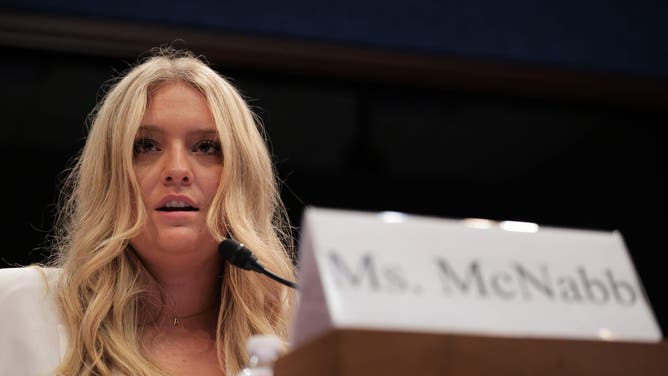
Payton McNabb speaks during the hearing on "Unfair Play: Keeping Men Out of Women’s Sports" held by the Department of Government Efficiency (DOGE) Subcommittee at the U.S. Capitol. (Photo by Kayla Bartkowski/Getty Images)
The Future Of Women's Sports Is Now
Now, the issue has reached the highest court in the land. The Supreme Court is weighing cases that go to the heart of Title IX and whether states have the authority — and responsibility — to preserve female-only sports. These cases aren’t abstract legal debates. They are about real girls with real bodies, real dreams, and real biological differences from males. They are about whether common sense still has a place in our laws, or whether biological reality can be ignored at the expense of women and girls. The Supreme Court isn’t being asked to invent a new rule — only to remember and reinforce the old one.
What the Court decides will shape not just policy, but the future of women’s sports for generations. And for athletes like me, it will finally reveal whether the system is capable of standing up for women at all. The Court has the opportunity to reaffirm that Title IX means what it has always meant: female athletes deserve fair, safe, and sex-based competition.
Title IX’s purpose has been to preserve and protect women’s spaces, and to ensure that women have equal opportunities to participate in both educational spaces and athletics. Before Title IX, female athletes were sidelined, underfunded, and routinely told that there was no room for them. Title IX recognized a basic truth — that fairness sometimes requires separation, not sameness. For decades, Title IX has worked exactly as intended. What has failed, however, wasn’t the law itself, but the willingness of adults to uphold it.
What happened to me wasn’t an isolated incident. Across the country, girls are losing starting positions, scholarships, championships, and in some cases their safety, all because the rules meant to protect us were being rewritten in real time.
I am thankful for the immense support that I have received; whether it was from elected leaders, policy experts, fellow athletes, or parents of teenage girls, I know that there are countless people who know what is right and who continuously stand up for me and for girls like me. But to those who may believe that they are on the inclusive and accepting side of the argument: girls are paying the price for your complacency.
Like countless others, I was taught to trust the adults in charge. That trust was broken when those same adults chose silence over responsibility, leaving girls like me to bear the consequences. Now, as the Supreme Court hears oral arguments that will determine whether states can uphold the purpose of Title IX and protect female-only sports, the system faces a moment of reckoning. This decision will reveal whether our institutions are willing to learn from the harm already done — or whether girls will once again be asked to sacrifice fairness and safety for ideology. The Court is not being asked to create something new, but to restore what was promised all along: that women and girls deserve protection, equal opportunity, and a system worthy of our trust.
Payton McNabb is a sports ambassador for Independent Women and a former three-sport high school athlete who turned tragedy into triumph after a traumatic brain injury ended her athletic future.