Sports Journalism Was Compromised Long Before NFL's Equity Stake In ESPN
“[The NFL] never once asked us to change our approach in terms of how we cover them," Pitaro said.
ESPN President Jimmy Pitaro says the network won’t change how it covers the NFL, even after giving the league a 10% equity stake in exchange for control of NFL Media assets.
"[The NFL] never once asked us to change our approach in terms of how we cover them," Pitaro said in an interview with The Athletic on Wednesday. "We are the place of record. A huge part of our DNA is how we cover sports objectively and fairly. They understand, as do all leagues, that that’s going to continue, hard stop."
Pitaro emphasized: "Nothing is changing."
Well, of course not – but not for the reasons he claims.
Nothing is going to change because ESPN and the NFL were already partners. The NFL was ESPN's most influential partner long before finalizing an equity agreement. In 2021, the network agreed to an 11-year, $29.7 billion rights agreement with the NFL for "Monday Night Football" and two future Super Bowls.
No NFL partner is truly empowered to cover the league "objectively and fairly," as Pitaro suggests. And no one understands that better than Pitaro.
Disney promoted Pitaro to ESPN president in 2018 with a mandate to repair the network’s fractured relationship with the NFL. Under previous president John Skipper, the relationship with the league had deteriorated. At one point, the network was reportedly prepared to lose its rights to air the NFL entirely. Tensions were that high.
The reason: ESPN covered the NFL too critically.
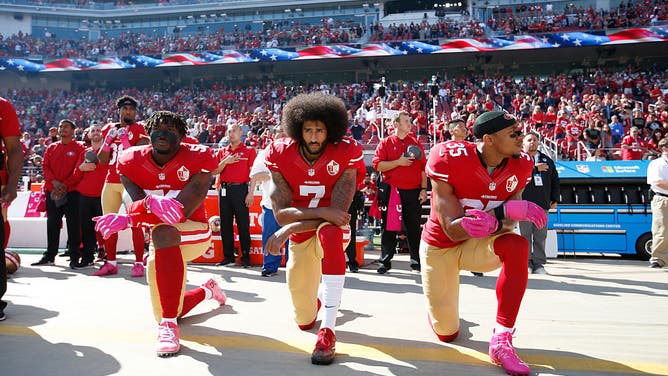
SANTA CLARA, CA - OCTOBER 23: Eli Harold #58, Colin Kaepernick #7 and Eric Reid #35 of the San Francisco 49ers kneel for the anthem prior to the game against the Tampa Bay Buccaneers at Levi Stadium on October 23, 2016 in Santa Clara, California. The Buccaneers defeated the 49ers 34-17. (Photo by Michael Zagaris/San Francisco 49ers/Getty Images)
It started with the network's coverage of concussions, following several lawsuits from former players who sued the NFL after the discovery of research related to chronic traumatic encephalopathy (CTE).
The scrutiny intensified in 2014, with how the ESPN commentators responded to the league’s handling of domestic violence — particularly after Ray Rice was caught on video assaulting his wife in an elevator.
Multiple ESPN pundits called for Commissioner Roger Goodell's job. Bill Simmons, the network’s most influential voice at the time, called him a "liar" on-air.
"Goodell, if he didn’t know what was on that tape, he’s a liar. I’m just saying it. He’s lying. I think he knew," Simmons said. "I really hope somebody calls me or emails me and says I’m in trouble for anything I say about Roger Goodell. Because if one person says that to me, I’m going public. You leave me alone."
ESPN suspended Simmons for three weeks for his comments.
The network also took a clear editorial stance against the NFL owners and in support of Colin Kaepernick. Not a single pundit questioned Kaepernick's intentions or why the league may not want to employ a backup quarterback who branded himself as a martyr to sell sneakers.
Eventually, the NFL responded to ESPN's coverage by throttling the appeal of its most valuable property, "Monday Night Football." The NFL loaded rival networks NBC, CBS, and Fox with marquee matchups and left ESPN with scraps.
While the other networks shared the Cowboys, Steelers, Tom Brady and Peyton Manning, ESPN was the exclusive home of the annual Jaguars vs. Colts showdown. The ratings reflected it, too.
But after Skipper's ousting in 2017 (which he claims was the result of a cocaine extortion plot), Pitaro took a different approach to covering the NFL. All of a sudden, the coverage was positive and no longer combative. He also dramatically improved the presentation, adding Joe Buck and Troy Aikman to the booth. For the first time in a decade, "Monday Night Football" felt important again.
In return, the NFL gifted ESPN with some of the juiciest matchups on the schedule, playoff games, and a place in the Super Bowl rotation.
All the network had to do was stop criticizing the league.
This is not a criticism of ESPN. Any network with rights to the NFL has to pull punches. The league is that powerful.
In actuality, the equity agreement ensures ESPN and the NFL will stay in business long term. The agreement takes off the table the possibility of a tech company outbidding ESPN for future NFL rights.
Similarly, Netflix's rights agreement to stream NFL games on Christmas Day will likely prevent the streamer from ordering some nine-part documentary detailing one of the league's past and ongoing scandals. The NFL also doesn't have to worry about any more Washington Post hit pieces on player safety—not since owner Jeff Bezos brought the NFL to Amazon Prime Video.
Who even knows what the NFL's partnership with YouTube--for Sunday Ticket and an exclusive Friday night match-up this season--means for the obviously manipulated algorithms on Google and YouTube? We have our suspicions.
Put simply, the most powerful tech and broadcasting companies in the country are all in the business of the NFL. And those that aren't, like Apple and HBO Max, want to be.
If this all sounds depressing and unsettling, it's because it is. But it's also the state of journalism. Political media is no better. Nearly every powerful news organization is grossly influenced by whichever political party the majority of its readers support.
Unfortunately, the most influential people in journalism have always been the subjects, not the reporters. In sports media, no subject has more influence on what is and is not printed than the NFL.
The NFL's new stake in ESPN is not a turning point. It’s a footnote, a formality of what was already one of many severely compromised relationships in journalism.