One Of CDC's Chief COVID Vaccine Messages Was Based On Misleading Information
Yes, the CDC needs to be reformed immediately
The Center for Disease Control and Prevention desperately needs to be reformed. And quickly.
Despite efforts by some politicians and their media partners to act as though the CDC is an impartial bastion of properly conducted science, their conduct and messaging during the COVID pandemic was anything but. And as we move further away from the pandemic, we find more and more examples of how purposefully misleading CDC information has proven to be.
There are endless examples of the CDC sharing inaccurate studies and inadequate, poorly conducted "research" to promote its political positions. For example, relying on a phone survey to make unsupported claims about the efficacy of masks. Then ignoring that one of the conclusions in their referenced study did not find statistical significance. Referencing a non-significant outcome on a conclusion is scientific malpractice. They did it anyway.
They were also told that their recommendations on masking were unsupported by the evidence. They continued with the same recommendations anyway.
READ: The CDC Knew Masks Didn’t Work And Misrepresented The Evidence Anyway
Turns out, one of their primary justifications for recommending COVID vaccines was based on similarly inaccurate information.
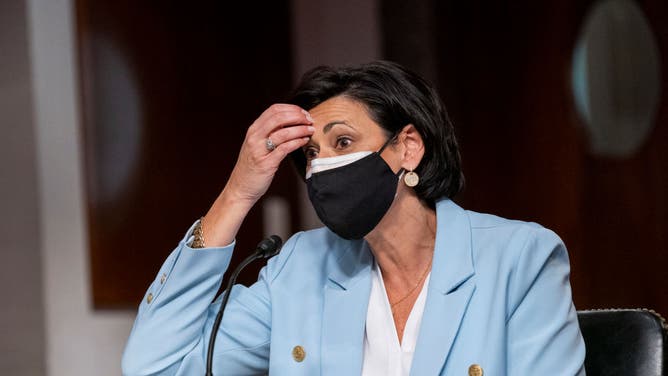
Dr. Rochelle Walensky, Director of the Centers for Disease Control and Prevention, testifies during a Senate Health, Education, Labor, and Pensions Committee hearing. (Photo by Shawn Thew-Pool/Getty Images)
CDC Relied On Shoddy Research For COVID Vaccine Propaganda
In late 2021, the CDC posted a graphic to its social media platforms claiming COVID vaccines were more protective than natural immunity against testing positive for COVID-19 among hospitalized patients with symptomatic illness. Not just more protective, but a shocking 5x more protective, relative to unvaccinated people. "Get vaccinated as soon as possible" was the ominous conclusion. Media and politicians immediately rushed to share and promote the message.

This conclusion remains unsupported by scientific evidence, but what makes this message much, much worse, is the fact that it wasn't even supported by the referenced study.
The link at the bottom of the graphic directs to a study entitled "Laboratory-Confirmed COVID-19 Among Adults Hospitalized with COVID-19–Like Illness with Infection-Induced or mRNA Vaccine-Induced SARS-CoV-2 Immunity — Nine States, January–September 2021." That study attempts to demonstrate the difference in protection between natural immunity and vaccine-conferred immunity among a given population.
Here's the problem: the conclusions it comes to don't exactly line up with the rosy message the graphic portrays. Again.
The researchers examined the period from Jan. 1-Sept. 2, 2021, starting a few weeks after the release of COVID vaccines. They created criteria for the "unvaccinated with a previous infection" category, namely that adults were included if they'd had a positive test result at least 90 days before hospitalization. Adults were considered fully vaccinated if they'd received their second dose of Pfizer or Moderna at least 14 days before the "index test date."
Here's where the issues start.
In their discussion, they point out that of the hundreds of thousands of COVID-like illness hospitalizations, there were just 7,348 eligible patients.
During Jan. 1–Sept. 2, 2021, a total of 201,269 hospitalizations for COVID-19–like illness were identified; 139,655 (69.4%) patients were hospitalized after COVID-19 vaccines were generally available to persons in their age group within their geographic region. Molecular testing for SARS-CoV-2 was performed for 94,264 (67.5%) patients with COVID-19–like illness hospitalizations. Among these patients, 7,348 (7.8%) had at least one other SARS-CoV-2 test result ≥14 days before hospitalization and met criteria for either of the two exposure categories."
Of those, 6,328 hospitalizations were among fully vaccinated patients without natural immunity. That's a whopping 86% of hospitalizations for symptomatic COVID-like illness. 86%! And this is during the time period, the first nine months of 2021, when the "experts" were still telling us that the vaccines were 95%+ effective at preventing symptomatic illness. That was clearly already inaccurate, as they were saying.
Here's the other incredible, accidental revelation from this study: the overwhelming majority of people who were in the hospital to be treated for COVID-like illness tested negative for COVID. Just 413 of the 7,348 eligible patients had lab-confirmed SARS-CoV-2 infections. That's just 5.6% of hospitalized patients with COVID-like illness testing positive for COVID. 94.4% of people seeking treatment in a hospital for a respiratory virus-like illness during a period of rampant viral spread tested negative for COVID.
This should be enough to make the study's conclusions worthless on its own. Because it ignores the millions of people in those nine states who had COVID and did not need hospitalization. So focusing on one specific group does not accurately demonstrate any potential benefit from vaccination against infection because it ignores the largest sample of people: those who never went to the hospital.
Even better, their data shows that 324 laboratory-confirmed infections were among fully vaccinated persons, and just 89 were among invaccinated individuals with previous positive tests, roughly 5.1%-8.7% between the two groups. But again, this is during a time period where Anthony Fauci, the CDC, social media "experts" and the media told us that 95% of hospitalizations for COVID were among the unvaccinated.
Here's just one example, from right smack-dab in the middle of the study period, from the always-inaccurate left-wing media outlet NPR.

This was completely false.
In this sample size, from nine states over nine months, 78.4% of hospitalizations with COVID-like illness and a lab-confirmed positive test were fully vaccinated. This study is an accidental demolition of the CDC's own messaging. The media breathlessly reported that 97% of COVID hospitalizations were unvaccinated, and in a CDC-supported study during the same time period, it was actually 21.6%. Whoops!
That's bad enough. The timeframes and potential biases included are just as bad.
CDC-Supported Study Relies On Shoddy
Of the fully vaccinated patients, the majority, 53% had received their second dose within 90-119 days of their index test date for COVID-like illness. Just 14% had received their second dose within 150-179 days.
Time since either previous SARS-CoV-2 infection or full mRNA vaccination until COVID-19–like illness index test date, days | |||
90–119 | 367 (36) | 3,325 (53) | 0.42 |
120–149 | 353 (35) | 2,101 (33) | |
150–179 | 300 (29) | 902 (14) | |
What does that mean? Well, we know vaccines wane over time, and that waning increases over time. So, the more recently someone's been vaccinated, the more likely it is that vaccine-efficacy will not have declined as precipitously as it does later on.
Sure enough, their "5x" more likely to have a positive test graphic was based on their model adjustments. With no restriction on time since previous infection, accounting for more vaccinated people who'd received their second dose up to 213 days prior to index testing, the adjusted odds ratio gets cut in half, from the unvaccinated being 5.49x more likely to test positive to 2.75x.
Along with the other obvious issues, that indicates that much of the observed benefit was likely due to recency bias. Particularly before the Delta variant took over in late-summer.
Not to mention that their "5x" indicator is highly misleading and only based on their adjustments around a specific time period. Instead of accounting for all time horizons, they picked the 90-179 day range, because that's where they could adjust to their biggest benefit. Still, even accepting their specific date range, the unadjusted odds ratio was just 1.8x. Their specific adjustments in the model created the 5x ratio, because it sure isn't in the unadjusted data.
Even they admit several other glaring issues with this study.
"First, although this analysis was designed to compare two groups with different sources of immunity, patients might have been misclassified," the discussion section says. "If SARS-CoV-2 testing occurred outside of network partners’ medical facilities or if vaccinated persons are less likely to seek testing, some positive SARS-CoV-2 test results might have been missed and thus some patients classified as vaccinated and previously uninfected might also have been infected."
This is, of course, an extremely likely outcome. There's no guarantee that someone got their pre-hospitalization COVID test months earlier from a "network partner medical facility." They could have easily gone to a pharmacy, doctor within a different hospital network, or gone to a pop-up testing site. Their reliance on in-network testing makes their conclusions virtually useless.
There's a selection bias issue too: "…selection bias might be possible if vaccination status influences likelihood of testing and if previous infection influences the likelihood of vaccination," they admit.
It's a near certainty that vaccination status influences likelihood of testing; those who were most concerned about COVID were more likely to test, and more likely to get vaccinated. That's another bias.
Finally, there's the difference in supposed benefit between age groups. Per their table, for the over 65 age group, the supposed benefit of vaccination was massive; those with previous infection and no vaccination were 19.57x more likely to test positive. But for those between 18-49, it was just 2.57x. Again, these are after their adjustments.
The wild disparity in outcomes indicates that there could be any number of factors impacting these results. From missed positive tests to time horizon issues, just to name a few.
Yet despite all these issues; the cherry-picking, extreme adjustments, the potential biases, the absurd variation in outcomes between age groups, the CDC ran with their headline anyway. And people bought it. Hook, line and sinker. Ignoring that this very study disproved months of messaging from the public health class, politicians and the media. Once again, the CDC used poor quality work to sell their preferred agenda. And this is why it must be fixed, if there's any chance of regaining a semblance of trust.