No, Megan Rapinoe, Science—Not Sentiment—Should Guide Women’s Sports | Payton McNabb
The IOC’s decision may have ruffled some feathers, but it’s the right one.
The International Olympic Committee recently announced a new policy protecting women’s competition by limiting it to biological females only. Under this new policy, the IOC will implement a one-time sex verification process to ensure fairness and safety. It’s a return to normal: The women’s category should have always been, and should always be, for females only. For many female athletes, this decision feels like a breath of fresh air. Finally, there is some common sense returning to women’s sports!
But not everyone agrees. Former U.S. soccer star Megan Rapinoe recently criticized the policy, calling it "horrible," "invasive," and not rooted in science. She framed the move as primarily political and unnecessary, arguing that the issue of fairness in women’s sports has been overstated.
Megan, I really wish that were true. But I know firsthand it’s not.

Payton McNabb, a former North Carolina high school volleyball player who was injured by a transgender opponent, speaks during the hearing on "Unfair Play: Keeping Men Out of Women’s Sports" held by the Department of Government Efficiency (DOGE) Subcommittee at the U.S. Capitol on May 7, 2025, in Washington, DC. (Photo by Kayla Bartkowski/Getty Images)
As a high school athlete, I was critically injured by a male competing on the girls’ volleyball team. In one single moment, what you are claiming is "overstated" drastically altered my life. The ball struck me with a force I wasn’t prepared for — because my body wasn’t built to absorb it. That injury not only ended my athletic career; I’ve dealt with vision problems, neurological issues, and lasting physical and emotional consequences. I haven’t been the same since.
So when I hear someone say this is an inconsequential issue, I have to ask: for whom? Because for girls like me, it is absolutely consequential. And unfortunately, I’m not the only one affected.
According to data cited by the Competition Report, published by Independent Women’s Law Center, males develop larger lungs and larger hearts than females, resulting in greater aerobic capacity. That means increased endurance, oxygen uptake, and overall physical output. The differences certainly don’t stop there. In addition to higher bone density, greater tendon strength, and faster reaction times, "grown males have approximately 36 percent greater muscle mass than grown females (with about 40 percent more muscle mass in the upper body, and 33 percent more muscle mass in the lower body)."
Testosterone-driven puberty permanently alters speed, power, and explosiveness — advantages that are not erased by hormone suppression. This is why, across nearly every sport, male performance outpaces female performance. It’s why records differ. It’s why the two categories exist in the first place.
In contact and high-speed sports, differences in strength and power translate directly into an increased risk of injury. When governing bodies ignore that, female athletes are the ones who are vulnerable to serious, career-ending injuries and losing their hard-fought medals and records.
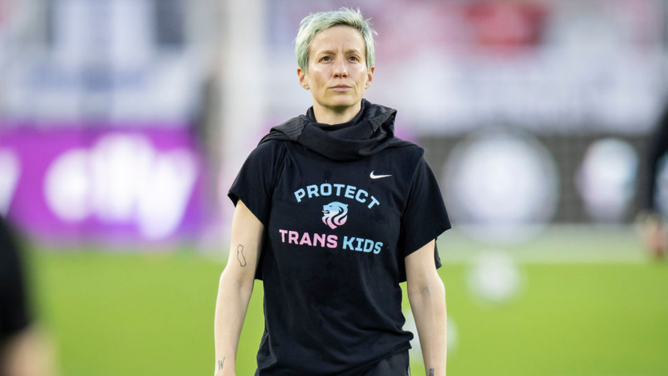
(American former professional soccer player Megan Rapinoe. (Photo by Ira L. Black - Corbis/Getty Images))
Rapinoe claims this policy is not rooted in science. But the opposite is true. This policy is rooted in decades of scientific consensus about sex-based differences in human physiology. What is not rooted in science is the idea that identity alone can override those differences.
Rapinoe asserted that the IOC’s rule was another way to "‘just hate trans people,’ which is such a small percentage of the population." But calling this a "small percentage" is not an argument. The entire purpose of rules in sports is to ensure fairness, even in niche cases. We don’t allow athletes to take drugs just because only a few athletes cheat. We don’t say rules don’t matter because violations are rare. We enforce them because integrity and safety demand it.
Furthermore, trans-identifying athletes are not banned from sports. Like everyone else, they are able to compete on teams that align with their biological sex. Trans-identifying males ("trans women") can still compete on the men’s team regardless of how they identify.
The IOC’s decision may have ruffled some feathers, but it’s the right one and should never have even become a debate to begin with. It is not political to have separate categories and fair play. It has taken mass propaganda to convince an entire swath of people that male "inclusion" in women’s arenas is a normal and safe practice. The IOC decision recognizes that the women’s category must be solely for females. And it affirms that science, not social pressure, must guide policy from here on out.
Megan Rapinoe is entitled to her opinion. But opinions don’t change biology. And biology is exactly why this policy is right.
Payton McNabb is a sports ambassador for Independent Women and former three-sport high school athlete who turned tragedy into triumph after a traumatic brain injury ended her athletic future.