Remember When Experts Said 'Science Isn't Political'? They Were Lying
While lecturing Americans on 'truth,' the NIH was busy funding a radical political agenda.
"Science isn’t political."
Remember that phrase? It was everywhere, for years, during the COVID-19 pandemic. Here's are a few examples.
"Science is a self-correcting process," said Anthony Fauci in an interview with CNN in 2020. "To make it a political issue is really unfortunate. Science is not political. Science is the pursuit of truth based on evidence."
Obviously, any criticism of someone at his level would amount to attacks on the very concept of unbiased science itself. "It’s very dangerous, because a lot of what you’re seeing as attacks on me, quite frankly, are attacks on science. All of the things I’ve spoken about from the very beginning have been fundamentally based on science," Fauci said in May 2021.
Scott Gottlieb, the former head of the FDA, a Pfizer board member, and frequent guest on CNN and other media outlets, said something similar: "We need to make sure that the scientists are the ones speaking to the public... We need to protect the independence of the agencies. Science shouldn't be filtered through a political lens."
Former CDC director Rochelle Walensky repeatedly made exactly those types of arguments, telling her new employees in 2021 that "Our work must be guided by science and data, not by politics. We will lead with the evidence, and we will be transparent about what we know and what we don't know."
She said the same to Congress later that same year: "I'm a scientist. I'm a physician. I'm a public health person. I believe that science needs to be the foundation of everything we do... it is not a political tool."
And here’s the most relevant example, from Dr. Francis Collins, who ran the National Institutes of Health for years. Another "Remember When Experts Said ‘Science Isn’t Political? They Were Lying" phony who rose to prominence during COVID…
"To have the science of a pandemic wrapped up in political campaign rhetoric is not a good place for science to be," he explained in a 2020 conversation with NPR. "Science is trying to find the truth. It’s trying to find the facts."
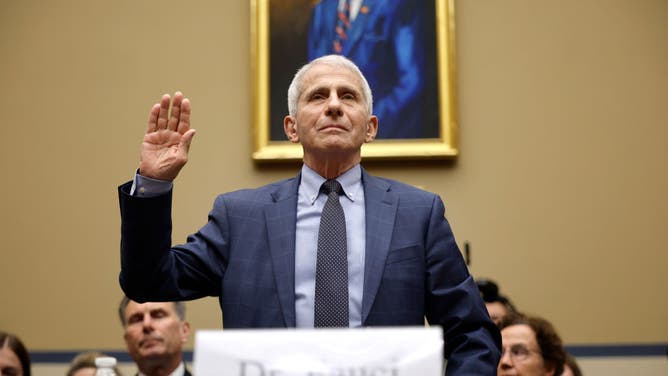
Dr. Anthony Fauci, former Director of the National Institute of Allergy and Infectious Diseases, is sworn-in before testifying before the House Oversight and Accountability Committee Select Subcommittee on the Coronavirus Pandemic at the Rayburn House Office Building on June 03, 2024, in Washington, DC. (Photo by Chip Somodevilla/Getty Images)
NIH, Fauci, Were Dishonest About Politicization Of Science
When he retired at the end of 2021, in his letter, he explicitly complained about the politicization of science.
"I am profoundly troubled by the way in which science has been politicized... Science should be the one thing we can all agree on, regardless of our political party."
Yet thanks to some new information revealed by current NIH director Jay Bhattacharya, we can now see that NIH, under Collins and Fauci, became overtly politicized, in one direction, naturally. And that their politicization of the organization directly impacted the type of research that was funded, as well as alienating employees with political statements. In a new interview with Jan Jakielek from Epoch Times, Bhattacharya revealed some new information he learned since taking over at NIH. The NIH formerly run by Francis Collins.
"Every single NIH employee had to write… a loyalty oath to DEI principles," Bhattacharya said. "None of it actually translated over to better health for anybody."
He continued, explaining that politics was incorporated into every level of the NIH agenda: "Over the last 15-20 years, the NIH incorporated into its agenda things I can only characterize as political agendas rather than scientific agendas."
That agenda took shape in the form of DEI where, according to Bhattacharya, researchers looking to get funding from NIH could "promise to do DEI research" and get a "ticket to…extra, relatively easy funds."
And here’s the kicker: "Much of that research had no real scientific basis at all."
"At the end of the year, the NIH would often have some money left over. The NIH program officers would go to the people who were doing these projects… and say, ‘look, we have some money left over, if you propose a diversity supplement,’—meaning essentially some DEI add-on that wasn’t actually good science—‘then you can get access to extra money for your research.’"
Science isn’t political. Anthony Fauci, Scott Gottlieb, Rochelle Walensky, Francis Collins. They all told us the importance of keeping politics out of research, keeping science focused on trying to "find the truth" or "find the facts." Science shouldn’t be "filtered through a political lens," they said. It’s the "pursuit of truth based on evidence," Fauci proudly explained.
And all this time, his organization was demanding DEI loyalty statements, a politically-charged decision, focusing on DEI-based research, giving away taxpayer money based on a political platform, and using "diversity" supplements to choose projects.
They never cared about science being political, or keeping ideology out of scientific research. They just didn’t want the "wrong" views to be part of science. Protesting "white supremacy" in 2020 was more important than avoiding large gatherings in early 2020, because white supremacy is a "public health threat" that predates the virus. That’s what the experts said. Nothing political about those views, right? Nothing political about the nation’s largest public health funding body choosing what studies to fund based on DEI, right?
It’s absurd, it’s hypocritical, and thanks to the new leadership at NIH, it’s over. Far too late to stop decades of politicized science, unfortunately.