James Gunn Makes Himself The Story Again, Says Nonexistent 'Racists' Are Calling Him 'Polarizing'
DC director says he's 'okay with being polarizing' following Superman box office disappointment
"Superman" director James Gunn is committed to making himself an all-important crusader against the imaginary forces of racism that criticize his work.
Gunn made headlines just before the release of the new "Superman" with a bizarre, unforced error. In an interview with a UK-based media outlet, Gunn decided to bring politics into a non-political movie. He said the film and the "Superman" was about the legendary character being an "immigrant."
Then told the Times of London, "Yes, it's about politics."
RELATED: 'Superman' Box Office Fizzles Out, Securing Yet Another Hollywood Superhero Flop
He then went on to blame those who were upset about it for correctly interpreting his remarks. As always, Gunn played the victim and the hero in his own story. And he's doing it again.
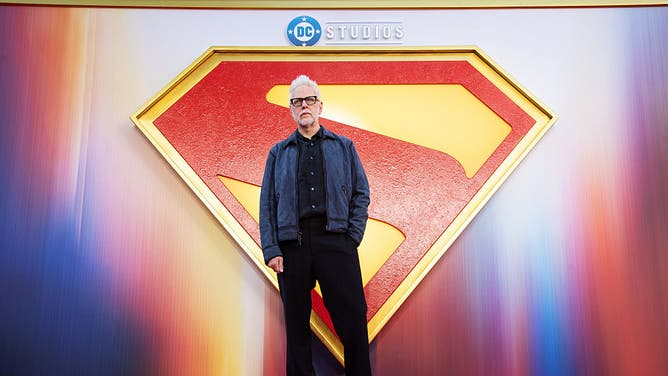
James Gunn. (Photo by Jeff Spicer/Getty Images for Warner Bros)
James Gunn Makes Himself The Victim, As Usual
Gunn's show, "Peacemaker" from the DC Comics universe, had a big storyline shift recently, where "Earth X," an alternate universe, is the hypothetical result of the Nazis winning World War II.
How did he signify this leading up to the big reveal? Well, by ensuring that "Earth X" was only populated by white people.
"No one noticed at all," Gunn said. "That was people of color, too, by the way. It wasn’t just, you know, the whites."
The Nazis were a white supremacist culture, obviously one component of their abhorrent views and ideology. Nobody in their right mind would call it "polarizing" to depict Nazis as the bad guys. But of course, Gunn found a way to make it all about himself.
"I really do whatever I want with ‘Peacemaker’ — and I mean, in one respect, I do whatever I want with anything, because I am able to make my own choices and I’m my own boss. But with ‘Peacemaker,’ we really let it go. We take chances. We go to places where I think other people are afraid to go," he said in a new interview with GQ. "We got a lot of pushback from various sources within the structure, on this episode in particular, and we’re like, ‘Let’s not be bashful about this. Let’s just do the story that we want to do and I don’t want to have to pull punches with it.'"
"I have a few racists that have called me polarizing, but I’m okay with being polarizing and letting racists fall to the wayside," he continued. "People have loved this episode the most, so it’s exciting. … Listen, we’re dealing with a very sensitive subject. We’re dealing with racism and, at the same time, there’s humor in this episode. And so, you’re dealing with something very delicate and yet we’re not being delicate about it — but I don’t think we’re not being delicate in a non-thoughtful way. We’re being thoughtful about it."
Where is the pushback and criticism for Gunn for making Nazis the bad guys? Who's ever had anything bad to say about making Nazis the villains?
This is what Gunn does. He makes these sweeping generalized statements about very obvious things. Then says how proud he is that some hypothetical worst people in society don't like him. It's just making himself the center of the story. It's patting himself on the back for bravery when he doesn't deserve it. People weren't upset about his remarks ahead of "Superman" because they were racist or unkind, they were upset because he was injecting politics where it didn't need to be.
And his movie's box office suffered as a result. It's just that simple.