Exclusive: Michael Wilbon Talks Washington Post Layoffs, AI And Future Of Sports Journalism
"That’s the question that haunts me. How do I look these kids in the face and tell them what to do?" Wilbon said.
The Washington Post shuttered its entire sports division this week. Michael Wilbon, the co-host of ESPN’s Pardon the Interruption, spent the first three decades of his career as a writer for the Post.
Wilbon, one of the most revered sports columnists of the past two generations, joined OutKick to discuss the paper, the future of sports journalism, his advice to aspiring writers, mixing sports and politics, artificial intelligence, and more.
Burack: What was your response to the news that The Washington Post was shuttering its sports department?
Wilbon: Devastation. To lose a place where I worked for 30 years and six months is devastating. I got there when I was 21 years old and left when I was 52 or 53. More than half my life was spent growing up at The Washington Post, growing up professionally.
We had heard rumors for a few weeks, but to have it taken away like that is hard. Part of it is personal, losing something that was near and dear to you. Part of it is professional. What happens now? Sports will no longer be covered in the nation’s capital? Really?
Taken together, the impact is enormous. It’s depressing. It’s awful.
Burack: Do you blame one single person for this?
Wilbon: No. I think Jeff Bezos is a lightweight. I think he’s weak-kneed, based on what we’ve seen and what he promised when he bought the paper. But I don’t blame one single person or one single thing.
Part of it is the climate. People don’t consume news habitually anymore, not the way they used to consume newspapers and magazines. Life changed over time, in the 1990s, the 2000s, and now the teens and 20s. There are a lot of factors, including the inability to figure out revenue streams and the unwillingness of people to consume news and information in the same ways.
You can see it happening everywhere. It’s not just The Washington Post. What makes this worse is how the Post went about it: killing sports altogether and killing overseas news. That’s doubly disappointing.
Burack: You still spend a lot of time at your alma mater, Northwestern, widely viewed as one of the best journalism schools in the country. What do you tell a young student who wants to pursue a career in sports writing right now?
Wilbon: That’s the thing, Bobby. That’s the question that haunts me. How do I look these kids in the face and tell them what to do?
I just had a group of students, some of whom I wrote recommendation letters for. They want to be journalists. What do I tell them? I don't know.
What encourages me is that storytelling has not gone out of style. Newspapers have gone out of style, but storytelling hasn’t. There are more places to tell stories and more ways to market and sell them. It’s just not going to be the way I did it. It’s not going to be newspapers and magazines.
I never wanted to be on television. I don’t know anything about "new media." They’re going to have to know new media and be experts at it. Newspapers were the preferred route for my generation. That’s no longer true.
Your question haunts me. When kids come up and say newsrooms are shutting down, what are we supposed to do? It’s a hard conversation.
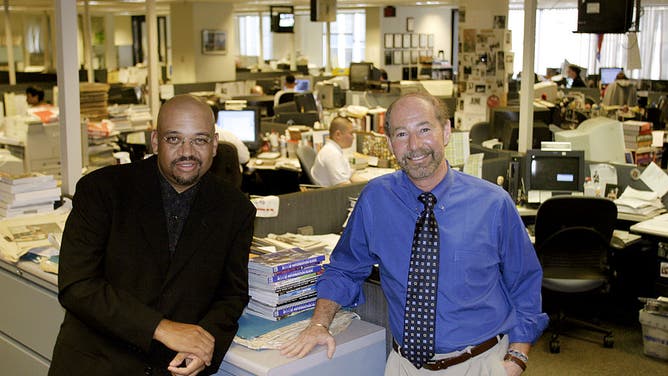
Michael Wilbon and Tony Kornheiser in the Washington Post Newsroom on JUne 24, 2004. (Getty)
Burack: You have a son close to college age. We've talked about him. Has he shown any interest in a career like yours?
Wilbon: He hasn’t. He was two years old when I left the Post, so it doesn’t resonate with him. I don’t even know what resonates with him when he sees my name on old newspaper pages. He cares about sports and events and understands the role sports play in communities, but not from a pure news-junkie standpoint.
Burack: There are many ways now to get messages out through social media. But when you and writers like Kornheiser wrote, you had to go into locker rooms and look players in the face. What do we lose now that just anyone can post a tweet or a video with their thoughts?
Wilbon: Accountability. It’s like facing your accuser, though it’s not that serious. You realize these are people, not just subjects.
The rule I followed, from Shirley Povich to Dave Kindred to Tony Kornheiser, was that if you’re going to be critical, you have to show up. If you’re going to be a big critic, do it to someone’s face.
I was once very critical of a coach, and I went to see him on Thanksgiving Eve and again on Thanksgiving Day. We laughed about it. He said what he needed to say. Because of that approach, I never had long feuds with players or coaches.
If you’re there the next day, you can hash it out. It usually wasn’t even that serious, and then it was over. But if someone can’t find you for days or weeks, of course they’re angry.
Players told me they talked to critics because those writers were there every day. There’s a relationship between the newsmaker and the chronicler, and that matters.
If I knew I wouldn’t be in town the next day, I tempered my criticism. My father used to say, "Don’t throw a rock and hide your hand."
Burack: That’s the opposite of how it works now. Writers criticize the people they know they won't see or hear from the hardest.
Wilbon: Exactly. If you’re too afraid to show up after what you wrote, maybe you went too far.
Burack: The Washington Post says it will reroute some of its sports writers to cover culture or politics. What are your thoughts on mixing sports with those topics?
Wilbon: We always did that naturally. I covered the Air Florida plane crash. I walked down to the bridge. Sally Jenkins wrote about it recently. Some of the best writing in newspapers has always come from sports writers, because they were often the best writers.
I covered many things that weren’t sports. I wrote about friends who died in plane crashes, including the Department of Commerce crash in the 1990s. You should be writing about multiple things.
It’s harder for people who’ve never covered sports to write about it because they don’t understand the connection between the writer and the reader, and that connection is essential.

Michael Wilbon before the 2024 NBA Finals on June 9, 2024 at the TD Garden in Boston, Massachusetts. (Photo by Mercedes Oliver/NBAE via Getty Images)
Burack: When sports become political, should writers stay neutral?
Wilbon: It entirely depends on the publication: its history, its place in the community, who the writer is, and what the agenda is. One of the things I was nominated for in the 1990s was writing about the Rodney King riots and finding the sports connection.
The idea that sports and society can be separated is usually an act of fear. People are too damn afraid of what some readers will say. My reaction was always, "Too fucking bad. Put it down and go read something else."
Burack: That’s how I feel.
Wilbon: Ha ha. I know you do, Bobby.
That said, it does depend on the publication and what the readership expects from you personally. But I don’t think these topics should be avoided out of fear. There’s no single right answer. It depends on many variables, starting with the publication and then the audience.
Burack: What was the most challenging assignment you had to cover as a newspaper writer?
Wilbon: Writing about death, whether it was a family member, Len Bias, a friend, or someone who died in a plane crash. Writing about life and death was always the most difficult for me, especially dealing with someone who was 21 years old.
I wrote about my friend Katherny Hoffman, who died in the Department of Commerce plane crash in the 1990s. It was always hard.

Kobe Bryant of the Los Angeles Lakers talks with Michael Wilbon of ESPN before the start of the Lakers and Washington Wizards game at Verizon Center on December 2, 2015 in Washington, DC. (Photo by Rob Carr/Getty Images)
Burack: How do you think AI will impact writing?
Wilbon: I honestly have no idea. I mean that sincerely. I really don’t know.
Funny story. One night I was going to write something. I was in the process of writing, but I was tired, lazy, and I really didn’t want to do it that night. A good friend of mine, who’s a science nerd, said, "Why don’t you just AI it and see what you would have said?"
I said, "What the hell are you talking about?" He said, "Why don’t you see what you would have said?"
I asked, "How does that work?" He said, "Dude, you’ve been writing for 40 years. If you just put in six or eight words and ask it to write the way you’ve written, it’s going to spit out 800 or 900 words in your voice."
I said, "No, it’s not." He said, "Yeah, it is."
And I did it, and it spit out something where I knew, yes, I could have written this.
Then I started wondering, what are the rules that govern that? If I use that, is it plagiarism, or are those my thoughts being regurgitated? I still don’t know. Do you need a lawyer, like an in-house lawyer? I didn’t have to publish anything, so it didn’t matter, but it did spur my interest. I don’t know what the rules governing that are.
It scares the hell out of me.
Burack: Every college student now has access to AI. The days of typos are gone. You can copy and paste your story into AI and say, "Fix all the typos." That was not the case when I started. It certainly wasn’t the case for you.
Wilbon: Oh, wow. Is that true? Wow. But it also doesn’t allow you to flourish. There are too many places you can go to check yourself, and you’re getting a bailout. I didn’t have that.
Burack: Was there spell-check when you started? Forgive me for asking.
Wilbon: No, no. It’s a good question. There wasn’t. I didn’t have the benefit of that until I was out of college. There was no bailout.
Burack: Final question. What’s your message to all the writers who were laid off and the people terrified for their security now, because The Washington Post won’t be the last publication to phase out its sports writing?
Wilbon: Yeah, there’s a lot more of this coming. I don’t know what advice to give, except that if I were starting with younger people, say 16 to 28, I would say concentrate on storytelling. Concentrate on the craft of telling a story, how to keep people’s interest, and how to really become a great storyteller.
The best storytellers aren’t necessarily people in college or just out of school with journalism degrees. Sometimes the best storytellers are people in a barbershop who just have a knack for it. People have to really lock in on the art of storytelling.
There are places to tell your stories and market them. There are more ways than ever to get people to listen to what you’re doing. That interests me. I’m not saying it doesn’t scare me, because it does, but I still think there are enough places that matter.
Storytelling will always, in some form, live on.