Study: Masks Helped Destroy Society, With Zero Benefits Against COVID
New data suggest masks hinder quick, accurate reading of facial emotions
We're rapidly approaching 2026, and for millions of people in the United States and across the world, masks are still a part of their daily lives.
Consumed by misinformation from the pandemic period, many have made masking a permanent part of their identity. Convinced, without evidence, that doing so will protect them from illness. Though that view is unsupportable, not only because the overwhelming evidence shows masks don't work, but because messaging from pro-mask fanatics like Anthony Fauci said masks were intended as source control. They wouldn't benefit the person wearing them, the story went, but they'd prevent others from becoming infected.
Somehow, over the years, that message disappeared. Replaced by fear, anxiety, an overwhelming media commitment to avoid admitting that they and the experts were wrong, and mistaken belief systems.
It's worth asking though, why does this matter? If there's an individual choice to wear masks, how does it affect me, or affect others? Because masking is a massive negative, with research now confirming the damage that permanent mask wearing causes. Particularly for those around the forever maskers, society at large, and physical and emotional cohesion and wellbeing.
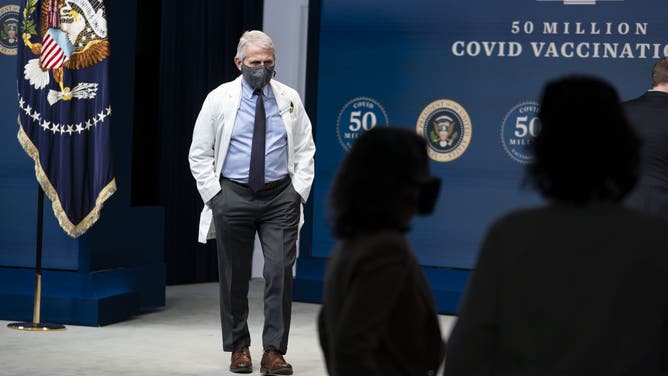
Dr. Anthony Fauci. (Photo by Doug Mills/Pool/Sipa USA)
Masks Destroyed Human Ability To Discern Emotions, With Catastrophic Results
This study, published by Italian researchers in Science Direct, went into detail on the impact of masking on adults' physical reactions to seeing masked faces, and their ability to recognize emotional expressions from those wearing masks. And it did so by quite literally measuring electrical activity in the brain.
"To assess the possible effect of surgical masks on the face-related ERPs (event-related potential) in accordance with an emotional coding, from September to November 2021 we recorded EEG (electroencephalography) signals from healthy participants during the presentation of angry and happy faces, shown either with a surgical mask covering the face from nose to chin, or without mask," the researchers write.
They also separated participants out into groups, based on how much time they were exposed to those wearing masks, or wore masks themselves.
"Moreover, to also explore the possible effect of the personal exposure to surgical masks, participants were required to report the time spent daily using a mask and the time spent daily in the presence of people wearing masks."
They used photographs of male and female faces with happy or angry expressions, then modified them by overlaying a surgical mask.
"Photographs in frontal view of 16 female and 16 male faces in happy and angry poses were selected and modified to measure 7.9° × 10.4° (400 × 530 pixels), seen at a distance of 72 cm. Each stimulus was then further modified by overlapping a white surgical mask which covered the face from the nose to the chin. The final set of 128 stimuli, comprising 16 females and 16 males in happy and angry pose, with the mask and without the mask, was converted into gray-scale images."

Example of unmasked and masked happy and angry faces.
Overwhelmingly, respondents who did not frequently wear masks or spend as much time around masked individuals were more accurate and quicker to respond.
"As regards accuracy, the main effect of Face was significant, showing a higher accuracy for Unmasked than for Masked faces." These results suggested "that participants with Low exposure were more accurate in emotion categorization with respect to participants with High exposure."

Accuracy in the categorization of emotional expression of Unmasked and Masked faces. (B) Response times for the correctly categorized trials of Unmasked and Masked faces.
Importantly, too, it wasn't just that the more masked cohort was worse at determining expressions, it's that they were significantly slower at determining happy expressions.
"Moreover, the interaction between Exposure and Emotion was significant and post-hoc comparisons revealed that participants with High exposure were slower in categorizing the Happy compared to the Angry expression, and that participants with Low exposure were faster than participants with High exposure in categorizing the Angry expression, whereas the same comparison did not reach significance for the Happy expression," they wrote.
"Finally, also the interaction between Face and Emotion was significant, revealing that for Unmasked faces, the Happy expression was categorized faster than the Angry expression, and that the Happy expression was categorized faster for Unmasked than for Masked faces, whereas for the Angry expression this comparison did not reach the significance."
Essentially, those with more exposure to masking were slower to recognize happy expressions than they were angry expressions. Masks destroyed important human connections based around happiness. For zero benefits at reducing the spread of infection.
What do all these results mean? Well, as the study authors explain, it's vitally important for humans to be able to decode emotional expressions, particularly happiness, and masks impair that ability significantly.
"In line with previous evidence, our behavioural results confirm an impairment in decoding emotional expressions when we look at a masked face. In particular for the happy expression RTs (response times) were slower for masked than for unmasked faces, showing that the expected facilitation in recognizing the positive expression disappears in the masked condition, and confirming previous evidence of a greater importance of the lower portion of the face for happiness recognition with respect to other emotions. Moreover, participants with high mask exposure were slower than those with low mask exposure in categorizing emotional expressions, a result which seems in contrast with the suggested stronger impairment in emotion recognition due to a low familiarity with the specific facial manipulation."
This research was conducted in 2021. This was after just a year and a half or so of masking as a societal norm. And already, those who wore masks or were exposed to masks more regularly were less likely to determine correct emotional responses. That's how dangerous masking is, and how dangerous permanent masking is. Even that framing undersells the importance. As the researchers say, masking actually impairs the brain's ability to process social stimuli.
"We conclude that the daily exposure to masks has added a constraint in the way in which our brain processes the social stimuli we are most accustomed to, namely our conspecifics' faces."
It gets worse. Their research found that masking creates an "anxiety-inducing signal" that "hinders correct and rapid detection" of emotions and facial cues.
"The fact that both behavioural (RTs) and ERP (P2) results do show a group difference in accordance with the mask exposure score also allows us to hypothesize a direct effect of the daily amount of exposure to masked faces on facial emotion processing. We speculate that perceiving a masked face can represent a potential anxiety-inducing signal, which hinders the correct and rapid detection of others' emotions…"
For years on end, masks were made a normal part of societal interaction. Based on misinformation, poor quality research, lack of accurate science communication from "experts" and their media partners. As we know from the accumulation of data and high quality research, there was no impact on the spread of the virus. But what masks did accomplish was to inhibit normal human brain activity. To cause anxiety and confusion. To increase detachment and anti-social reactions. Which matches perfectly the increase in crime, decrease in quality of life, and rampant disregard for others that started during COVID pandemic restrictions.
Fauci and his allies quite literally changed the human brain with pointless masking, without a care in the world. They never admitted wrongdoing, or acknowledged the harms and side effects of their policies. And because there's now a concerted effort to act as though the pandemic and these mandates never happened, they almost certainly never will.