Paul Tagliabue’s Death Sparks Debate on Whether We Tell the Whole Truth About Legends
Hall of Fame commissioner died at age 84 from heart failure complicated by Parkinson's disease
There is no perfect day for this but former NFL commissioner Paul Tagliabue died on Sunday – an NFL Sunday.
Appropriate.
Tagliabue’s family announced Tagliabue died at age 84. The apparent cause of death was heart failure complicated by Parkinson's disease.
His survivors include his wife, Chandler, their son, Drew, and their daughter, Emily.

Aug 7, 2021; Canton, Ohio, USA; Class of 2020 member and former NFL commissioner Paul Tagliabue speaks during his Professional Football HOF enshrinement ceremonies at Tom Benson Hall of Fame Stadium. Mandatory Credit: Charles LeClaire-USA TODAY Sports
Tagliabue Pro Football Hall Of Famer
Tagliabue became commissioner in 1989, taking over for Pete Rozelle. He served 17 years before he was succeeded by current commissioner Roger Goodell in 2006.
He oversaw the expansion of the league to 32 teams. State of the art stadiums were built during his tenure. And television contracts that became the biggest source of revenue for the league ballooned in value.
Tagliabue was the NFL's commissioner before the league got kind of woke.
Tagliabue was named to the Pro Football Hall of Fame in 2020 as a contributor. He will be forever enshrined in Canton, Ohio.
Goodell, now the only living NFL commissioner or former commissioner, released a statement on his predecessor's passing.
Goodell Shares Thoughts On Mentor
"All of us in the NFL are deeply saddened by the passing of Paul Tagliabue, whose principled leadership and vision put the NFL on the path to unparalleled success," Goodell said.
"Throughout his decades-long leadership on behalf of the NFL, first as outside counsel and then during a powerful 17-year tenure as commissioner, Paul served with integrity, passion and an unwavering conviction to do what was best for the league.
"Paul was the ultimate steward of the game – tall in stature, humble in presence and decisive in his loyalty to the NFL. He viewed every challenge and opportunity through the lens of what was best for the greater good, a principle he inherited from Pete Rozelle and passed on to me.
"Paul was a fierce advocate for diversity and inclusion and guided the league through the challenges of 9-11 and Hurricane Katrina."
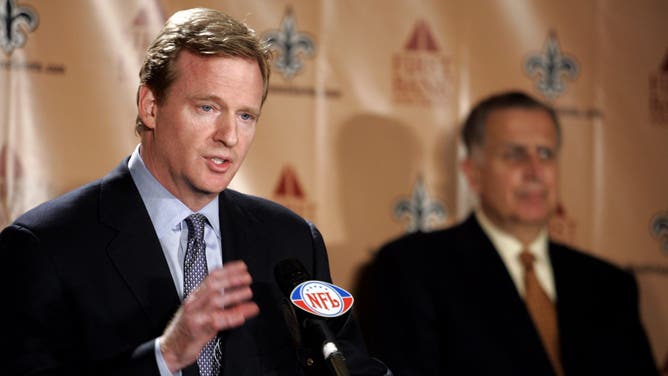
Sep 25, 2006; New Orleans, LA, USA; NFL commissioner Roger Goodell speaks at a press conference as former commissioner Paul Tagliabue watches before a Monday Night Football game in the Louisiana Superdome. The game is the first event in the Superdome a year after it was heavily damaged by Hurricane Katrina and used as a shelter from the storm by tens of thousands of people. Mandatory Credit: Photo By John David Mercer-USA TODAY Sports Copyright © 2006 John David Mercer
Sept. 11 Tagliabue's Finest Hour
Indeed, Tagliabue's finest hour might have come following the terrible Tuesday of Sept. 11, 2011. The NFL, located in New York, was emotionally rocked, as were all New Yorkers and, indeed, Americans.
And that's when Tagliabue made the decision to not play NFL games the following weekend to allow the nation to mourn.
"At a certain point, playing our games can contribute to the healing process," Tagliabue famously said. "Just not at this time."
Later he was more reflective: "We had to pause and make sure everyone had our priorities straight, make sure we understood how unified we needed to be," he said.
It was absolutely the right call. It was perhaps Tagliabue's finest hour.
But here's where telling you about Tagliabue's life gets dicey. Because, like all of us, he was an imperfect vessel.
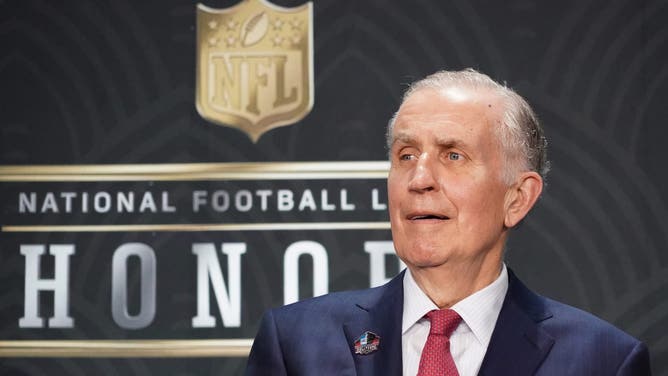
Feb 1, 2020; Miami, Florida, USA; Hall of Fame inductee Paul Tagliabue looks on during the NFL Honors awards presentation at Adrienne Arsht Center. Mandatory Credit: Kirby Lee-USA TODAY Sports
Tagliabue Had One Major Failing
And he made mistakes.
So is it correct to give a fair and balanced accounting of that record? Or only share the victories, accomplishments and good out of respect for his passing?
Today, I've decided to give you a more complete picture because the NFL Tagliabue fostered accountability as a core value. Because Tagliabue was accountable in life. So, one assumes, he would be in death.
He was the NFL commissioner who denied the league had any issues with head trauma injuries and concussions. In 1994, he called player concussions "one of those pack-journalism issues."
"I claimed then the number of concussions ‘is relatively small; the problem is the journalist issue,’" Tagliabue admitted decades later.
The remark framed the problem as a media exaggeration, not a medical reality. Tagliabue influenced league policy for years in the regard that concussions were under-reported, under-diagnosed, and players were often cleared too quickly.
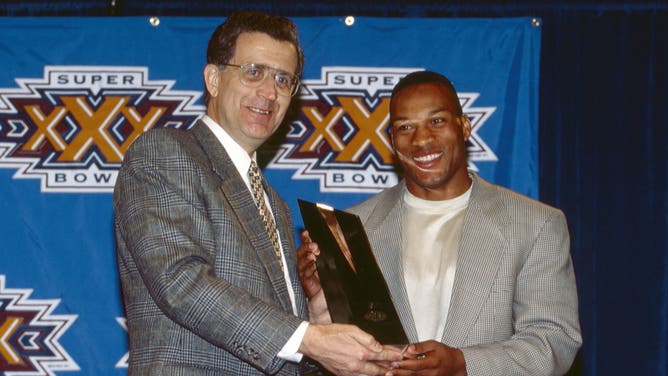
Jan 29, 1996; Tempe,AZ, USA; Dallas Cowboys cornerback Larry Brown accepts the MVP trophy from commissioner Paul Tagliabue a day after defeating the Pittsburgh Steelers in Super Bowl XXX at the Sun Devil Stadium. Dallas defeated Pittsburgh 27-17. Mandatory Credit: Matthew Emmons-USA TODAY Sports
Tagliabue Eventually Regretted Remarks
When the science became undeniable, the NFL faced accusations of a systemic cover-up of head-injury data. And the issue came at a price.
In 2013, after Tagliabue’s tenure, the NFL reached a landmark $765 million settlement (later uncapped) to compensate retired players suffering from CTE, dementia, and other cognitive disorders.
Plaintiffs repeatedly cited the dismissive culture that began under Tagliabue’s leadership as evidence of institutional negligence.
"Obviously … I do regret those remarks," Tagliabue later admitted. "Looking back, it was not sensible language to use to express my thoughts at the time. My language was intemperate, and it led to serious misunderstanding."
So those were the highs and the one significant low point of Tagliabue's career.
"Among his many enduring lessons of leadership, we remember, was his understanding of the power of sports to bring people together and make a difference off the field of play, including most recently collaborating with our league to promote civic engagement around the country," said NBA commissioner Adam Silver. "Paul was that kind of selfless leader throughout his life and career.
"I send my deepest condolences to Paul's family and everyone in the NFL family on the loss of a giant in professional sports."